Public-domain ebook
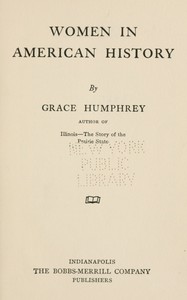
Women in American history
Language: en565 downloads on Project Gutenberg
Subjects
In: Biographies·History - American·History - Ancient
Public-domain ebook sourced from Project Gutenberg #76056.
Public-domain ebook
Language: en565 downloads on Project Gutenberg
Subjects
In: Biographies·History - American·History - Ancient
Public-domain ebook sourced from Project Gutenberg #76056.
The opening · free to read
One cold stormy day, more than three hundred years ago, a group of Indians was sitting around the fire in a “long house” on the James River in Virginia. Warriors and young braves, squaws and maidens, were listening to stories, while the children played about boisterously. Some of them were wrestling, some racing with dogs, and others turning somersaults in the long narrow passageway.
Suddenly the deerskin curtains parted and in dashed an Indian runner. He spied the chief at the far end of the room near the fire and started toward him; but one of the children, a little girl named Mataoka, who was turning hand-springs, collided with him and knocked him down. A little girl she was, ten or eleven years old, with swarthy skin, black eyes and long straight hair, like all the other Indian girls; but she was distinguished among the group, for she was the daughter of the chief.
“Child,” said her father, “in your rough play you have knocked down your brother, the runner who has come with some message. That is not play for a girl. Why will you be such a little tomboy?”
At this all the Indians present took up the word tomboy and repeated it in the guttural Algonquin speech--_pocahuntas_, pocahuntas. And that nickname stayed with her all her life long.
“I have news,” said the runner, when he could get his breath. “I have great news,” and he paused dramatically. “The white captain is caught!”
What an excitement this created in the long house! Warriors and squaws crowded around the tired runner, eager to have the details of his story--how two hundred Indians, with the chief’s brother at their head, had watched from behind the trees as the white captain, with an Indian guide, left his two men in the boat and went ashore; how stealthily they lay in wait to attack him, in the heart of the deep woods; how they shot their arrows thick and fast, when the right moment came, till they saw the white captain seize the Indian and use him as a shield, while he slowly made his way back toward the boat; how the Indians were afraid they would lose their prey after all, but fortune favored them when the white man stumbled into a bog and was held fast by the slippery ground and the icy water; and how, after he was nearly dead with the cold and had thrown away his arms, they took him prisoner. At first, said the runner, the braves wanted to kill him, but later thought it would be a better plan to lead him to the village where the whole tribe could rejoice in this triumph.
All this Pocahontas, the little daughter of the great chief Powhatan, heard, and was deeply interested. For the plucky captain had saved his life by a device that was almost an Indian trick. So you may be sure she was there, the next day, when the noted prisoner was brought in. She was very proud of her father, who ruled over a league of nearly forty tribes, numbering some eight thousand people, as she looked up at him, sitting in state on a raised platform, dressed in raccoon skins, with all the tails left on, and wearing his splendid crown of red feathers. Proud, too, she was to be his favorite daughter.
At the council Mataoka listened while the Indians told how the prisoner had shot at their men, one of whom had since died. She was heavy-hearted when she learned the verdict, “Then he too must die--that is the Indian custom!” She watched while some young braves brought in two great stones and placed them in front of Powhatan. She saw them seize the prisoner, drag him before her father, force him down until his head was on the stones, and then tie his hands and feet. And all the time her heart went out to him, so fair, so friendly, so fine a man he was!
Meanwhile John Smith, the white captain, not understanding what the Indians were saying, could only guess at his fate. He had often been near to death, in his adventurous life, and he thought now of some of his narrow escapes--of his fighting days in the Low Countries, in the Holy Land against the Turks, and that wonderful day when he met the three Turkish champions in single combat, came out victorious, and was given a coat of arms. He thought of the times he had been robbed and shipwrecked, captured by Barbary pirates and sold into slavery. Yes, he had been close to death before. Would some providence save him this time?
No, there were only forbidding looks on the swarthy faces around him, glances of hatred, contempt, of triumph. Smith, from his position on the ground, saw the chief motion to the executioners, who brought in their great war clubs. Now they swung them up over their shoulders and stood ready for the word of command. Powhatan had opened his lips to speak when suddenly there was a commotion in the group as a little figure darted past the platform, slipped through deterring hands, and flung herself on the helpless prisoner.
No girl’s game now was the little tomboy playing, as she took John Smith’s head in her arms and with her own body shielded him from death. The executioners stopped, uncertain what to do, for they were fond of the chief’s daughter and would not harm a hair of her head. With flashing eyes she waved them back and pleaded with the stern Powhatan to spare the white captain’s life.
At once there was a scene of the wildest commotion. There were shouts and threats and many cries of “Kill! Kill!” for the Indians feared the power of these newcomers and longed to drive them from the land. But the little Pocahontas was a chief’s daughter and stood for her rights. Let them grant this enemy his life and adopt him into their tribe; for what harm had he done them? They ought to be friends. And she had her way. Powhatan raised his hand and when the clamor ceased, he spoke to the warriors who set the plucky paleface free.
Mataoka smiled upon him and gave him many a look of wondering curiosity. Smith presented her with some trifling gifts and asked her name. Now it was the Indian custom never to tell a name to a stranger, lest it give him some magic harmful influence, so Powhatan replied that his daughter’s name was Pocahontas.
This story is questioned by some historians because Smith did not include it in his first published account of the Virginia colony, nor yet in the second, though he did praise the Indian girl. In a letter he sent to the English queen, years later, bespeaking for her the royal favor, he tells how Pocahontas saved his life and the colony as well.
True or not, Pocahontas and Smith became warm friends and the kind-hearted little Indian girl was loyal and faithful to the settlement at Jamestown, and saved the colony more than once. Frequently she would go with her brothers, or some of her Indian attendants, carrying corn or venison to the people who were in danger of starving--you remember how improvident those first colonists were, and how badly their affairs were managed? Once she hid a messenger whom the savages planned to kill; she saved the life of a captured English boy; three times she stole cautiously into Jamestown and warned her new friends of threatened attacks; and she told Smith himself of a trap laid to surprise him, while his party waited for promised provisions.
“Great cheer (corn) will be sent you by and by,” she whispered, “but my father Powhatan and all the power he can make will come afterward, if the braves that bring the corn do not kill you when you are at supper. Hurry away! No, no,” she added, refusing a compass he offered her, “I can no take. Indians see it. Powhatan kill me. If know I tell you, I am but dead.”
As quietly as she had come through the forest she slipped away, while the Englishmen, ready for the attack, returned in safety to Jamestown.
In the autumn of 1609, tired of the endless quarreling and dissension in the colony, and sorely wounded by an explosion of gunpowder, Smith went back to England. Then Pocahontas made no more visits to Jamestown. Finally word came that Smith was dead and the little Indian girl grieved deeply. After this all friendship between the red men and the whites ceased. The settlers were often greedy and selfish, frequently breaking their promises to the Indians who soon came to distrust, then to fear and at last to hate them.
A British soldier, Captain Argall, half pirate and half trader, thought of a fine plan to persuade Powhatan, who was trying to starve the British out, to keep the peace. This was to get Pocahontas into their power, and the old chief would do anything to ransom her. Now the maid was visiting old Chief Japazaws and his wife on the Potomac River. And so Captain Argall won them to his scheme by promising them a wonderful copper kettle if they succeeded, and threatening them if they failed. The squaw was to bring Pocahontas aboard his ship, lying at anchor in the Potomac.
As they walked along the river bank the old woman said she had seen the English ships three times before, with their great sails like white wings, but she had never been aboard, and oh! how much she wanted to go! Wouldn’t her husband take her?
“No, no,” he said sternly.
And when she continued to beg, he threatened to beat her--all part of the plan! Pocahontas with her tender heart was moved to pity and offered to go with her, if Japazaws would consent, which he did but only on condition that he accompany them. So the three of them paddled out to the ship, where they were well entertained and invited to a merry supper; after which the Indians with the precious kettle went ashore while Pocahontas was kept a prisoner.
A message was sent to Powhatan that his delight and his darling, Pocahontas, was a captive there at Jamestown and would only be released if he sent back all the Englishmen he held, all the tools and guns and swords he had taken or stolen, and a large amount of corn as a ransom. The maid had a long wait, for the chief made no reply for three months, torn between affection for his daughter and desire for the weapons; and then he sent back only seven Englishmen and a few guns. So the crafty Argall continued to hold her prisoner.
Perhaps she liked the little town better than the smoky long house of her tribe, for she was treated with the greatest friendliness. From the very first she had been warm and cordial to the strangers. Now, an innocent, interesting prisoner, she was honored and petted. Pocahontas had grown to be a woman and had learned the ways of English people. One of the settlers, Master John Rolfe, who is described in the old records as “an honest and discreet gentleman of good behaviour,” fell in love with her, for she was gentle and generous, pretty and graceful, altogether captivating--and she loved him in return.
Rolfe consulted Governor Dale about this marriage and gained his approval. Powhatan also consented and sent his brother to give the bride away, and his two sons and several chiefs of the tribe to be present at the wedding.
In the little church at Jamestown, Pocahontas was baptized and christened Rebecca. And early in April, 1614, she and John Rolfe were married there. The whole colony went to the ceremony, for everybody was interested in the little hostage, and hoped great things from this union--peace with the tribes of red men, and plenty of trade--with Pocahontas as the bond to cement their friendship. They must all have rejoiced when a year later her little son was born, and felt saddened when the family moved out to Bermuda Hundred, a new plantation on the James River where Rolfe raised the first tobacco in Virginia.
The book keeps going
Reading is free forever. Sign up and watch scenes appear while you read.



Scenes Storieta drew for other classics.
New illustrated classics
Once or twice a month: the latest books to get full character casts, scene art, and free comic editions. No account needed.