Public-domain ebook
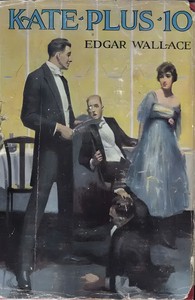
Kate plus 10
Language: en425 downloads on Project Gutenberg
Subjects
In: Crime, Thrillers and Mystery·Novels·British Literature
Public-domain ebook sourced from Project Gutenberg #76212.
Public-domain ebook
Language: en425 downloads on Project Gutenberg
Subjects
In: Crime, Thrillers and Mystery·Novels·British Literature
Public-domain ebook sourced from Project Gutenberg #76212.
The opening · free to read
The Earl of Flanborough pressed a bell push by the side of his study table and, after an interval of exactly three seconds, pressed it again, though the footman’s lobby could not have been far short of fifty yards from the library and the serving man was never born who could sprint that distance in three seconds.
Yet, in such awe was his lordship held that morning by his man-servants, his maid-servants and everything within his gates, that Sibble, the first footman, made the distance in five.
“Why the dickens don’t you answer my bell when I ring?” snapped the Earl and glared at his red-faced servant.
Sibble did not reply, knowing by experience that, even as silence was insolence, speech could be nothing less than impertinence.
Lord Flanborough was slightly over middle age, thin, bald and dyspeptic. His face was mean and insignificant and if you looked for any resemblance to the somewhat pleasant faces of the Feltons and Flanboroughs of past generations which stared mildly or fiercely, or (as in the case of the first Baron Felton and Flanborough, a poet and contemporary of Lovelace) with gentle melancholy from their massive frames in the long hall, you looked in vain. For George Percy Allington Felton, Earl of Flanborough, Baron Felton and Baron Sedgely of Waybrook, was only remotely related to the illustrious line of Feltons and had inherited the title and the heavily mortgaged estates of his great-uncle by sheer bad luck. This was the uncharitable view of truer Feltons who stood, however, more remotely in the line of succession.
Lord Flanborough had been Mr. George Felton of Felton, Heinrich and Somes, a firm which controlled extensive mining properties in various parts of the world, and the one bright spot in his succession to the peerage lay in the fact that he brought some two millions sterling to the task of freeing the estates of their encumbrances.
He was a shrewd man and an unpleasant man, but he had never been so objectionably unpleasant until he assumed the style and title of Flanborough and never so completely and impossibly unpleasant in the period of his lordship as he had been that morning.
“Now, what did I want you for?” asked Lord Flanborough in vexation. “I rang for something--if you had only answered at once instead of dawdling about, I should--ah, yes--tell Lady Moya that I wish to see her.”
Sibble made his escape thankfully.
Lord Flanborough pulled at his weedy moustache and looked at the virgin sheet of paper before him. Then he took up his pen and wrote:
“Lost or Stolen: Valuable pearl chain consisting of eighty-three graduated pearls. Any person giving information which will lead to their recovery will receive a reward of two hundred pounds.”
He paused; scratched out “two hundred pounds” and substituted “one hundred pounds.” This did not satisfy him and he altered the sum to “fifty pounds.” He sat considering even this modest figure and eventually struck out that amount and wrote, “will be suitably rewarded.”
He heard the door click and looked up.
“Ah--Moya. I am just tinkering away at an advertisement,” he said with a smile.
The Lady Moya Felton was twenty-two and pretty. She re-collected in her admirable person many of the traditional family graces which had so malignantly avoided her parent. Well-shaped and of a gracious carriage, though no more than medium in height, the face with its delicacy of moulding was wholly Felton. If the stubborn chin, the firm mouth and the china-blue eyes had come from the dead and gone Sedgelys, the hair of bronze gold was peculiarly Feltonesque.
When she spoke, however, the carping critic might complain that her voice lacked the rich quality upon which the family prided itself, for the Feltons were orators in those days when a parliamentary speech read like something out of a book. Moya’s voice was a trifle hard and without body; it was also just a little unsympathetic. Lord Flanborough boasted with good cause that his daughter was a “practical little woman” and at least one man beside her father could testify to this quality.
“Dear, don’t you think it is a little absurd--advertising?” asked the girl.
She seated herself at the other side of the desk and, reaching out her hand, opened a silver box and helped herself to one of her father’s cigarettes.
“Why absurd, darling?” asked Lord Flanborough testily; “lost property has been found before now, by means of advertising. I remember years ago when I was in the city, there was a fellow named Goldberg--”
“Please forget all about the city for a moment,” she smiled, lighting her cigarette, “and review all the circumstances. Firstly, I had the pearls when I was at Lady Machinstones’ house. I danced with quiet, respectable people--Sir Ralph Sapson, Sir George Felixburn, Lord Fethington, Major Aitkens, and that awfully nice boy of Machinstones. They didn’t steal them. I had the pearls when I left, because I saw them as I was fastening my fur cloak. I had them in the car because I touched them just before we reached the house. I don’t remember taking them off--but then I was dead tired and hardly remember going to bed. Obviously, Martin is the thief. She is the only person who has access to my room; she helped me undress; it is as plain as a pikestaff.”
Lord Flanborough tapped his large teeth with his penholder, a practice of his which annoyed his daughter beyond words, though at the moment she deemed it expedient to overlook the fault. The loss had frightened her, for the pearls were worth three thousand pounds and she was one of those people whose standard of values had a currency basis.
“I have asked Scotland Yard to send their very best man,” said Lord Flanborough importantly. “Where is Martin?”
“Locked in her room--I have told Fellows to sit outside her door,” said the girl, and then, interestedly, “When will the detective arrive?”
Lord Flanborough picked up an open telegraph form from the table.
“‘Sending Inspector Pretherston’--by Jove!”
He blinked across the desk at his daughter.
“Pretherston,” she repeated thoughtfully; “isn’t it strange?”
“Pretherston--hum,” said her father and looked at her again.
If he expected to see any confusion, any heightening of color, even so much as a faltering of glance, he was relieved, for she met his gaze steadfastly, save that there was a far-away look in her eyes and a certain speculative narrowing of lids.
The romance was five years old, and if she cherished the memory of it, it was the charity which she might show to a favored piece in her china cupboard; it was something to be taken out and dusted at intervals. Michael Pretherston was a bad match from every point of view, though his invalid cousin was a peer of the realm and Michael would one day be Pretherston of Pretherston. He was hideously poor, he was casual, he had no respect for wealth, he held the most outrageous views on the church, society and the state; he was, in fact, something as nearly approaching an anarchist as Lord Flanborough ever expected or feared to meet.
His wooing had been brief but tempestuous. The girl had been overwhelmed and had given her promise. Recovering her reason in the morning and realizing (as she said) that love was not “everything,” she had written him a letter of fourteen pages in which she had categorically set forth the essential conditions to their union. These called for the abandonment of all his principles, the re-establishment of all his shattered beliefs and an estimate of the cost of placing Pretherston Court in a state of repair suitable for the reception of the Lady Moya Pretherston (née Felton).
To her fourteen pages, he had returned a thirty-two page letter which was at once an affront and a justification for anarchy. It was not a love-letter; rather was it something between a pamphlet by Henry George and a treatise by Jean Jacques Rousseau, interspersed with passionate appeals to her womanhood and offensive references to her “huckster-souled” father.
“He was always a wild sort of chap,” said Lord Flanborough, shaking his head darkly. “I understood that he had gone abroad.”
“I suppose there are other Pretherstons,” said the girl; “still it is strange, isn’t it?”
“Do you ever feel…?” began her father awkwardly.
She smiled and laid down her cigarette on the crystal ash-tray.
“He was wholly impossible,” she agreed.
There came a gentle tap at the door and a girl entered.
She was dressed neatly in black, and her prettiness was of a different type to that of her employer (for Lady Moya indulged in the luxury of a secretary). It was a beautiful face with a hint of tragedy in the down-turned lips and, it seemed, a history of wild sorrow in her big grey eyes. Yet of sorrow she knew nothing, and such tragedy as she had met had left her unmoved. Her abundant hair was of a rich brown; the hand that clasped a note-book to her bosom was small and artistic. She was an inch taller than Lady Moya, but because she did not show the same erectness of carriage she seemed shorter.
“Father, you asked me to let you have Miss Tenby this morning,” said Lady Moya with a nod for the girl. “I don’t know whether you will still want her?”
The book keeps going
Reading is free forever. Sign up and watch scenes appear while you read.



Scenes Storieta drew for other classics.
New illustrated classics
Once or twice a month: the latest books to get full character casts, scene art, and free comic editions. No account needed.