About this book
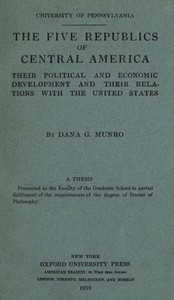
Dana Gardner Munro’s study is a systematic survey of the five Central American republics, written from the author’s own two‑year residence in the region. The opening pages set out his purpose: to move beyond the “superficial descriptions” that portray the area as a perpetual hotbed of revolutions and to present a measured account of political institutions, economic conditions, and the influence of the United States. Munro explains that reliable sources are scarce, so he relies on a mixture of official documents, travelers’ memoirs, and his own observations in both cities and rural districts. The book proceeds through a detailed geography of the Isthmus, an analysis of the social hierarchy, and chapters devoted to each nation, culminating in discussions of federation, U.S. intervention, and commerce.
The work reflects the scholarly tone of early‑20th‑century American political geography, with a formal, almost didactic style that blends statistical observation with vivid travel narrative. Readers interested in historical international relations, comparative politics, or the economic development of Latin America will appreciate Munro’s thorough, source‑critical approach. It is especially suited to students, historians, and policy analysts seeking a nuanced portrait of Central America at the turn of the century, rather than to those looking for a literary travelogue.