Public-domain ebook
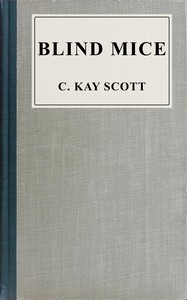
Blind mice
by C. Kay-Scott
Language: en521 downloads on Project Gutenberg
Subjects
In: Novels·American Literature
Public-domain ebook sourced from Project Gutenberg #76357.
Public-domain ebook
by C. Kay-Scott
Language: en521 downloads on Project Gutenberg
Subjects
In: Novels·American Literature
Public-domain ebook sourced from Project Gutenberg #76357.
The opening · free to read
The suburban train was crowded and the stops were frequent.
Two young men, who had secured seats near the end of their car, were occupied, one in reading an evening paper and the other in making some calculations in a note book. The one reading stopped often to quote a news item to his companion, or to make some remark. This was John Winter. He was rather short and well nourished, one of the men who indicate that in later years they will grow stout. He had very blue eyes and fair hair and his clear skin was smoothly shaven. His cheeks were pink and white, his lips very red. His clothing, which was of the latest cut, was dark blue. He wore, as was his invariable custom, a necktie the exact color of his eyes, which was for him a most becoming combination. With this exception, however, his dress showed a noticeable lack of care. He had a somewhat boisterous and affectionate manner, and a rather loud voice. When excited or interested he had a boyish way of removing his hat and running his fingers through his hair.
His friend, James Sprague, did not seem to mind John’s interruptions and replied good naturedly. Both appeared in the best of spirits and the good understanding between them was evident.
Sprague was tall and slender, with large hands and feet. An even color glowed through his darkly tinted skin. He had deep set brown eyes. The other features were large; the mouth straight. A brown moustache, closely cut as was his dark hair, shaded his heavy upper lip. He wore fastidiously selected clothing that displayed an exaggeratedly quiet taste; the cravat chosen in stripes too minute for good general effect, and the cuffs, shoes, and other details of attire immaculate and suggestive of extreme thought for appearance. Sprague’s voice was low pitched and subdued. He spoke slowly and smiled occasionally in an extraordinarily attractive manner.
It was raining. At one of the stations a pretty girl entered the car, her mackintosh and umbrella dripping. John Winter, although farthest from the aisle, jumped quickly to his feet to offer her his place. Sprague moved next to the window, to allow her to sit down without passing him, and at once resumed his figuring. Winter hung to a strap and continued the reading of his paper and his frequent remarks to his friend, glancing now and then at the girl’s profile which was particularly pleasing. She looked demurely at her gloves, smiling slightly at some of John’s conspicuously uttered sallies to Jim. After three stations were passed she arose, and, with a hasty glance at the pleasant boyish face of the young man standing, left the car. Winter’s gaze followed her to the door.
“Why don’t you sit down, John?” asked Sprague without lifting his eyes from his work. Winter sat down rather suddenly. “We ought to put cement into that cellar wall of Howland’s house,” Sprague continued. “I told him so today and it was included in the estimates.”
“I didn’t know he came to the office,” returned Winter. “When was he there?”
“Just before you got back from lunch,” answered his companion.
“I was looking at some designs for art tiles,” explained John, “and so I was late. I wanted to see Howland badly. Did he say anything about my decoration scheme for the interior?”
“I showed it to him,” responded Sprague, “but he said he couldn’t afford it.”
“I’m sorry we ever touched his rotten house!” exclaimed Winter. “He has no more taste than a billy goat.”
“He’s coming in again tomorrow.” Sprague smiled a little. “So you can talk with him yourself.” Then, after a pause, “Lucy is expecting her mother, you said. When does she get here?”
“Tomorrow,” replied John with a grimace, taking up his paper again.
Jim resumed his figuring.
“Here, wake up,” he said a few minutes later, glancing out of the window as the train slowed down at a small station. “This is Rosedene. Suppose we get off here.” And the two alighted from the car.
When they turned into the street where John lived the rain had ceased falling, and they saw Mrs. Winter and Dimmie waiting at the gate in front of the pretty yard.
Lucy Winter’s smile was of the slow but warming kind. Her child’s was also warm, but quicker, like his father’s. As Lucy kissed John, Dimmie (who was named for Sprague, “Jimmie” having been corrected into “Dimmie” by the young gentleman himself at a fabulously tender age) attacked Jim with such demonstrations of esteem as would have disconcerted a less robust and self-contained individual.
Lucy was of medium size, with hands and feet not too small. She had a rather generous figure, the waist large and bosom low. Her hair, fine in texture and not abundant, was of a nondescript shade of brown, and was arranged low over her ears. Her nose was extremely shapely, her mouth large, but so well cut as to be beautiful. Her grey eyes had a wonderful clarity and frankness of gaze. She could not be called pretty, partly because the impression of her personality suggested too much seriousness, and partly because the line from her ear to her chin was too long. She wore a simple house dress of wash goods. The gingham sleeve apron, which she had taken off before going to the front gate, hung over one arm. While not over strong physically Lucy suggested an atmosphere of wholesomeness. And she was direct, almost abrupt, in speech.
Dimmie was a slim child of four with features and complexion like John’s, but he had his mother’s fine grey eyes. Dressed in clean white blouse and breeches, white shoes and socks, his yellow hair bobbed in Dutch fashion, he made a picture of health and buoyancy.
“What a glorious rain, Lucy.” John chuckled exuberantly. “The train went through it like a ship in a storm.”
“Did it?” She smiled, feeling his coat sleeve to see if it was damp. “Are your feet wet, John? And you too, Jim?” shaking hands warmly with Sprague.
“No,” they both answered. “Just like chorus girls,” John added, at which they all laughed.
“Don’t step in the water, dear,” Lucy cautioned Dimmie as they turned to go into the house.
The first thing Jim did, after hanging his hat and rain coat in the hall, was to offer to help put the dinner on, as this was his usual task on such occasions.
“I don’t need any help,” said Lucy briskly, leading him back into the dining room. “You two boys fix yourselves some near cocktails while I finish. It’ll only take me a minute. You know where the ingredients are, Jim.”
Jim mixed the cocktails, going out in the kitchen to the refrigerator for ice, and swearing when he could not find the shaker.
“Where is it, Lucy?” he asked.
“Why don’t you look for it?”
“I have,” he protested.
“Here it is.” She brought it from the pantry where he had just been. “If it had been a snake it would have bitten you.”
“Say, but that soup smells good,” he exclaimed as she removed a cover and placed a tureen on the kitchen table. “What kind of soup is it?”
“Wait and see,” she replied. “You go and fix that cocktail or the soup will get cold--and call John.”
Jim obeyed. John came in from the living room, where he had been playing “The Evening Star” from Tannhäuser on the piano, with many mistakes in the execution, and Lucy put the soup on.
“Sit down,” she commanded. “You know your place, Jim. Where’s Dimmie?”
“I’ll get him,” offered Jim, going out through the kitchen. “There’s some cocktail left for you,” he called back.
Lucy took up the glass and tasted its contents gingerly. “I don’t like it,” she objected to John, making a face.
“Oh, women usually don’t like dry cocktails,” he laughed. “That’s a Martini. We make Manhattans for the ladies. But it’s almost as good as a real one. Old Jim’s supply of alcohol and synthetic flavors won’t last much longer though.”
Jim came in with Dimmie, and dinner was begun.
“I’ve been thinking a long time,” Jim looked alternately at Lucy and John as he spoke, “that we ought to combine with some such firm as Layard’s occasionally so that we can swing bigger things. They are close to all the supply companies.”
“Have some more soup,” urged Lucy.
The book keeps going
Reading is free forever. Sign up and watch scenes appear while you read.



Scenes Storieta drew for other classics.
New illustrated classics
Once or twice a month: the latest books to get full character casts, scene art, and free comic editions. No account needed.