Public-domain ebook
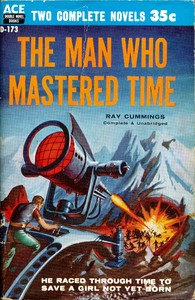
The man who mastered time
by Ray Cummings
Language: en284 downloads on Project Gutenberg
Subjects
In: Science-Fiction & Fantasy·Adventure·Novels
Public-domain ebook sourced from Project Gutenberg #76503.
Public-domain ebook
by Ray Cummings
Language: en284 downloads on Project Gutenberg
Subjects
In: Science-Fiction & Fantasy·Adventure·Novels
Public-domain ebook sourced from Project Gutenberg #76503.
The opening · free to read
"Time," said George, "why I can give you a definition of time. It's what keeps everything from happening at once."
A ripple of laughter went about the little group of men.
"Quite so," agreed the Chemist. "And, gentlemen, that's not nearly so funny as it sounds. As a matter of fact, it is really not a bad scientific definition. Time and space are all that separate one event from another. Everything happens some_where_ at some_time_."
"You intimated you had something vitally important to tell us," the Big
Business Man suggested. "Something, Rogers, that would amaze us. Some project you were about to undertake--"
Rogers raised his hand. "In a moment, gentlemen. I want to prepare you first--to some extent, at least. That's why I have led you into this discussion. I want you to realize that your preconceived ideas of time are wrong, inadequate. You must think along entirely different lines, in terms of, I shall say, the new science."
"I will," agreed George, "only tell me how."
"You said that time, space, and matter are not separate, distinct entities, but are blended together," the Doctor declared. "Just what do you mean?"
Rogers gazed earnestly about the room. "This, my friends. Those are the three factors which make up our universe as we know it. I said they were blended. I mean that the actual reality underlying all the manifestations we experience is not temporal or spatial or material, but a blend of all three. It is we who, in our minds, have split up the original unity into three such supposedly different things as time, space and matter."
"Take space and time," said the Big Business Man. "Those two seem wholly different to me. I shouldn't think they had the slightest connection."
"But they have. Between the three planes of space--length, breadth and thickness--and time, there is no essential distinction. We think of them differently; we instinctively feel differently about them. But science is not concerned with our feelings--and science recognizes today that time is a property of space, just as are length, breadth and thickness."
"That's easy to say," growled the Banker. "Any one can make statements that can't be proven."
"It has been proven," Rogers declared quietly. "The mathematical language of science would bore you. Let me give you a popular illustration--an illustration, by the way, that I saw in print long before Einstein's theory was made public. For instance, think about this: A house has length, breadth and thickness. The house is matter, and it has three dimensions of space. But what else has it?"
A blank silence followed his sudden question.
"Hasn't it duration, gentlemen? Could a house have any real existence if it did not exist for any time at all?"
"Well," said George, "I guess that's something to think about."
Rogers went on calmly: "You must admit, my friends, that the existence of matter depends on time equally as on space. They are, as I said, blended together. A house must have length, breadth, thickness and duration, or it cannot exist. Matter, in other words, persists in time and space. Let me give you another illustration of this blending. How would you define motion?"
Again there was a dubious silence.
"Motion," said George suddenly, "why, that's when something--something material changes place." He was blushing at his own temerity, and he sat back in his leather chair, smoking furiously.
"Quite so," smiled Rogers. "That, gentlemen, is about the way we all conceive motion. Something material, a railroad train, for instance, changes its position in space." He regarded the men before him, and this time there was a touch of triumph in his manner. "But, my friends, that's where our line of reasoning is inadequate. Time is involved equally with space. The train was there then; it is here now. That involves time."
"In other words--" the Doctor began.
"In other words, motion is the simultaneous change of the position of matter in time and space. You see how impossible it is to speak of one factor without involving the others? That is the mental attitude into which I'm trying to get you. I want you to think of time exactly as you think of length, breadth and thickness--as one of the properties of space. Isn't that clear?"
The Big Business Man answered him. "I think so. I can understand now what you mean by a blending of--"
"Oh, his words are clear enough," the Banker interjected testily. "But what's the argument about? He started in by saying--"
George sat up suddenly. "Mr. Rogers, you said we were to come here for something vitally important to you. Something about time and space. You said--"
Rogers interrupted him. "I did indeed. I asked you all to come here to the club tonight because you are my friends. Mine and Loto's. And the affair concerns him more directly than it does me."
He glanced across the room. "Come, Loto. You're the one to tell them."
The Chemist's son, a young man of twenty, rose reluctantly from his obscure seat in a corner of the room. He was tall, and slight of build, with thick, wavy chestnut hair and blue eyes; his delicate features were offset by a square firmness of chin. He came forward slowly, flushing as the eyes of the men were turned on him; a poetic-looking boy, with only the firm line of his lips and the set of his jaw to mark him for a man.
"My son, gentlemen," Rogers added. "You all know Loto."
"We do," said George enthusiastically. He vacated his own chair, shoving it forward, and selected another, more retired position for himself.
Loto settled himself in the chair and then hesitated, as though in doubt how to begin. He was still flushing, and yet his manner was thoroughly poised. His forehead was wrinkled in thought.
"Father and I were experimenting," he began abruptly, "about two years ago. We were interested in electrons. We were experimenting with the fluorescence in a Crookes tube--breaking down the atoms into electrons. Then we followed the experiments of Lenard and Roentgen. We darkened the tube and prepared a chemical screen, which grew luminous."
Loto turned to Rogers: "They don't want to hear all this. These technicalities--"
Rogers smiled. "We hit upon it quite by accident--an accident that we have never been able to duplicate. We had, that evening, an adaptation of the familiar Crookes tube. I do not know the exact conditions we secured; we had no idea we were on the threshold of any discovery and we kept no record of what we did. Nor am I sure just how I prepared the screen--what proportions of the chemicals I used--"
"You're worse than Loto," the Banker growled. "If you'll just tell us what--"
"I will," agreed Rogers good-naturedly. "We were working one night in my laboratory on Forty-third Street--only a few hundred yards from the Scientific Club here. The room was dark, and we had set up a small chemical screen. It grew luminous as the electrons from the tube struck it, but the glowing was not what we had expected--not what we had observed before. The difference is unexplainable to you, but we both noticed it. And then Loto noticed something else, something in the darkness behind the screen."
Loto was sitting upright on the edge of his chair; his eyes were snapping with eagerness as he interrupted his father.
"I'll tell them because it was I who saw it first. Behind the screen, the darkness of the room itself was growing luminous with a glowing radiance that seemed to spread out into rays that were not parallel, but divergent. It looked almost as though the screen were a searchlight sending a spreading beam out behind it.
"Father saw it almost as soon as I did. It was a very curious light; it did not illuminate the room about us. Then we suddenly discovered that it went through the walls of the laboratory. We were looking into a space that seemed to be opening up for miles ahead of us. The walls of the room, the house itself, the city around us, were all blotted out. We were looking into an empty distance."
"Empty?" echoed George tensely. "Didn't you see anything?"
The book keeps going
Reading is free forever. Sign up and watch scenes appear while you read.



Scenes Storieta drew for other classics.
New illustrated classics
Once or twice a month: the latest books to get full character casts, scene art, and free comic editions. No account needed.