Public-domain ebook
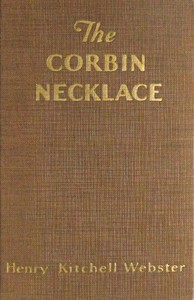
The Corbin necklace
Language: en299 downloads on Project Gutenberg
Subjects
In: Crime, Thrillers and Mystery·Novels·American Literature
Public-domain ebook sourced from Project Gutenberg #76546.
Public-domain ebook
Language: en299 downloads on Project Gutenberg
Subjects
In: Crime, Thrillers and Mystery·Novels·American Literature
Public-domain ebook sourced from Project Gutenberg #76546.
The opening · free to read
“How much do you suppose it’s really worth?” Punch wanted to know.
“Your grandmother’s necklace?” I inquired. It had been ten minutes or so since we’d mentioned it. Evidently, though, it was still on his mind. “Oh, something fabulous,” I told him.
But I saw at once that the reply hadn’t passed muster. It had struck him, apparently, as a typically adult remark, frivolous, or ignorant--or both. I don’t like being a typical adult to Punch so I tried to do better.
“I don’t know much about pearls,” I said. “They’re a special subject. And I haven’t even seen the necklace since your mother wore it at some ball or other--oh, pre-war. Perhaps a dozen years ago. But you can put it at this, safely enough. If it were sold and the money it brought invested, even conservatively, it would produce an income one could live on.”
“If you had to sell it to a fence, though,” Punch observed, “you wouldn’t get near so much for it. And a regular jeweler would know where it came from, if you’d stolen it, and call up the police. I suppose the way to do would be to break the string and sell the pearls one or two at a time. Even that would be pretty hard to do.”
“You aren’t planning to steal the necklace yourself, are you?” I inquired.
He smiled politely, by way of acknowledging the joke, but without losing his thoughtful air.
“It was horribly silly putting it in the paper, anyhow.”
“Putting what in the paper?”
“About how Gran was going to give it to Judy for a wedding present. I’ve got it here. I tore it out of Tuesday’s paper. I thought perhaps it was just as well not to have it lying around the house.”
He removed it in a wad from a pocket in his knickerbockers and brought it around for me to see.
There were columns about Judith Corbin’s approaching wedding in all the papers, these days. Justifiably, too, perhaps. If news is whatever people are curious about, the Corbins have been news for three generations. But the particular article which Punch had put into my hand was written in the vein I most detest, knowing, insinuating, pandering to the most abject form of snobbery.
“Confound American newspapers!” I said.
Punch caught me up sharply. “It isn’t their fault,” he declared. “They’re better than the newspapers in any other country.”
His Americanism, I may remark, is almost rabid. As a result of his having been dragged all over Europe for most of his boyhood, the temperature of his patriotism is far above normal; say about one hundred and four. It goes rather oddly with the rest of him for in the other respects he’s an incorruptible realist.
“My remark about American newspapers is stricken out,” I said hastily. “I didn’t mean to insult our country. But I agree with you that the reference to the necklace is unfortunate. Of course your mother....”
I was going to say, “knows best,” or something like that, just to avoid any implied criticism of Victoria. But Punch broke in.
“I don’t think it was mother who told them. She’s been kind of funny about that necklace.”
Well, there were old reasons why the necklace should be a sore point with Victoria. I didn’t feel like going into them with her thirteen-year-old son.
“Where is it?” I asked. “In the bank, I suppose?”
“No, it isn’t. It’s down here. Grandmother’s got it in that silly old safe of hers. Isn’t that the worst possible place to keep anything that people might want to steal? It isn’t supposed to be hard at all to open an ordinary safe. If Gran would just give it to me and let me hide it for her, somewhere, it would be a whole lot safer.”
“I know,” I agreed, “that in every detective story and in most plays there’s a character who can sandpaper the tips of his fingers and open a safe quicker than I can break into a can of sardines. Whether experts of that sort are really so numerous, or safes so little entitled to their name, I don’t know.”
He didn’t a bit mind my laughing at him. “Well,” he said, “there’s going to be big trouble, I bet, before this business is over.”
Certainly there’s no denying that in this instance Punch was a good prophet.
It is probably unnecessary to remark that he derives his nickname from the fact that his sister had been named Judith. He was christened John Benedict Corbin, as were his father and grandfather, both now long dead, before him. And perhaps, since I have been in a way commissioned to set down an account of the business of the next few days and the trouble it involved, I may as well begin being a little more explicit. The consensus seems to be that I know as much about it as anybody, though--or perhaps because--I have really been very little involved.
I might have been involved a good deal deeper, since I’m the Corbins’ only near neighbor. The original plan had been that on the occasion of Judith’s wedding--an old-style country wedding it was to be--I should keep bachelor’s hall for the groom, his best man and some of the ushers. Also, as a traditional friend of the family, I’d have been over at The Oaks most of the time from the beginning of the festivities to the end. But my house, a few days earlier, had been pretty well wrecked and gutted by a bad fire, and in the course of my efforts to get things out of the burning building, I’d had the serious misfortune--that, anyhow, was the way I felt about it at the time--to break my leg.
In the light of ensuing events, I’m not altogether sorry that I had to spend those wretched days in my gardener’s cottage with my leg in a cast. It had, at least, its compensations. Nobody, as far as I know, from first to last suspected me of complicity in, or even guilty knowledge of, any crime. A pair of crutches, which I was frightfully clumsy with, a twenty-pound cast on my leg and an iron-clad alibi served to protect me. And with Punch for a daily visitor, I don’t think I missed much of the excitement.
It is possible that since he takes his obligations seriously, he felt he owed me something in return for the thrill he’d been afforded by my fire and my broken leg. He’d helped the surgeon put on the cast--this was before my nurse arrived--and he took a professional, almost a proprietary, interest in the damaged limb from that point on. But I’m proud to believe that Punch likes me. I’m not often, he’s good enough to imply, betrayed into that levity in dealing with serious matters, to which most of my generation are incorrigibly addicted. I’m coeval more or less with his mother.
I’ve always known Victoria and got on with her well enough, though I never was one of her numerous adorers. Perhaps it was their numerousness that put me off. I haven’t, either, in the years since her husband’s death, always applauded her judgment, especially in the matter of bringing up her children. But I’d be the first to admit that she’s had difficulties.
Oh well, perhaps, since I’ve already kept Punch waiting so long, I may as well go ahead and tell my history right end to.
The first John Corbin’s father, Peter, I think his name was, came out to these parts somewhere about the time of the Black Hawk War. His ancestors had been seafaring folk--Newburyport, I think they came from--and had prospered at it. Peter had money behind him, anyhow, and he got possession of some thousands of acres of the best land in Illinois--chased the Indians off it, I suppose--and built his first house out of bricks that he made on the place.
His son, Punch’s grandfather, inherited the whole thing. He may have been able enough, though I suspect the line was thinning out. Anyhow, the most important thing about him is the woman he married.
I haven’t an idea who, in the social sense, she was. But certainly for the past fifty years or so she has been a tremendous person. She had two sons--she’d probably have had a dozen but for her husband’s untimely death. She completely dominated the elder, Punch’s father, and quarreled violently with the younger one, Alexander--she quarreled with everybody she couldn’t dominate--so that he ran away, fought in the Spanish War, went out to the Philippines and stayed there.
John married Victoria Ashcroft; he died two or three months before Punch was born. Judy remembers him, of course, and adores his memory. It’s one of the reasons, perhaps, why she doesn’t get on better with her mother.
The proceeding years never softened up the old lady a bit. Her husband’s will left the whole fortune in her hands, and she has used it remorselessly as a club to enforce submission to her ideas. In the main I think her ideas have been pretty sound--certainly her business judgment has always been above reproach--but they aren’t Victoria’s ideas in the least. It’s hard to imagine a more difficult position than that of being old Mrs. Corbin’s daughter-in-law.
The famous necklace affords an illustration. As an adornment it has long been useless to the old lady. She’s been crippled with arthritis for years, living, from somewhere about dawn till nine o’clock at night, in a wheel chair. Victoria used to wear the necklace frequently. Pearls, I believe, and especially old pearls, need wear. And the thing was popularly supposed to be hers.
But between the old lady and Victoria there was never any ambiguity about it. The mother-in-law kept tabs on it most jealously; decreed when it should be worn and when it should not, and kept it most of the time in her possession. She has never liked Victoria, has often openly mistrusted her, and it was easy to believe that her decision to give the necklace to Judy was inspired by a wish to do Victoria out of it finally.
With the children Victoria more nearly had her own way. She had some money of her own, though nowhere near enough to carry out her program for them, and as long as she could keep them away from The Oaks, far enough away to sift out details, their grandmother’s edicts were of little effect.
But too far Victoria dared not go. There could be no shadow of doubt that the old lady was in her right mind and able to make a will, and upon this will the disposal of the whole Corbin fortune depended. She could found a theological seminary with it if she liked.
To make it harder for Victoria--as if it weren’t hard enough already--she had not, during the past three or four years, got on very well with Judy. Within the last few months we who were her friends had vaguely understood that the difficulty had got a good deal worse, and Judy was, for a while, a declared rebel. Victoria had been half frantic between the necessity of winning Judy back and keeping all echoes of the trouble from reaching Mrs. Corbin’s ears. This acute phase had passed somehow, and Judy had come back, curiously sobered and, superficially at least, tractable.
The book keeps going
Reading is free forever. Sign up and watch scenes appear while you read.



Scenes Storieta drew for other classics.
New illustrated classics
Once or twice a month: the latest books to get full character casts, scene art, and free comic editions. No account needed.