Public-domain ebook
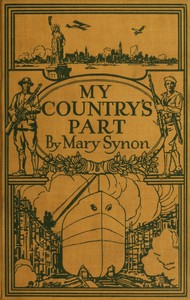
My country's part
by Mary Synon
Language: en220 downloads on Project Gutenberg
Subjects
In: Children & Young Adult Reading·History - American·History - Warfare
Public-domain ebook sourced from Project Gutenberg #76636.
Public-domain ebook
by Mary Synon
Language: en220 downloads on Project Gutenberg
Subjects
In: Children & Young Adult Reading·History - American·History - Warfare
Public-domain ebook sourced from Project Gutenberg #76636.
The opening · free to read
“MY GRANDMOTHER AND MYSELF”
What can an American boy or an American girl do for our country?
The ways are many. Every man, woman, and child in the United States has the duty of defending the nation. In time of war every American must be in spirit, if he cannot be in actual duty, a soldier. A soldier’s part is to guard his nation. An American’s part is to guard America. The guarding may be done by saving the food that the government asks its citizens to save, by buying War Thrift Stamps, by buying Liberty Bonds, by working for the Red Cross, or for other patriotic organizations; but it must be done with the idea that our country is our first concern, our first care.
Every American must be watchful for his country’s welfare. How may he do this duty? By remembering always that he is, first of all, an American. No matter what country his father or mother, or grandfather or grandmother came from, he is American, with the rights and privileges and obligations of his citizenship. And he must have no divided allegiance.
The story of what one American boy could do for his country is told in the story that follows. Some people call this a fiction story. But the root of it is truth. For every boy and every girl in the United States can hold to the love of country that John Sutton’s grandmother put into his soul through the incidents that make up the tale of
“MY GRANDMOTHER AND MYSELF”
My grandmother was at the basement window, peering into the street as if she were watching for some one, when I came home from school. “Is that you, John?” she asked me as I stood in the hall stamping the snow from my boots. “Sure!” I called to her. “Who’d you think I was? A spirit?”
She laughed a little as I went into the room and flung down my books. My grandmother hasn’t seen any one in ten years, though she sits day after day looking out on the street as if a parade were passing; but she knows the thump of my books on the table as well as she knows the turning of my father’s key in the lock of the door. “’Tis a lively spirit you’d make, Shauneen,” she said, with that chuckle she saves for me. “No, ’twas your father I thought was coming.”
“What’d he be doing home at this time?”
“These are queer days,” she said, “and there are queer doings in them.”
“There’s nothing queer that I can see,” I told her.
“I’m an old, blind woman,” she said, “but sometimes I see more than do they who have the sight of their two eyes.” She said it so solemnly, folding her hands one over the other as she drew herself up in her chair, that I felt a little thrill creeping up my spine. “What do you mean?” I asked her. “Time’ll tell you,” she said.
My mother came in from the kitchen then. “Norah forgot to order bacon for the morning,” she said. “Will you go to the market, John, before you do anything else?”
“Oh, I’m going skating,” I protested.
“It won’t take you five minutes,” said my mother. She seemed tired and worried. The look in her eyes made me feel that there was trouble hanging over the house. My mother isn’t like my grandmother. When things go wrong, my grandmother stands up straight, and throws back her shoulders, and fronts ahead as if she were a general giving orders for attack; but my mother wilts like a hurt flower. She was drooping then while she stood in the room, so I said, “All right, I’ll go,” though I’d promised the fellows to come to the park before four o’clock.
“And look in at the shop as you go by,” my grandmother said, “and see if your father’s there now.”
“Why shouldn’t he be?” my mother asked.
There was a queer sound in her voice that urged me around past my father’s shop. My father was there in the little office, going over blue-prints with Joe Krebs’s uncle and Mattie Kleiner’s father and a big man I’d never seen before. I told my grandmother when I went home. “I knew it,” she said. “I knew it. And I dreamed last night of my cousin Michael who died trying to escape from Van Diemen’s Land.”
“You knew what?” I asked her, for again that strange way of hers sent shivery cold over me.
“Go to your skating,” she bade me.
There wasn’t much skating at Tompkins Square, though, when I found the crowd. The sun had come out strong in the afternoon and the ice was melting. “Ground-hog must have seen his shadow last week,” Bennie Curtis said. All the fellows--Joe Carey and Jim Dean and Frank Belden and Joe Krebs and Mattie Kleiner and Fred Wendell and the rest of them--had taken off their skates and were starting a tug of war in the slush. Mattie Kleiner was the captain on one side and Frank Belden the captain on the other. Mattie had chosen Joe Krebs and Jim Dean and Joe Carey on his side. Just as I came along he shouted that he chose me. Frank Belden yelled that it was his choice and that he’d take me. “He don’t want to be on your side!” Mattie cried. “He’s with the Germans!”
“Well, I guess not,” I said, “any more than I’m with the English. I’m an American.”
“You can’t be just an American in this battle,” Frank Belden said.
“Then I’ll stay out of it,” I told him.
They all started to yell “Neutral!” and “Fraid cat!” and “Oh, you dove of peace!” at me. I got tired of it after a while, and I went after Mattie hard. When I’d finished with him he bawled at me: “Wait till your father knows, he’ll fix you!”
“What for?” I jeered.
“For going against his principles, that’s what,” Mattie Kleiner roared.
“I’d like to know what you know about my father’s principles.” I laughed at him.
“Well, I ought to know,” he cried. “I heard him take the oath.”
“What oath?” we all demanded, but Mattie went off in surly silence. Joe Krebs and Joe Carey trailed after him. I stayed with the other fellows until it was dark. Then I started for home.
Joe Carey was waiting for me at the corner. “Do you believe him, John?” he asked me. “Do you believe Mattie about the oath?”
“How’s that?” I parried. I seemed to remember having heard a man who’d been at the house a fortnight before whispering something about an oath, and I knew that I’d heard my mother say to my grandmother: “I pray to God he’ll get in no trouble with any oaths or promises.” I kept wondering if Mattie Kleiner’s father and Joe Krebs’s uncle and the big man with the blue-prints who’d been in my father’s shop had anything to do with it. “Oh, Mattie’s talking in his sleep,” I said.
“Well, maybe,” said Joe Carey; “but he wasn’t sleeping the night they had the meeting in his house. He was on the stairs going up to the top floor, and he kept the door open a little way and he heard everything they said, and nobody at all knew he was there.”
Joe Carey’s eyes were almost popping out of his head, and so I knew that Mattie had been telling him a long story. “I guess he didn’t hear very much,” I said.
“You bet he did,” Joe declared. “He heard them reading the letters telling people not to go on the ships because they were going to be sunk, and he heard them talking about bombs and munition factories. He says that he heard your father say that he’d gladly lay down his life for the sake of Ireland.”
“But Ireland’s not in this war!”
“Sure it is! Mattie says the Germans are going to free Ireland if they beat England. That’s why the Irish ought to be with the Germans. Mattie says your father’ll be awful ashamed that you wouldn’t go on his side. Mattie says your father----”
“I don’t give a whoop what Mattie says about my father,” I told him. “I guess I can take my own part.”
“I guess you’ll have to,” said Joe.
As I went up the street toward our house I had that queer feeling that comes sometimes after I’ve been away for a while, a fear that something terrible has happened while I’ve been gone and that I’ll be blamed for it. It was dark on the street, for people hadn’t lighted the lamps in the basement dining-rooms, and I was hurrying along when suddenly a man’s voice came over my shoulder. I hadn’t heard his step behind me at all, and I jumped when he spoke. “Where does Mr. John Sutton live?” he asked me.
The book keeps going
Reading is free forever. Sign up and watch scenes appear while you read.



Scenes Storieta drew for other classics.
New illustrated classics
Once or twice a month: the latest books to get full character casts, scene art, and free comic editions. No account needed.