Public-domain ebook
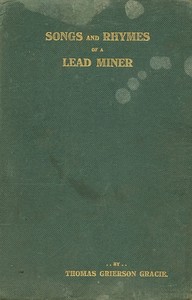
Songs and rhymes of a lead miner
Language: en3,364 downloads on Project Gutenberg
Subjects
Public-domain ebook sourced from Project Gutenberg #76732.
Public-domain ebook
Language: en3,364 downloads on Project Gutenberg
Subjects
Public-domain ebook sourced from Project Gutenberg #76732.
Songs and rhymes of a Lead Miner is a self‑published collection by Thomas Grierson Gracie, a native of Wanlockhead born in 1861. The volume opens with a litany of titles, “The Auld Sangs,” “Turnin’ o’ the Wheel,” “Bonnie Jean,” “Wanlock,” and many more, grouped under headings such as “Songs,” “Miscellaneous Pieces,” and “Personal Note and Preface.” Gracie then offers a candid autobiographical sketch, describing his upbringing in a ten‑child mining family, his early work as a lead washer, and his eventual transition to underground mining. He explains that the verses were composed during the Great War, often to rally morale, and acknowledges the modest literary skill of a self‑taught man. The book proceeds to present the poems and songs themselves, occasionally noting familiar tunes or providing brief contextual comments.
The voice is unmistakably that of a working‑class Scotsman speaking in a mixture of vernacular dialect and plain English, reflecting the late‑Victorian and early‑twentieth‑century milieu of the Scottish Lowlands. Gracie’s style is straightforward, occasionally rough around the edges, and his subject matter ranges from mining life and local folklore to wartime patriotism and everyday humor. Readers with an interest in regional Scottish poetry, folk song collectors, or anyone curious about the cultural texture of a mining community in the era of lead and coal extraction will find the work engaging.
The opening · free to read
PERSONAL NOTE AND PREFACE.
One of a family of ten, I was born at Wanlockhead, Dumfriesshire, in the year 1861. My boyhood was spent in the midst of comparative poverty, under whose grim shadow so many toilers live and die. Of my parents I say nothing here, except that my love and reverence for their memory remain undimmed to this day. The amount of love and self-sacrifice involved in bringing up a large family on the earnings of the lead miner at that period--from fifteen to seventeen shillings per week--I leave to the imagination of my readers. In spite of poor environment, my boyhood was, on the whole, happy and care-free. My greatest delight was to roam the glens and hills of my nativity. My pet aversion was the school, and to be confined within its four walls when the sun was shining and the birds singing outside was to me the refinement of cruelty. My parents and teachers must have been at their wits' end with me, for, in spite of heavy punishment, I played truant whenever opportunity offered. I was employed as a lead washer at the age of thirteen, for the magnificent wage of fivepence per day. This was increased at the rate of one penny or twopence yearly, at the discretion of the manager. After working five years at lead washing it came my turn to go underground as a labourer and miner's assistant, where in course of time I became a fully qualified lead miner.
I will not weary my readers with an account of my ups and downs in life or of my many startling experiences in the lead and coal mines. I was a coal miner in different parts of Scotland for six years. I did not take kindly to the work, and when I left it I fervently hoped it was for good. Of the coal miners I have a high opinion. Beneath the rough exterior of the most of them they are true to the core; brave hearted men, who have proved their sterling worth on many a shell-torn, blood-stained field, and in many an appalling mine disaster; ready to fight, suffer, or die on the field of battle for their ideals: ready in the mine disaster to go to almost certain death to rescue their comrades. Can human nature rise higher than this?
My hobby has been the study of music and the playing of different instruments. I have gained an elementary knowledge of composition, harmony, and counterpoint, and in the playing of different instruments made myself fairly expert. My favourite is the violin, and my earnings with it at concerts, balls, kirns, and merry-makings generally enabled my wife to keep the pot boiling and the bairns fed and clad when the lead miner's wage was utterly inadequate for that purpose.
At the outbreak of the Great War I commenced to rhyme. I am sorry if the jingo spirit is too evident in some of my pieces. Such were composed in the dark days, when our brave soldiers had their backs at the wall, and required every moral and material support that could be given them. For the political and religious bias of my pieces I make no apology. I make no claim to the honour of being a Poet; that I have no claim will be evident to cultured minds to whom these songs and rhymes will no doubt appear poor in conception, crude in expression, grammatically wrong in parts, and altogether commonplace. But as I am writing to people on my own level of intelligence--that is, the intelligence of a self-taught man--cultured people do not come into the picture. Some of my friends are quite pleased with my verses, but I will not require a larger size in headwear over the opinion of others. I am pleased, however, to note that they all agree about the general tone and sentiment being of a high order. With that I am content. If there is anything in my pieces that will raise a smile, a laugh, or a tear--anything that will make the human more humane, any thought or sentiment that will tend to raise the moral or mental standard of my readers--they have not been written in vain.
One third of the pieces in this book have already been published, and my thanks are due to local and other Editors for space given me, and specially to the Editor of the "Dumfries and Galloway Courier and Herald," for an artistic touch here and there in some of them. I give the tunes when well known to which a number of my songs may be sung. As for the others, the music being new, it will depend on circumstances whether they ever see the light of publicity. The song "Wanlock," by M'Arthur, schoolmaster in Wanlockhead (1850), and "The Lowther Winds Wail," by the Rev. J. Moir Porteous, minister of the Free Church, Wanlockhead (1877), I insert so that they will continue to be familiar to the people of the district in which their authors lived and worked.
I am indebted to Robert Wanlock Reid for permission to publish his "Letter in Rhyme," and to J. M. Harkness for his appreciation expressed in "Auld Cronie Tam;" also to Miss Annie J. Mitchell for kindly typing the bulk of my pieces; and to all those who have given me any encouragement in the making of this book.
AUTHOR.
DESCRIPTIVE PIECES.
THE RIDGE OF GLENGONAR.
WINTER SCENE.
The pale lovely moon o'er the Lowthers was rising As lonely I strayed at the fall of the night Away to the far-stretching Ridge of Glengonar, The high hills to view in their mantle of white.
Old Boreas had swept them for days in his anger, As though he would crush them beneath his proud sway; But grandly they stood, with their brows high uplifted, Firm based in majestic, eternal array.
Then thoughts did arise as I gazed on the scene That lay bathed in the silvery light of the moon Of Flanders' torn fields that were once fair and fertile, Made barren and shrouded in sorrow and gloom;
Of men who went forth in the pride of their manhood, Aroused, by the call that appeals to the brave, Inspired by the noblest and purest of motives, Who fell on the field or were sunk 'neath the wave.
I stood all alone on the Ridge of Glengonar, Alone 'neath the stars that shone bright in the blue; And prayed to the Ruler of men and of nations To strengthen the arms of our gallant and true;
To silence for ever the roar of the cannon And sink in oblivion this era of pain, That in peace we might live in the land of our fathers 'Neath harmony, love, and prosperity's reign.
A FIS'HIN' SPLORE.
Wullie, Sandy, Rab, an' Tam Yae nicht when sittin' owre a dram Agreed when neist the day wad daw Tae tak' their rods an' trudge awa' An' try their skill wi' flee an' worm On bonnie Carron's wimplin' burn.
The mornin' broke sae fresh an' fair, New life was in the caller air; Owre Grey Mere's Tail the sun did peep, Tae wake oor fishers frae their sleep. Ilk yin gat up wi' bizzin' croon; Short time had passed since they lay doon.
They dressed fu' quick, nae time tae loss, An' sune were skelpin' through the moss; Owre dyke an' fence, through sheuch an' glen, Up, up, they spieled tae Enterkin: An' when at last they did get there A view they had ayont compare.
They had nae time the scene tae view, Sae hurried owre the mountain's broo, An' doon the brae they ran pell-mell Tae hae a drink at Katie's Well, "Whaur Black M'Michael's bearded lip Yince fain did dip."
Then doon they ran wi' muckle speed, Tae Nature's charms they paid nae heed, An' didna slack their pace a jot Until they reached the Lucky Pot[1]; Sae awfu' keen an' anxious they Tae see if luck was theirs that day.
Then walin' steps wi' canny care They gaed alang the hill-side bare, Whaur Kelt,[2], the hound, fell aff his steed When Harkness[3] shot him through the heid; The roarin' pool whaur he fell in Has since been known as Kelty's Linn.
There fore-nent them Stey-Guile stood, Defyin' time an' storms an' flood; They gazed upon its steepest side, Doon whaur 'twas said bold Graham[4] did ride, His pony shod wi' deevils' cloots; 'Twas maybe true. "They had some doots."
Owre Dalveen Hill an' doon the brae Richt cheerily they held their way; An' when they High Dalveen had passed They reached the Carron Burn at last; Then fast their taikle they gat oot, Their minds fair set on killin' troot.
Then Wullie, keen his skill tae test, Got started weel afore the rest; He banged oot yin, syne made it twa; When oot cam' three, lie croose did craw. "Come here, ma callans, gin ye wish, I'll show ye hoo tae catch the fish."
"But pleesures are like poppies spread, Ye seize the floo'er, its bloom is shed;" He thocht he was a fisher rare, But, strange tae say, he gat nae mair; An' then he cried "I'll bet a quid It's been the tail en' o' the tid."
But Rab an' Tam, mair skilfu' they, On pools an' streams their flees did play; They played wi' sic a cunnin' wrist The finny tribe couldnae resist, But lap an' danced at bob an' trail; Some e'en were hookit by the tail.
Doon by Stonebutt an' by the Brig, They landed fishes wee an' big; An' when they reached the Carron Mill, O' fishin' they had got their fill: An' here a signboard took their e'e, A maist uncommon sign tae see:
"Ginger-beer an' lemonade, Here as guid as can be made, An' if ye want some more repast, Dinner, supper, or breakfast;" These lines, my friens, depend upon it, Composed were by Grier the Poet.
The landlord there, a sober chiel, Wad hae nae traffic wi' the deil: O' aqua vitae he had nane; Sair did oor weary fishers grane; An' ere they rested on their hurdies, Hied owre the hill tae Tam o' Murdy's.
Tam o' Murdy's, Durisdeer, Was famed for Mountain Dew an' beer, An' ony ither kin' o' drink, But jist for them wha had the clink: For Tammy, tho' a kin'ly man, Could aye look efter num'er wan.
An' there they sat an' smoked an' sang, An' gill stoups toomed o' liquor strang, Which quickly put them a' at ease, In tellin' stories, maistly lees, O' salmon they had landed oot, An' hoo they lost their biggest troot.
Their pooches toom, nae mair tae spen', Their nonsense sune cam' tae an en', An' forced were they tae tak' the gait, Tho' they were in a muddled state. The moon on them was shinin' clear, When leavin' guid auld Durisdeer.
They wandered on, whiles up, whiles doon, An' heard fu' mony an eerie soon; The fitpath wasna' braid aneuch, They tumelt in the burn an' sheuch; They staggered in amang the dreels, O' turnip, kail, an' tattie fiel's.
An' tho' they had nae wish tae tarry, Their legs refused the drink tae carry: An'' doon on Carron's hichts they sank, An' for a time their min's were blank; Hoo they gat hame, what them befel, Deil yin o' them could ever tell.
MORAL.
When man is on enjoyment bent, O' aftermath he should tak' tent, An' no abuse John Barleycorn, Or life o' pleesure will be shorn.
[1] A natural pot formation in the bare rock in the middle of the burn, about twenty yards down from the foot-path from which, if a fisher, in the morning, out of three stones put one in the lucky pot, his luck was in for that day.
The book keeps going
Reading is free forever. Sign up and watch scenes appear while you read.



Scenes Storieta drew for other classics.
New illustrated classics
Once or twice a month: the latest books to get full character casts, scene art, and free comic editions. No account needed.