Public-domain ebook
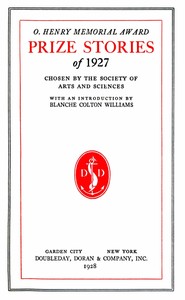
O. Henry Memorial Award prize stories of 1927
Language: en1,135 downloads on Project Gutenberg
Subjects
In: Short Stories·American Literature
Public-domain ebook sourced from Project Gutenberg #76802.
Public-domain ebook
Language: en1,135 downloads on Project Gutenberg
Subjects
In: Short Stories·American Literature
Public-domain ebook sourced from Project Gutenberg #76802.
The volume is a curated anthology of the O. Henry Memorial Award prize stories for the year October 1926 through September 1927. The committee sifted more than six hundred submissions down to fifty finalists, then selected fifteen winners by a panel of five judges. The opening pages explain the ranking process, noting first‑place “Child of God” by Roark Bradford (Harper’s, April 1927) and second‑place “The Killers” by Ernest Hemingway (Scribner’s, March 1927), along with a special prize for the best short short story. The introduction also highlights the growing presence of African‑American narratives, citing several stories that appear in this collection, and provides contemporary commentary on their literary merit and cultural significance.
The anthology reflects the concise, dialogue‑driven style favored by early‑20th‑century American magazines, ranging from Hemingway’s stark realism to the lyrical, regionally colored tales of authors like Roark Bradford and Sherwood Anderson. Its tone is scholarly yet accessible, offering both the polished craftsmanship of prize‑winning short fiction and the period’s social concerns, especially regarding race and post‑war experience. Readers who enjoy tightly plotted, historically grounded stories, whether they are fans of classic magazine literature, students of American literary history, or anyone interested in the evolution of short‑form storytelling, will find this collection a compelling snapshot of the era’s most celebrated writers.
The opening · free to read
1, 2, 3, 4, 5, 6, 7 Readers, First Judges 5, 6, 7, 8, 9 Final Judges.
In preparing this the ninth volume of the series, the O. Henry Memorial Committee selected more than six hundred stories from some twenty-five hundred published in the year October, 1926, to September, 1927, inclusive. Of these six hundred the best according to the votes of at least two judges are listed in the following pages. From the fifty stories ranking highest were chosen, in the usual process of elimination by five final judges, the fifteen included in this volume.
“Child of God,” by Roark Bradford, received four votes for first place, and wins by a number of points. To this story, published in Harper’s Magazine, April, 1927, is awarded the first prize of $500.
Four candidates were considered for second place. One judge preferred “Singing Woman”; another, “Shades of George Sand” (closely followed by “The Little Girl from Town”); another, “Fear”; two others cast votes for “The Killers.” To this last named story, which wins by points, is awarded the second prize of $250. “The Killers,” by Ernest Hemingway, was published in Scribner’s Magazine, March, 1927.
For the special prize awarded the best short short story, the following were nominated by one or more of the judges: “Another Wife,” by Sherwood Anderson; “Sandoe’s Pocket,” by Elsie Singmaster; “Tommy Taylor,” by Zona Gale; “The Scarlet Woman,” by Louis Bromfield. “The Scarlet Woman” leads and receives therefore the award of $100. The story was published in McClure’s, January, 1927.
Among the fifteen stories ranking highest, four happen to be about the American Negro. The increasing representation of this race in brief fiction I observed in my introduction to O. Henry Memorial Award Prize Stories of 1925. Of that year Du Bose Heyward’s “Crown’s Bess” and Julia Peterkin’s “Maum Lou” were reprinted; John Matheus’s “Fog,” Frederick Tisdale’s “The Guitar,” and Elsie Singmaster’s “Elfie” were mentioned. The volume for 1926 reprinted Arthur Huff Fauset’s “Symphonesque” and Lyle Saxon’s “Cane River.” The present collection offers, first, “Child of God.” “Never,” writes Mrs. Wood, “was the spirit of an age and a people more happily caught than here. The old-time darky and his tales may have been lost in a modern deluge of the nigger minstrel type, that ‘extinct species of a race that never existed’; but he comes back into his own in ‘Child of God’ with his characteristic ideas of a perfect heaven.” That the idea of heaven advanced is Willie’s idea appears to have eluded those who raised a small storm when they read the story in Harper’s. The visions Mr. Bradford spreads upon the page with sympathy and naïve simplicity are, of course, the visions vouchsafed to Willie in the few seconds after the trap gave way under his feet and before his body was borne out of jail; just so Willie would have constructed those visions. Added to the dream is something else that is greater art. The supernatural, revealing Willie’s experiences after death, is joined to the human dream so well as to defy detection. Who knows when life was pronounced extinct? What part of Willie’s dream belongs to earth and what to the heaven of his fancy? “There is art, exquisite art, in the joining,” as O. Henry once wrote of another story, and tenuous though the fabric may be, the seam is indiscernible. And how completely the delicately woven stuff covers the hard reality of the green-eyed man’s collapse! That ugly blue face and frothy saliva potently declare that the hangman was neatly punished by Willie’s ghost. “Mr. Bradford is of course the unquestionable find of the year,” writes Mr. Ramsay. “His ‘Child of God’ would perhaps never have been written if Molnar had not shown us in Liliom how interesting it may be to see heaven through a glass very darkly; but it is an amazingly successful transcription into terms of Negro psychology.” The chairman suggests that it be read side by side with Ambrose Bierce’s “An Occurrence at Owl Creek Bridge”--a tale many times reprinted--for testing its indubitable superiority.
“Bulldog,” like the prize winner, makes of an alleged criminal a hero. The black giant, of square and protruding jaw, square and receding forehead, was a fighter, one intent upon vengeance, willing to take punishment. The brute strength that served him falsely in his personal fracases served him and the judge truly in the fifteen-mile odyssey to Ossabaw. Mr. Daniels’s use of revealing incident and character prepares acceptance for Bulldog’s herculean feat, climax to an escape at once logical and stirring. Call to mind all the thrills you have enjoyed--say, from the many chases in Les Misérables on--and compare with them the action from “Stan’s yo’ back!” to the “cry through the stillness of the night”; you will find that it survives in form, in style, in substance. With right logic and humorous turn the author brings Bulldog back to the opening scene and to the sentence of six months on the farm.
“Done Got Over” dramatizes the struggle between superstition harnessed with petty vengeance against enlightenment aided by generosity. Whoever has lived in the cotton belt knows with what excitation of horror, with what sense of the occult and foreboding of the mysteriously awful the old-time Negroes await the funeral sermon over the manifest ungodly. Intimation of a “preaching-to-hell” draws--or not many years ago drew--an audience keyed to highest expectancy, all sympathy lost in shuddering anticipation of the sinner’s doom. The idea seldom occurs that the verdict of the preacher is not irremediable. Perhaps “Done Got Over” falters at the moment of climax, perhaps one may wish that Miss Jinny Pickens had spoken. Her simple act, however, was sufficient--one who knows the Pickenses testifies to this point. The local colour witnesses the authors’ careful observation; the atmosphere declares their participation in the drama. They must have seen Draper’s yard of prince’s feather and dog-fennel; must have smelled the fig leaves in Miss Jinny’s back yard, the cape jasmines on Tampa’s coffin; surely they felt the agony of Tampa’s son.
“Monkey Motions,” from a seemingly casual recountal of Sam’l, rises to the perfect description of his dancing. That climax becomes a flashlight to illumine the backward way, to outline clearly details unguessed as salient. Pictures of the dance have always tempted the pen, not infrequently to failure; this instance is successful. “What are you weeping about?” asked Tom. If you have followed with the dancer his exposition of the “origins, methods, and significations” of the Charleston, if through it you have followed his race’s history, you may still have no more reason than Aunt Lady, but you will be dropping a tear with her. And your reason may be that so poignant a summary of race history in so short space presents the motive.
“The Killers,” second prize winner, one of three photographically realistic studies here reprinted, has been the most talked about story of 1927. In its seeming incompleteness is its superb completeness. Max and Al, the killers, do not get their man this particular evening, but they will get him; and the doom that Ole Andreson knows to be upon him when he says, “There isn’t anything I can do about it,” is more appalling than would be the actual shot from that sawed-off gun. Unknown horrors are greater than known horrors, a truth of which Mr. Hemingway has taken advantage in leaving the reader to construct the climax. If Ole stays in the room, the slayers will find him; if he goes out, they will find him; in either choice, they will inevitably shoot him. Can such things be? carries its answer: Such things are. Without a word of preachment, the story arraigns a world of presumable law and order. Mr. Hemingway’s dialogue, lacking specious suspense or excitement, tells the story. Six or seven hundred words in addition relate the bare action and sketch the setting. In transferring this narrative to the dramatic form no changes are necessary except the conversion of non-dialogue into stage directions; the story is economically perfect. It is not really a story, says Mrs. Wood, “not to be insulted as half-caste ‘realism’--just a blazing bit of reality to which you are the unwilling witness. Like the black cook, you ‘don’t like any of it--don’t like any of it, at all!’ yet you could no more tear yourself away from that peep-hole in the kitchen than you could resist the weaving head of a cobra. Of course, it is stale comparison to liken ‘The Killers’ to Greek tragedy, but since that is our golden milestone no other comparison serves.”
Of all the stories here reprinted, Maxim Lieber thinks “Night Club” “by far the best. It is a very swiftly moving, sharply outlined story, and the author achieves a remarkable effect with the utmost economy of words.” In “Night Club” Miss Brush purports to retail the drab evening of Mrs. Brady, maid, and in so doing adds another instance to examples of old truths: Romance is never at hand, but far away; the searcher fails to see that what he seeks is near home; life is stranger than fiction. The parts of the story are greater than its whole, a six-in-one marvel that tells the stories of (1) a wife who denies her marriage tie, for reasons implied, (2) of a dope fiend, (3) of an unfaithful husband, the wife, and the other woman, (4) of a girl who finds a pair of scissors necessary with her escort, (5) of an elopement, (6) of a girl who marries wealth to save her sister’s life. Even summary details convey other stories: “she saw a yellow check with the ink hardly dry.” Like “The Killers,” this story is of the immediate present. Nothing in fiction has described night-club life so deftly, much less described it from the cubbyhole of a maid who saw nothing.
Third of these photographic studies is “The Little Girl from Town,” an exquisite picture of childhood embroidered in tiny, colourful stitches. It reminds the chairman of nothing so much as a treasured piece of tapestry, bought years ago in Bath, in which thousands of stitches portray a small girl, her dog, her parrot, and her flowers. Patricia’s beauty and helplessness, set off by the hardier country children’s assurance, emphasized by her seeming victory, her pitiful failure, in saving the calf--this slight theme the author has embellished with a wealth of detail. As in the grimmer realism of “The Killers,” dialogue does most of the work. The minute accuracy of its transcription reads like a stenographic report edited by an artist. In this story, “quiet and penetrating,” to quote Mr. Ramsay, and in “Eminence” (see page xxii), whose chief character is a relative of Patricia’s, Miss Suckow has surpassed her former writing. Interesting by way of comparison for similarity of theme is Nels Anderson’s “Old Whitey” (see page xxxi).
Elisabeth Cobb Chapman’s “With Glory and Honour,” which shares with “Night Club” the element of setting, uses the setting for a different purpose. Hal Levering, who has denied his race, learns by a humiliating lesson what every man of every race must learn, that individual fulfilment depends upon race, pride in race, acceptance of racial possibilities. The work of Irvin Cobb’s daughter, “With Glory and Honour,” itself a happy testimonial to inheritance, reveals individual power that promises well. In suggestion, choice of detail, and rhythm, the story might be the accomplishment of a master.
The book keeps going
Reading is free forever. Sign up and watch scenes appear while you read.



Scenes Storieta drew for other classics.
New illustrated classics
Once or twice a month: the latest books to get full character casts, scene art, and free comic editions. No account needed.