Public-domain ebook
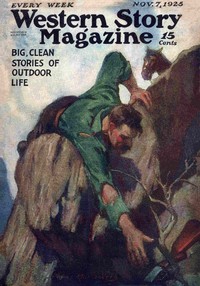
A knife in time
Language: en269 downloads on Project Gutenberg
Subjects
In: Short Stories·Adventure·American Literature
Public-domain ebook sourced from Project Gutenberg #76839.
Public-domain ebook
Language: en269 downloads on Project Gutenberg
Subjects
In: Short Stories·Adventure·American Literature
Public-domain ebook sourced from Project Gutenberg #76839.
The opening · free to read
Author of “The Mutt,” etc.
Good mule skinners were at a premium with the Q B freighting outfit, or Tom Morgan couldn’t have held his job ten minutes.
Tom, drifting in from nowhere, had fully demonstrated to McCarthy, the wagon boss, that he could handle a six-mule hitch. He seemed to have a way with mules; he also had a sheath knife in plain view.
“You’re hired,” said McCarthy. “I’m needin’ good men to handle that Red Cliff ore contract--but what’s the idea o’ that scalpin’ knife ye’re carrying there?”
The stranger had just grinned and shrugged, which made him look more insignificant than before--for he was undersize, underweight, and altogether unattractive.
“No idea,” he answered with a grunt back.
“Then scrap it, fer this is no fightin’ outfit,” advised McCarthy, “an’ a knife----”
“I always carry it,” said Morgan, with such evident finality in his words that McCarthy swallowed what he meant to say. After all, a driver was a driver, and Morgan had proved he could handle the ribbons. The matter of the knife could be postponed a while at that, for the Red Cliff contract would brook no delay, and three six-mule hitches, minus drivers, were eating their heads off in the corrals.
“Pick your team,” said McCarthy, as he showed the new driver the surplus animals.
“I’ll take any of ’em,” said Morgan indifferently; “mules is mules, boss!”
So Morgan came to work for the Q B, the biggest freighting outfit in the Colorado Hills. The Q B handled ore and timber contracts, conducted a number of stage and freight lines, and occasionally worked big grading jobs.
The knife that had attracted McCarthy’s attention when he hired Morgan, speedily put the new driver in bad with the wagon crews, who viewed him askance.
“A knife thrower, eh?” commented “Big Jim” Williams. “The little runt ain’t man enough to fight his battles like a white man. He must be a fine feller!”
“Him and his sword,” said another driver bitterly. “I’d not trust him far behind me back!”
The remarks were meant for Morgan to hear. He did. He reddened, protested, flared up--but the persecution did not cease. It grew worse as the days went on. Finally McCarthy, the wagon boss, grew desperate. The men were goading Morgan to violence, and the wagon boss trembled to think what would happen if Morgan sent his knife flashing home on some unlucky teamster. Murder--perhaps a lynching, afterward--and scandal, and “Old Man” Ashton, the wealthy owner, fuming in from Denver to find a new wagon boss.
“Still,” debated McCarthy, “if I can him there’ll be a six-mule team in the corrals idle, and the ol’ man will raise Ned ef he sees that!”
So, seeking a solution to the trouble, the wagon boss went to some of the skinners.
“Ye’ll have to stop baiting that runt Morgan,” ordered McCarthy, “or thar’ll be plenty o’ grief and some jobs open, too! Ye’re drivin’ him wild with yer talk an’ I can see him gettin’ to th’ breaking point. He ain’t harmed any of you that you should rag him like that?”
“No, he ain’t,” said Joe Myers, “but that’s the way them knife fighters do; they lay low until their chance comes, an’ then they tickle a man’s backbone with the blade when he’s least expectin’ it. This little rat we got will do that an’ the boys hate him fer it!”
McCarthy was still without a solution. He tried to pacify Morgan, but Morgan was bitter, too. He said he was being persecuted, and McCarthy couldn’t deny it. What McCarthy could and did do, moreover--was to warn the runt against violence in no uncertain terms.
“We’re a peaceable lot,” said McCarthy, “an’ the ol’ man, especially, is against trouble--says it brings bad repute on the outfit an’ sets towns against us. We gotta toe the straight and narrer here. Mebbe the boys are carryin’ their joke a bit too far against you--but never you mind. If you weren’t such a good driver----”
“I understand,” said the runt sourly.
Three days later Ashton, the owner, struck camp. McCarthy offered up a silent prayer. True, the corral was as empty as ever Ashton had seen it--not even a sick or lame animal in camp; still McCarthy trembled. The bad blood between Morgan, the knife carrier, and the rest of the men, was reaching fever pitch. Even the cook and his helper had started to discriminate against the runt. If there is one place where persecution actually hurts, it’s in the mess room of a freighting outfit.
Ashton had come to praise, not to find fault, much to the surprise of McCarthy.
“The Red Cliff people tell me we’re more than caught up,” said Ashton, “and that is good news to hear. Over on the western division we have landed a good dirt-hauling job that will keep every man and mule in the Mesa region on the job all fall, and further----”
Here the boss’ face beamed with pride.
“Monte Vista has just paid us a fine compliment, McCarthy. They’ve asked me to bring down five of our best hitches for a special freight-wagon race for their rodeo, next week--which is showing their faith in the Q B, and is a big ad for us, too. They’ve offered a prize of twenty-five dollars to the winning driver----”
“Too bad,” said McCarthy, “that we’re all tied up here, and you say the western division is goin’ to tackle a dirt-haulin’ contract----”
“Already started,” said the big boss crisply, “but that doesn’t cut any ice. You have the pick of the stock, McCarthy, in this camp--and the drivers, too--so you’ll pick five outfits----”
“But the Red Cliff job----” began McCarthy.
“We’re caught up now, and we can catch up again if we have to,” said Ashton. “You leave Evans in charge here and bring down five of the best hitches to Monte next Wednesday. It’ll take you a day to drive over, so leave here Monday morning--see that every wagon is tiptop, every mule in good shape, every driver----”
“Yes, sir!” said the wagon boss.
When news of the race, and of the boss’ unusual interest in it, spread through the camp, the drivers went wild with excitement. McCarthy found himself besieged by every one of the thirty-odd skinners on the division. He saw Ashton safely on his way, and then set to work to pick his rodeo team. The first driver he thought of--and there was nothing strange about it, seeing he had the best working hitch in camp--was “Runt” Morgan. But the wagon boss was too canny to write Morgan’s name down heading the list. In fact, he debated for a long time about writing Morgan’s name down at all. Finally he reached a decision.
“If I’m boss here, as I’m supposed to be, Morgan will go, ’spite all heck--an’ if I ain’t boss here, then the sooner I find it out the better fer us all!”
So the list of lucky drivers was posted:
What a howl went up--not only from the drivers who were not included, but from Neeson, Buckley, Dwyer, and Flynn, as well. The quartet objected to the fifth-man, Morgan. McCarthy was ready for the protest.
“You fellers,” he told the aggrieved foursome, “go with me an’ Morgan, or you don’t go a-tall. I’ll choose four others! That’s that. Are you going, or are you ain’t?”
“We’ll go,” they agreed.
As for the howl from the camp in general, the wagon boss ignored it completely. With the five men he had picked he set to work polishing up mules, harness, and wagons. The rest of the crew, under Evans, the assistant wagon boss, went sadly back to the task of hauling ore.
“That knife thrower will ruin ’em all,” said Jack Engels. “He’ll lose--an’ then he’ll knife the winner!”
The book keeps going
Reading is free forever. Sign up and watch scenes appear while you read.



Scenes Storieta drew for other classics.
New illustrated classics
Once or twice a month: the latest books to get full character casts, scene art, and free comic editions. No account needed.