
Public-domain ebook
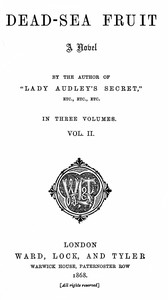
Dead-sea fruit, Vol. 2 (of 3)
Language: en281 downloads on Project Gutenberg
Subjects
In: Romance·Novels·British Literature
Public-domain ebook sourced from Project Gutenberg #76886.
Public-domain ebook
Language: en281 downloads on Project Gutenberg
Subjects
In: Romance·Novels·British Literature
Public-domain ebook sourced from Project Gutenberg #76886.
The opening · free to read
ALPHA AND OMEGA.
THERE were some days on which M. de Bergerac had no work for his secretary, and on such occasions the young man was free to dispose of himself as he pleased. These days Eustace Thorburn devoted partly to reading and meditation, partly to the delightful duty of ministering to Helen’s caprices--if, indeed, the word “caprice” can fairly be used in relation to any one so entirely amiable as Mademoiselle de Bergerac.
Happily for the ambitious hopes of the student, there were some days on which Helen asked no service from her willing slave, and when the slave could find no excuse for intruding on the privacy of his mistress as she read, or practised, or worked in her pretty drawing-room.
On these leisure days Eustace made good progress with his own studies. He cherished the ideas of the ancients as to the requirements of a poet, and thought that whatever was learnt by Virgil should be at least attempted by every student who would fain sacrifice at the shrine of the Muses. On dull days he was wont to spend the morning in his own room, working his hardest, but in fine weather he preferred a solitary ramble in the park, or on the banks of the river, with his own thoughts and a volume of classic prose or poetry for company.
He set out for a day’s ramble, one fine, sharp morning in December, at the same hour in which a gentleman arrived at Windsor by the morning express from town.
This gentleman left his luggage and his servant at the station, and set out to walk from Windsor to Greenlands, as Eustace had done about four months before. He was a man of middle size and of middle age, with a slender but muscular form, and a fair patrician face--a face with an aquiline nose and cold, bright-blue eyes that might have belonged to some Danish Viking, but a face in which the rugged grandeur of the old warrior-blood was tempered by the effeminacy of half a dozen generations of courtiers.
There was an inexpressible languor in the droop of the eyelids, an extreme hauteur in the carriage of the head. The mouth was perfect in its modelling, but the lips had the sensuous beauty of a Greek statue, too feminine in their soft harmonious line, and out of character with the rest of the face.
Such was Harold Jerningham, owner of Greenlands, in Berkshire, and of the bijou house in Park Lane. Fifty-two years of an existence that may be fairly termed exhaustive had left their impress upon him. There were traces of the crow’s-foot at the corners of the clear, full blue eyes, and sharp lines across the fair, proud brow. The waving auburn hair was sprinkled ever so lightly with the first snow-flakes of life’s winter, and the auburn moustache and beard owed something of their tint to the care of an assiduous valet; but Mr. Jerningham was the kind of man who looks his handsomest at fifty years of age; and there were few faces in foreign Court or ball-room that won more notice than his on those rare occasions on which the blasé English traveller condescended to appear in public.
The lively Celts amongst whom Mr. Jerningham made a languid endeavour to get rid of his existence regarded that gentleman as a striking example of the English “spleen,” and were prepared to hear at any moment that Sir Jerningham had made an unusually careful toilet that morning, and had then proceeded, with insular frigidity, to cut himself the throat à la manière Anglaise.
For the last seven or eight years the world had found no subject for scandal in the life of Harold Jerningham. It seemed as if those wild-oats which he had been sowing, more or less industriously, ever since he left the University must needs be at last exhausted, so quiet, and even studious, was the existence of the gentleman, who appeared now in London, anon in Vienna, to-day in Paris, next week in Norway; and who seemed always to support the burden of his being with the same heroic endurance, and to combine the cold creed of the Stoic with the agreeable practice of the Epicurean.
He had lived for himself alone, and had sinned for his own pleasure; and if his life within the last decade had been comparatively pure and harmless, it was because the bitter apples of the Dead Sea could tempt him no longer by their outward beauty. He was unutterably weary of the inner bitterness, and even the outward beauty had lost its charm. If he had ceased to be a sinner, it was that he was tired of sinning, rather than that he lamented his past offences.
A sudden fancy, engendered out of the very emptiness and weariness of his brain, had brought him to England, and the same fancy brought him to Greenlands. He wanted to see the old, abandoned place, which had echoed with his childish laughter in the days when he could still be amused; the woods that had been peopled by his dreams, in the days when he had not yet lost the power to dream. He wanted to see these things; and, more than these things, he wanted to see the one friend whose society was pleasant, whose friendship was in some wise precious to him.
“I have rather gloried in outraging the prejudices of my fellow-men,” he had said to himself sometimes, when anatomizing his own character, in that critical and meditative mood which was habitual to him; “but I believe I should scarcely like Theodore de Bergerac to think ill of me. It is not in me to play the hypocrite, and yet I fancy I have always contrived to keep the darker side of my nature hidden from him.”
The master of Greenlands happened to be in an unusually reflective mood, and his reflections of to-day were tinged with a certain despondency. This nineteenth of December was his birthday, the fifty-second anniversary of his first appearance upon the stage of life; and the reflections which the day brought with it were far from pleasant. For the first time in his existence Mr. Jerningham had this morning been struck by the notion that it was a dreary thing to eat a solitary breakfast on the anniversary of his birth, uncheered by the voice of kinsman or friend invoking blessings on his head. The luxurious little dining-room in Park Lane glowed in the ruddy fire-light, and glittered with all the chaste splendour of Mr. Jerningham’s art-treasures, as he trifled with his tea and toast, far too tired of all the delicacies of this earth to care for the bloated livers of Strasbourg geese or the savoury flesh of Bayonne pigs. The room in which he had breakfasted, and the table that had been spread for him, formed a picture which a painter of still-life might have dreamed of; but it had seemed very blank and dismal to Harold Jerningham on this particular occasion, when an accidental glance at the date of his Times reminded him that his fifty-second year had come to an end.
He resolved forthwith upon a visit to the only friend whose sincerity he believed in, and the only living creature from whose lips good wishes would seem other than a conventionality.
“I suppose it is because I am getting old that such gloomy fancies come into my head,” he said to himself, as he walked from the station to Greenlands. “It never struck me before that a childless man’s latter days must needs be blank and empty. Must it be so? Which is the lesser of the two evils--to be the father of an heir who languishes for his heritage, or to know that one’s lands and houses must pass to a stranger, when the door of the last narrow dwelling has been sealed upon its silent inhabitant? Who knows? Is not existence at best a choice of evils--and the negative misery is always the lesser. Better to suffer the dull sense of loneliness than the sharp agony of ingratitude. Better to be Timon than Lear.”
This is how the philosopher argued with himself on his fifty-third birthday, as he walked the lonely road between Windsor and Greenlands.
“Dear old Theodore!” he said to himself; “it is nine years since I have seen him--three or four since I have heard from him. God grant I may find him well--and happy!”
Mr. Jerningham had walked this road often in his boyhood and youth--very often in the days when he had been an Eton boy, and had boldly levanted from his tutor’s house, and crossed that purely imaginary boundary, the Thames, for an afternoon’s holiday at home, where the horses and dogs and servants seemed alike rejoiced by the presence of the young heir. He had walked the same road at many different periods of his existence, in every one of which his own pleasure had been the chief desire of his heart; not always to be achieved, at any cost, and rarely achieved with ultimate satisfaction to himself.
He had travelled this road in a barouche, one bright summer afternoon, with his handsome young wife by his side, and the bells of three parish-churches ringing their joy-peal in honour of his coming. He remembered what a folly and a mockery the joy-bells had seemed; and how very little nearer and dearer his wife’s beauty had been to him than the beauty of a picture seen and admired in one hour, to be forgotten in the next.
“I think I was once in love,” he said to himself, when he meditated on the mistakes and follies of his past life. “Yes, I believe that I was once in love--fondly, foolishly, deeply in love. But it came to an end--too soon, perhaps. In his youth a man has so many dreams, and the newest always seems the brightest. Well, they are all over--dreams and follies; the end has come at last, and it is rather dreary. I suppose I have no right to complain. I have lived my life. There are men who seem in the very heyday of existence at fifty years of age; but those are not men who have taken life as I have taken it. It is the old story of the candle burnt at both ends. The illumination is very grand, but the candle suffers.”
Mr. Jerningham entered the park by that small gate through which Eustace Thorburn had passed six months before. Greenlands was very beautiful, even in this bleak winter weather, but there was a desolation and wildness in its aspect eminently calculated to foster melancholy thoughts. It was by the express wish of the master that the park had been permitted to assume this aspect of wildness and decay. “My good man,” he had said to his bailiff, “I assure you all this trimness and primness, which you make so much fuss about, is to the last degree unnecessary, so far as I am concerned. I shall never again come here to live for any length of time; and when I do come, it pleases me best to come and go as a stranger. Let those poor old dawdling men in the grounds take matters as quietly as they like. You will pay them their wages on Saturday just the same as if they did wonders in the way of sweeping, and pruning, and clipping. I don’t want Greenlands to look like a Dutchman’s garden; and I am glad to think that there is some kind of use in the world for poor dawdling old men who only excel in the art of not doing things.”
The bailiff stared, but he obeyed his master, whose reputation for eccentricity had long been established at Greenlands.
In the chill wintry morning the desolation of the place was more than usually apparent, and Mr. Jerningham, being on this particular occasion inclined to contemplate every object on the darker side, was strongly impressed by the dreariness of the long avenue, where the bare, black branches of the elms swayed to and fro against the winter sky, and where the withered leaves drifted before him with every gust of biting winter wind.
The book keeps going
Reading is free forever. Sign up and watch scenes appear while you read.



Scenes Storieta drew for other classics.
New illustrated classics
Once or twice a month: the latest books to get full character casts, scene art, and free comic editions. No account needed.