Public-domain ebook
Over the straits
Language: en253 downloads on Project Gutenberg
Subjects
In: Short Stories·Adventure·American Literature
Public-domain ebook sourced from Project Gutenberg #76958.
Public-domain ebook
Language: en253 downloads on Project Gutenberg
Subjects
In: Short Stories·Adventure·American Literature
Public-domain ebook sourced from Project Gutenberg #76958.
The opening · free to read
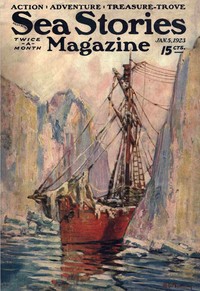
The stanch little cannery tender must get her load of valuable red salmon across before the fish spoiled, yet one of the worst storms that had ever swept the coast was raging up the straits. But business is business, even when lives are at stake, and that cargo of salmon represented a small fortune. A story with the tang of salt spray, and quiet, unself-conscious heroism of strong men.
The Star left the city float in Ketchikan at six o’clock in the evening, headed down Revillagigedo channel, bound for the Prince of Wales Island, thirty-four miles across the straits.
A bad-weather flag had been run up on the post office flag pole just before the eighty-horse-power, seventy-foot purse-seine boat had cast off her lines. There was, so the weather man said, a fifty-mile blow on the outside and the boats were all hurrying for port.
The city marshal, standing on the dock and watching the crew of seven discuss the matter, had given us some practical if blunt advice. It was no time for a consumptive-engined, barnacle-encrusted cannery tender, smelling to high heaven of fish odors, to be out in this kind of weather. Not even though the smell was strong enough to float a battleship. These were his words.
But it was imperative that the Star get across. In her hold were fifteen thousand Sockeyes, choicest of Alaskan red salmon, which had been lifted from the company traps two days ago. Those salmon had to be in the cannery in another ten hours or they would sour, and with Sockeyes at forty cents apiece, and not many to be had at any price, it was easy to see that there was a small fortune in the bottom of the boat.
Nineteen hundred and twenty was a poor fish season and the Star had ranged up and down the coast hundreds of miles, buying up everything offered.
“What do you think, fellows?” asked Bob, our skipper.
“Let’s go. Them fish has got to get out of that hold quick.” Ed Fraser emphasized his statement by taking a huge crescent-shaped segment out of a plug of Climax medium.
“Rather rough,” suggested Milt, the son of an Alaskan mining magnate who was out for his fall school money.
“Hell, I’d just as soon drown as be on the same boat with sour fish,” spoke up Al, the engineer.
Charlie, a short and pudgy bald-headed German grinned doubtfully and squinted toward a leaden sky. Charlie scarcely ever said anything. It took too long to talk.
“What do you say, Hal?”
I ran my fingers through a luxurious three-month beard--fully an inch or an inch and a half long--and tried to look judicial. Most of all I wanted a good long sleep, after having been battered around the wheelhouse through a week’s steady running in rough water. Then I wanted to have a night off in Ketchikan and limber up the rusty springs of joviality; we hadn’t been near a town for a month. Added to these reasons was the gale outside.
“Um,” I said, trying to convey an impartial answer.
“How’s the engine running, Al?” Bob queried.
“It’s all right, if the carburetor’ll only keep mixin’ like it has been th’ past few days.”
“Got plenty of oil and gas?”
“Yep. Both tanks full.”
“All right; let’s go, gang. What say?”
“Go she is.”
“Ed, you better lash down everything above deck--Charlie, giv’m a hand-- Hal, take first trick at the wheel---- Ahoy, on the dock, let go our lines will you?” and shortly, with a farewell screech, we were out in the channel.
A short distance down we passed a subchaser on our port side, coming in. As I took a spoke in the wheel I wished very fervently that I was on that boat, bound back to the dock. I clawed around with my free hand and drew up the tops of my boots, and reached over for my oil coat which hung on a hook. This sounds strange, I know; but there is a curious sensation of dampness that pervades one when running in a heavy sea, and be the pilot house ever so comfortable and warm, the sight of wave after wave piling up and smashing over the bow always makes one mechanically reach for boots and slicker. I was beginning to see things, though we were still in calm water, comparatively.
The run down the protected channel was quickly made. We passed a score of cannery tenders, all bound for town. Most of the men on them waved at us wildly and pointed the other way. I gave them all a debonair toot of the whistle, a bit of hypocrisy that soothed my feelings considerably.
The trap door connecting the pilot house with the galley opened and Bob entered, wiping his mouth on the back of his jacket.
“All right, Hal, I’ll take ’er while you get a bite to eat.”
“You better start collecting all the spare rope you can find, Dad,” I said to the cook as I squeezed into the diminutive galley. “Enough to lash yourself down with, too.”
Dad was a spry young adventurer of some seventy-two years. He had fought nearly all the Indian tribes in the Northwest, it seems, under General Miles, when a young buck of eighteen, and somehow, now at the other end of the cycle, the lure had returned to him and he had taken to the water. This was his first sea job.
“Gwine ter be rough, I reckon, heh? Well, let ’er come--_yerroo-oop_!” He let out a wild war whoop. Suddenly he made a grab for the coffeepot which rocked wildly on the stove. We were weaving in and out of the protecting islands between the straits and the channel.
“Yeroop, yourself,” I said, hastily gulping down my coffee and making for the door. “You’ll be using worse language than that in a mighty short space of time.”
“Heh! Git out of my kitchen!”
It was growing dark when I retook the wheel. Overhead the sky was a mottled gray-black. The wind was beginning to sing through our mast and rigging. On either side were the blurred outlines of the islands we were hugging. In another few minutes they would be behind us, and we would be out in the straits bucking a wind that hit us on our port quarter.
The waves were running higher now, and the boat began to pitch and roll. Ahead I could faintly make out the jagged, angry outlines of the sea. The crew had scattered. Al was down by his precious engines and Charlie had gone with him. Milt and Ed were sitting on the bench behind me. In the gloom I could make out the glow of their cigarettes, reflected in the windowpanes. Bob, beside me, was peering intently through the fogged glass.
Crash! Our bow shot up suddenly as if some giant hand down in the depths had punched it. For an instant we hung there, then the sea dropped away and we lunged down into a deep gray gulley and rolled dizzily on our side; a thick, twisting wall of water crashed down on our foredeck with a jarring, smashing impact and dashed up against the front of the pilot house.
I braced myself on a cleat, hung to the wheel, and twisted it sharply to get back into the wind. Bob slipped and seized the handrail. Behind me I heard the thud of two soft bodies hitting the floor, and from the galley came the crash and clatter of pans and dishes, mixed with the shrill treble curses of Dad.
We were out in the straits.
“What’s your course now, Hal?” asked Bob, face glued straight ahead.
I switched on the binnacle light and peered into our Standard Navy compass. It was a large thing, too large for our boat; for, like a rat terrier, we pitched and plunged, rocked and rolled, with short, choppy motions, while our instrument was fitted for a larger ship that rolled and swung with a slow wallow. I watched the card recover from a long, deliberate swing and estimated its arc.
“About north, a quarter east,” I answered. “But she’s swinging too slow to be accurate.”
“Ease her off to starboard a little more. We’re headin’ way below Morey Light now.”
The wind, hurling itself through Dixon’s Entrance, fifteen miles below, came sweeping, tearing up the straits. We were right in the teeth of it. The singing in our mast changed to a low, ominous moan, mounted higher, broke into a screech, then still higher, higher, into an insistent, piercing shriek.
The book keeps going
Reading is free forever. Sign up and watch scenes appear while you read.



Scenes Storieta drew for other classics.
New illustrated classics
Once or twice a month: the latest books to get full character casts, scene art, and free comic editions. No account needed.