Public-domain ebook
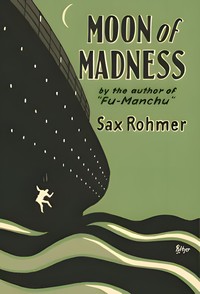
Moon of madness
by Sax Rohmer
Language: en406 downloads on Project Gutenberg
Subjects
In: Crime, Thrillers and Mystery·Adventure·Novels
Public-domain ebook sourced from Project Gutenberg #77001.
Public-domain ebook
by Sax Rohmer
Language: en406 downloads on Project Gutenberg
Subjects
In: Crime, Thrillers and Mystery·Adventure·Novels
Public-domain ebook sourced from Project Gutenberg #77001.
The opening · free to read
“I should love a long glass of iced German lager,” said Nanette. “Besides, I refuse to be deserted for a whole morning.”
Her Japanese parasol lay along the rail of the veranda, her round bare elbows rested upon it and she cuddled her obstinate little chin in upturned palms. I turned to her with a glance in which I had meant to convey rebuke. But the blue eyes danced with mischief and pouting lips smiled impudently, a smile half childish and half elfin.
“Young ladies of eighteen do not drink beer,” I answered paternally. “It isn’t done.”
Jack Kelton came out as I spoke, saw Nanette, and flushed like a girl. When I say “like a girl” I mean like a girl of Victorian literature. To-day one should say “like a boy.” I never saw Nanette blush during all the time I knew her. I saw her grow deathly pale; but this was later.
Jack was good to see in the Madeira sunlight; one of those lean-limbed young Oxonians who strip so well and who always look amazingly clean. Nanette turned a slim shoulder in his direction, and stared out pensively across the bay. I thought that she had the most perfect arms imaginable. So did Nanette.
“I want to go out with you two and Mr. Ensleigh to that ship,” she said, peering aside at the enraptured Jack. “Please ask Mumsy. She likes you--and I love beer.”
Jack and I exchanged glances. We both looked at Nanette; and then beyond to where the subject of controversy lay anchored--a big German out of Bremen, in from the River Plate.
“I have asked her,” Jack declared. “She’s adamant.”
“So have I,” came a cheery voice--and Ensleigh joined the party. “She says that Mr. Kirby is coming to lunch.”
“But I loathe Mr. Kirby!” cried Nanette, turning upon the speaker scornfully. “He’s one of the reasons why I want to go!”
“Is that so, Nan?”
From a long, awning-covered chair near the corner of the veranda Nanette’s mother arose--a gracefully pretty woman who solved the mystery of Nanette’s beauty for those who had met only her father.
“Mumsy! Have you been sitting there all the time?”
“All the time, dear--and I have heard every word! So don’t attempt to take one back!”
Ensleigh, the well-groomed, became all attention. He became attentive from the crown of his perfectly brushed hair to the soles of his spruce white shoes. He placed a chair for Nanette’s pretty mother. He focussed his Zeiss glasses to enable her to view the German liner. She thanked him with a smile that was very like Nanette’s.
“So you loathe poor Mr. Kirby?” she murmured, raising the glasses.
“Hate him poisonously!”
“And you love beer?”
“Simply worship it, Mum! Lager is my vice!”
Her mother lowered the glasses and fought with rising laughter, for Nanette was looking straight at her. Then:
“You little devil!” she said. “I don’t believe a word of it! But your father simply won’t hear of you going on board a German ship. Don’t ask me why. You know him as well as anybody.”
“I’ll ask him myself!” Nanette said, flashing blue eyes rebelliously. “Where is the funny old thing?”
“Nan, dear!”
“Oh, he’s a darling! But he is funny! He’s never forgotten that I was once a baby.”
“You are still a baby, Nan--a mere infant.”
Nanette threw back her shapely bobbed head and laughed scornfully. Wild canaries were love-making in the palm grove below the balcony, and, being poetically inclined, I suppose, I thought that Nanette’s soft rippling laughter was music sweet as theirs.
She turned swiftly. She had all her mother’s grace as well as the divine abandon of youth. With never another glance at any of us, she walked in through the open French window. Jack Kelton’s glance followed the slim, straight figure. Her mother looked up at Ensleigh.
“Have you a daughter?” she asked.
“No,” he replied. “I regret----”
“Don’t regret,” she interrupted; but her smile belied the Chinese solecism to come: “Pray that you may never have a daughter!”
“Really,” Jack began, in his youthful, diffident way, “I don’t think there’s any harm in----”
He was interrupted. Nanette returned, dragging by the hand a very bored, gray-haired gentleman who carried a copy of the Times that was ten days old. The gentleman, blinking through his glasses, was being forced out into the sunshine.
“Now, Pop,” said Nanette firmly, “is there really any reason why I shouldn’t go with Mr. Ensleigh, Mr. Decies, and Mr. Kelton to see that German liner?”
“Well, dear,” her father replied, in his laboured manner, “I am afraid you would be late for lunch, and----”
His glance sought his wife’s. I distinctly detected a negative shake of the head from Nanette’s mother.
“And,” he went on, “your mother thinks that this would be rude, as Mr. Kirby is expected.”
He smiled almost apologetically, patted Nanette on the head, and, Times in hand, returned to his shady lair in the smoke-room. Nanette stared reproachfully at her mother.
“Don’t be huffy about it, darling,” said the latter. “Really, you will only have time for a swim and a sun bath, if you are to make yourself presentable by one o’clock.”
Nanette looked swiftly from face to face. A number of people had now begun to come out from late breakfast. She checked speech, withered poor Jack with a final, comprehensive look of scorn, and walked quickly into the hotel. The last few steps that were visible, as she crossed the threshold, almost consisted of stamping her little feet.
He hurled himself in the direction of the steps and disappeared. A moment later he reappeared, running after the girl. We watched.
The book keeps going
Reading is free forever. Sign up and watch scenes appear while you read.



Scenes Storieta drew for other classics.
New illustrated classics
Once or twice a month: the latest books to get full character casts, scene art, and free comic editions. No account needed.