Public-domain ebook
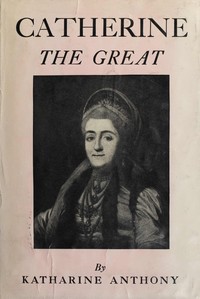
Catherine the Great
Language: en5,156 downloads on Project Gutenberg
Subjects
Public-domain ebook sourced from Project Gutenberg #77133.
Public-domain ebook
Language: en5,156 downloads on Project Gutenberg
Subjects
Public-domain ebook sourced from Project Gutenberg #77133.
The work is a biographical study of Catherine II, Empress of Russia, by Katharine Susan Anthony. It begins not with the Russian court but with a vivid portrait of early‑18th‑century Stettin, a grim Prussian frontier town scarred by the wars of Peter the Great and Frederick William I. The author sketches the town’s barren coastline, its militarised atmosphere, and the modest household of Prince Christian August of Zerbst‑Dornburg and his young wife, Johanna Elisabeth of Holstein‑Gottorp. Their marriage, the birth of their children, and the tangled dynastic connections that eventually link their son to the future Empress provide the backdrop for the later rise of Catherine. The opening therefore frames the Russian monarch’s story within the ordinary, often harsh, circumstances of her family’s German origins.
Written in a measured, scholarly prose typical of late‑19th‑century historical biographies, the narrative blends detailed social description with genealogical insight. Its tone is factual yet occasionally colored by contemporary judgments, offering a clear-eyed view of the period’s politics, religion, and domestic life. Readers who enjoy thorough, source‑driven histories of European royalty, especially those interested in the lesser‑known German roots of Catherine the Great, will find this book both informative and engaging.
The opening · free to read
Early in the eighteenth century, the north German town of Stettin had all the grim and rigid characteristics of a frontier post. It was a border town and had long been a center of warfare. The broad rich lands of Pomerania, bursting with fertility, had been repeatedly devastated by the march and countermarch of Russian and Prussian soldiers. High on a strip of barren coast, the gray stone walls of Stettin overlooked a bleak northern sea over which the boats of the great Russian Peter had come sailing to batter and destroy the town. But if Stettin had trembled before Peter, who was six and a half feet tall, it had trembled even more before Frederick William who was so short that his children called him Stumpy behind his back. Ceded finally to Stumpy by treaty in 1720, Stettin settled down to the dull routine of garrison life.
It was not a place in which the refinements of society flourished. A reviving commercial life brought no relief to the rigid military atmosphere which prevailed. Ships moved out of the harbor laden with guildsmen’s stuff from the interior of Germany. A chamber of commerce came into existence and a new class of prosperous trades-people appeared on the scene. But the hereditary aristocracy of Stettin was not prosperous. Stumpy’s officers were usually hard-up; they were under-paid and over-regimented. Their wives led a dull life in the Prussian garrison where society was neither gay nor gracious. Stettin had no style.
Its military and religious grandees understood each other perfectly. In those days the Prussian warrior was so pious and the Lutheran believer so militant that they faded imperceptibly into each other. Frederick William and Martin Luther worshiped an identical God.
“Ein’ feste Burg ist unser Gott, Ein’ gute Wehr und Waffen.”
The Lutheran idol was an armored hero whom a Prussian soldier could fear and respect. He dominated the spiritual climate of Stettin without a rival, except for the unimportant claims of a Calvinist deity worshiped by the French governesses and emigrant school-masters of the place. Luther had elected to throw in his lot with the German nobles and they in turn had embraced his religion with the puritanical devotion of recent converts. In military circles bigotry was the fashion.
Such was Stettin in 1727, after seven years of regimentation by the Prussian king. In that year there stood at Number One in the Grosse Domstrasse a substantial gray stone house owned by the president of the Handelskammer. A newly married pair took up their residence there in early winter. They were rather ill-matched as to age, the husband being thirty-seven and the wife fifteen. They were poor but pretentious, the kind of gilded paupers that heralded the decline of feudalism. Prince Christian August of Zerbst-Dornburg was the commander of a regiment of infantry quartered in Stettin. He was one of Frederick William’s generals, who had reached this degree of promotion after many years of campaigning in the Prussian service. The business of soldiering had given him little taste or opportunity for home and the family which he was to found in Stettin was not to see a great deal of him. His wife seemed to manage just as well without him.
The general was a cousin of the reigning Prince of Anhalt-Zerbst who was growing old without an heir. Christian August and his brother Johann Ludwig, of the Dornburg branch, both had an eye on the little principality and its petty emoluments which loomed large to them. The brothers were both pious and unmarried and were on excellent terms with each other. It was clearly the duty of one of them to perpetuate the family. But Johann Ludwig, the elder and the logical successor, lived in Jever with a spinster sister and did not wish to change his state. It therefore fell to Christian August to go forth and seek a wife. The history of his wooing is unfortunately not known to us. Whether he saw it as a duty or an opportunity we cannot say. At any rate, he was successful.
Promoted to the status of a married man and the father of a family, he was regarded by the elder but childless brother Ludwig as co-heir. When the reigning duke finally died the two brothers inherited Zerbst together and ruled the principality as co-regents. They were peace-loving men who lived in harmony with each other, except for occasional strife, stimulated, it is said, by sister Sophie Christine. At any rate the loyal pair did not live long to rule in Zerbst. After three years Johann Ludwig died and five months later Christian August followed him. Two months afterward Sophie Christine was buried beside her brothers. They died as they had lived in the narrow bonds of mediæval clannishness. It was an unaggressive and obscure strain. Not all the efforts of German historical research have availed to discover any brilliance or heroism in the race.
In the meantime, the marriage of Christian August had yielded, after some disappointments, the desired heir. This son lived to become the last reigning Prince of Zerbst and followed in the undistinguished steps of his ancestors. Only because he turned out to be the brother of Catherine of Russia did he become more famous than the rest. Catherine’s memoirs refer with vague sarcasm to the “peculiar exploits” of his career and Schlözer speaks of him as a gentleman of “unstable temperament.” Although married in his youth for a few brief years, he left no heirs behind. With his death in 1793 the house of Anhalt-Zerbst came to an end. The heroic attempt of his father to perpetuate the family had only resulted in prolonging it by one generation. In the personality of this sterile princeling, however, the general commonplaceness of the Zerbst family was touched with eccentricity. This proceeded from his mother without doubt, who was a clever, energetic and hysterical woman.
Johanna Elisabeth of Holstein-Gottorp was not yet sixteen when she married her Prussian general, yet she ruled the family from the first. The portraits of this lady and her spouse which hang in the Potsdam palace reveal, even through the conventional art of Pesne, marked differences of temperament. The general has the dreamy eye that betrays the extreme idealist, while his wife looks out with the peculiar verve and readiness of a real woman of action. “Apparently they got on excellently with each other,” says their daughter in her memoirs, “in spite of the great difference in age and although their inclinations were so different. My father, for instance, was very saving; my mother, on the other hand, was quite extravagant and open-handed. My mother loved pleasure and fashionable society exceedingly; my father valued retirement. She was cheerful and wilful; he serious and austere in his morality.... My mother passed as more clever and intellectual than my father; but he was a man of earnest and sterling character and well-stocked knowledge. He liked to read, as did my mother, but all that she knew was very superficial. Her spirit and beauty had won for her a great reputation; moreover, she understood the ways of the fashionable world better than my father.”
Christian August had married his wife at the court of the Duchess of Brunswick, her godmother, who had brought her up as if she were her own child. Johanna Elisabeth was the daughter of the Bishop of Lübeck who had twelve children. Having lost Schleswig to the Danes and finding himself therefore in reduced circumstances, he willingly gave away one of his children to the kind godmother who offered to bring her up. The court of Brunswick, which thus became the home of the keen little Princess of Holstein-Gottorp, was one of the most showy in Germany. It was far more elegant than the court of the parsimonious King of Prussia. Here Johanna Elisabeth seems to have grown up partly as a much-spoiled favorite and partly as a poor relation. She brought nothing to her marriage but the bridal chest given her by her godmother. The newly married pair started housekeeping in the Domstrasse house under the most frugal circumstances. Garrison life must have seemed sordid to her after the refinements of Brunswick. One hope at least she had. If she produced an heir she might one day become the reigning Princess of Anhalt-Zerbst instead of being merely the wife of a Prussian general in a garrison town.
In the meantime she made the most of being a Holstein-Gottorp, a clan whose members had married royalty and were related to thrones. Johanna Elisabeth’s brother had been affianced to the youngest daughter of Peter the Great and, but for his death by the smallpox, would have become the great Czar’s son-in-law. Johanna Elisabeth’s first cousin, who was a nephew of Charles XII of Sweden, had married another daughter of Peter the Great and had left a son who had claims upon the thrones of both Sweden and Russia.
These alliances with Holstein-Gottorps were supposed to bring to Russia a strip of sea-coast, and sea-coast was Peter’s passion. No doubt he regretted that he had only two daughters to sell for a bit of strand. But he never realized on these schemes and the young ladies themselves fared badly. Elisabeth, who lost her bridegroom through smallpox, remained unmarried all her life, while Anne, who went to live in Kiel, was scandalously neglected by her husband. “I have to tell you,” she wrote her sister, “that the Duke and Mavrushka [her best friend] are quite loose. He stays not a single day at home, rides out with her in the same carriage, or goes visiting or to the theatre.” Poor jealous Anne was obliged to stay at home because she expected a child. Three months after its birth, she gave up her spiritless existence and died of “tuberculosis and homesickness.” Her son, who was called Karl Peter Ulrich, was handed over to nurses and developed into a sickly, unpromising boy.
But no tragedy could dim the luster of the Russian connection in the eyes of the romantic Johanna Elisabeth of Holstein-Gottorp. She felt that her husband should announce their marriage to the Russian court. The Prince of Zerbst therefore wrote: “Imperial Highness: May you, in your world renowned magnanimity, not take it ill that I venture to inform you with the most humble respect that on the eighth of November, after previous betrothal, I married the youngest sister of the Bishop of Lübeck recently deceased in Petersburg, the Princess Johanna Elisabeth of Holstein-Gottorp, in the country seat of Weheln in Brunswick-Wolfenbüttel.” This humble composition bears all the marks of being the Prince’s own.
Soon after her marriage, the Princess made a round of visits accompanied by her husband in order to present the general to his numerous Holstein relatives. “In this week,” says a family letter, “comes the Princess Elisabeth and her man.” The Holsteiners were not especially impressed by the Prince of Zerbst and took him rather casually from the first. As time went on the Princess managed to escape from the dulness of her Stettin home as much and as often as possible by making long visits to Holstein relatives in Hamburg and Brunswick. After the first formalities of introduction were over she left her husband at home. But she was always accompanied by her daughter on these restless flights from the tedium of small town life.
The book keeps going
Reading is free forever. Sign up and watch scenes appear while you read.



Scenes Storieta drew for other classics.
New illustrated classics
Once or twice a month: the latest books to get full character casts, scene art, and free comic editions. No account needed.