
Public-domain ebook
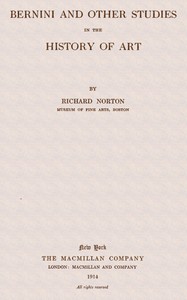
Bernini and other studies in the history of art
English199 downloads on Project GutenbergDownload EPUB
Public-domain ebook sourced from Project Gutenberg #77325.
Public-domain ebook
English199 downloads on Project GutenbergDownload EPUB
Public-domain ebook sourced from Project Gutenberg #77325.
The opening · free to read
During the last hundred years there has come a great change in the feeling of most people towards the art of the different epochs of the Renaissance. Whereas our grandfathers and our great-grandfathers held Carracci and Guido and others of the same time in high esteem, we are now taught that these later men are of little value or interest in comparison with the artists of the fifteenth century, and even the most halting and stuttering “Primitive” is held of more worth than the more able masters of the seventeenth century. This change is natural enough, but betokens a lack of true understanding of the purpose and powers of the fine arts.
The altered mental attitude in religious matters which renders most people incapable of feeling the appeal of the mystical fervour of the seventeenth century explains in a measure why the earlier work is preferred; and added to this is the effect of the development of archæological training which has given rise to an interest in the mere search for origins—a search that has done infinite harm in blinding the eyes of students to the fact that, for the world at large, it is far more important to see whither life is carrying us than from what slow, groping, and inexplicable protoplasm and haphazard chance it sprung. The teachers of our universities go on in their dull round, like Dervishes, repeating that the Parthenon was the most perfect expression of Greek art, and there are those who cannot see the beauty of the silver vases from Boscoreale because they choose to call them Roman. Without doubt there are many sound reasons for the purely archæological study of classic art, and recently a small but perceptive band of scholars has raised Roman art from the ignorant neglect into which it had fallen and given it the proper position due to any such able expression of great ideas; this justifies the hope that the worth of the later Italian schools will become once more manifest, not again to be forgotten.
The idea that the art of any civilized people rises by a steady and constantly more perfect progression to one glorious peak of perfection and then falls by rapid and recurring blunders to a waste of meaningless effort is, I believe, due to the too frequent mistake of considering the monuments of the arts as separate entities and as self-ordained rather than as indices of vital currents of thought and life. The English dictionary is not synonymous with English literature. Nor does the will-o’-the-wisp phrase “art for art’s sake” mean that each work of art is a unique and inexplicable phenomenon. Its true meaning is that the artist, be he poet or sculptor or musician—no matter what form his art takes—finds the only adequate expression of himself in the forms and under the governance of the laws of the art which he follows. By so far as he follows these laws is his work intelligible to other men; by so far as he finds new combinations for the forms and new adaptations of the laws to meet the new circumstances of ever changing life is he original and great. When Shakespeare or Keats wrote a sonnet the verses were not produced by them merely for the sake of using a certain complicated formula of fourteen lines to make certain statements, nor when Pheidias carved the Athena or Praxiteles the Hermes was it merely with the idea of reproducing the human form in stone.
Had such been the motive of these poets and sculptors their results would have had small value; but each one of them had something to say that he could best express in the form chosen, some feeling towards life he wished to share with others, and in this outgiving he steadily sought to perfect the form that held his idea. The care he lavished on the verse and marble so that the expression of this thought might be the completest possible and truest to his idea, the delight in making his chosen art conform to the laws of language or of gravity, while at the same time it held the thought as a nest holds an egg, that was art for art’s sake, and a very different matter from mere technical dexterity.
All the arts are alike means of conveying ideas from brain to brain and from the past and forgotten generations to those not yet thought of. No one school ever told the whole truth, but only that part of it maybe which local circumstances enable it to see. Each of them, from the earliest which faded away before recorded time, to the latest which looks eagerly forward to to-morrow with the hope of new accomplishment and absorption in new truths discovered, is but as the searchlight casting its sharp-defined ray through the immeasurable dark. The flames of Priam’s pyre crimsoning the night which hung over the “topless towers” were not marked on the Argive hills, but the message was flashed hither and yon over the star-tracked sea, raising now hopes now fears, till at Mycenæ no answering flame was lit, but instead the young Phœnix was born.
And as no one school can answer all the questions, so no one single pundit can tell all the truth even of his own school. In each honest, unshamming workman there is something of truth, something others long ago thrilled to or that others yet to come may also feel, something that he knows with a clarity and conviction not to be equalled by any other. In a sense he does express his time, but neither the artist nor any man else is merely the product of his time, and the truly great ones go ahead of it, following the gleam of the divine spark which each man is born with to shelter in his heart as best he may. If it keep alight, by God’s grace, his life becomes in truth art for art’s sake, and he is one of the successful runners in the torch race across the great divide of life that separates the hopeless past from the hopeful future.
Of such there are many to spur on the weary and to guide the strayed back to the beacon path. In every man who has appealed to the masses, whose ears have rung and whose heart has swelled with the loud cries of “well done,” there is, be sure, something of the ultimate divine truth—some no mockery—some sincerity which heated in the fires of his soul and beaten with long pain and trouble on the anvil of his heart, shall be, if we can grasp it, a treasure undiminishing so long as we have breath to live.
Such an one was Giovanni Lorenzo Bernini, whose life was almost coterminous with the seventeenth century (1598–1680). Honoured during life by three courts, and at that time court patronage was a very different thing to what it is now, he has of late been treated with a disregard which is unjustified, and has been blamed for faults which were not his. These false judgments can be traced back to the envy of some of his contemporaries, who on the one hand accused him of ignorance of the mechanics of his art and of stupidity of design, and on the other, oftentimes, did their best to copy him. But it gives us pause when we consider that notwithstanding the forces of jealousy backed by powerful influence that were brought to bear on him he remained in the eyes of artistic Italy during his sixty and more working years the “Michael Angelo of the seicento.” And this estimate of him, if we lay aside preconceived notions and formulas handed down to us by our parents, and look at his work with our own eyes and study it in the light of our own knowledge, will turn out to be the right one. Only the rash and heedless dare say of one who acquired such admiration in his own day that his work was poor and unworthy. And yet this is what is said. His style is said to be extravagant and artificial and his violent material effects are said to show that he was unable to express thought. Even the group of Apollo and Daphne is held to exhibit his ignorance of the proper domain of sculpture. It seems to me more likely that the judgment of the artists and critics of the seventeenth century is apt to be the correct one.
What would be artificial in an artist to-day was not so in Bernini, but was, if we could see it and free our hearts from the bonds of tradition, the most honest and simplest expression of a genius who had a new message for those who would take the trouble to understand. Frequently his work is criticised for not conforming to the “severe laws” of good sculpture and in this criticism lies the common fallacy of letting personal taste usurp the place of critical judgment. There are, of course, laws of gravity, and of stress or strain to which a sculptor must conform because they are in the nature of the material he uses, just as there are optical laws which the painter should know; but there are no laws to fix what the artist may or may not represent or the forms which he should give to his representations. Personal taste is very well in its place, but it is not criticism; and severe laws are good training for our powers, but dependence on them leads to stagnation and not to discovery. Because the stage-coach follows the old gray road is it artificial of the aeroplane to soar through the trackless ether? Probably most critics, when they speak of severe laws as fixed and irrevocable, have in mind those followed by the Greeks of the fifth century B.C.—surely of no later time, for what of the violent material effects of Pergamon? But suppose portraits of the present-day business kings were carved according to the one-time valid classic laws? Strangely unlike the subject would such portraits be!
There is nothing ultimately right in severity nor ultimately wrong in violence. The money-changers were not led from the temple by a ribbon round their necks. The pioneer and path breaker must be violent. This was Bernini’s work and purpose, and it is no more reasonable to blame him for the insincerity and stupidity of his followers than to blame Columbus for lynch law. As of many another, Bernini’s fame has been dimmed by the follies and shams of his would-be imitators. Many tried to imitate and surpass him, but it was not to be done. He had the quality of genius which is more than the power of taking infinite pains. That his pupils had, but they merely exaggerated the form of the outer husk of his work till it lost all semblance of truth and became nothing but untruth and error. In him was the divine spark, the light of which showed new worlds for sculpture to work in and the heat of which moulded his material into the eternal forms of beauty.
The study of Bernini is established on very strong foundations, and the misinterpretation of his aims is inexcusable; for we have sure records of every kind concerning him. From his surprising youth to his busy old age we can trace his progress and the development of his powers. Of all his numerous works scarcely one is lost, and such as have disappeared are of no importance whatever in comparison with what remains. The full account of his life was written by two contemporaries, one of them his son, and this is amplified by many letters and other papers—accounts of payments for his work, stories of his doings, plans for work sometimes never undertaken and other times finally accomplished by himself or his pupils, that have been turned up into the light after long sleep in Italian archives.[1] It is all before us, and each chapter of his life can be recalled from the Elysian fields. We grow eager with the same hopes, we feel despondent at the same broken faith and pledges, we grow interested in the same companionships, we rest after the same magnificent accomplishments, and to the end we are keen in search of new worlds to open up.
The book keeps going
Reading is free forever. Sign up and watch scenes appear while you read.



Scenes Storieta drew for other classics.
New illustrated classics
Once or twice a month: the latest books to get full character casts, scene art, and free comic editions. No account needed.