Public-domain ebook
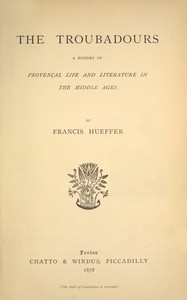
The troubadours: A history of Provençal life and literature in the middle ages
Language: en2,047 downloads on Project Gutenberg
Subjects
Public-domain ebook sourced from Project Gutenberg #77644.
Public-domain ebook
Language: en2,047 downloads on Project Gutenberg
Subjects
Public-domain ebook sourced from Project Gutenberg #77644.
Francis Hueffer’s work is a scholarly survey of Provençal culture, aimed at presenting the first comprehensive English account of the troubadours and their milieu. The author begins by positioning the book against a backdrop of scattered articles and earlier, incomplete attempts, explaining that it draws on original troubadour poetry while acknowledging the contributions of French and German philologists. The opening pages lay out a clear purpose: to offer a readable overview for learners rather than an exhaustive scientific treatise, yet still providing a technical section on metre and interlinear translations for the more adventurous reader. The volume is organized into three parts, general background, biographical sketches, and technical analysis, covering language development, poetic forms, and the social roles of troubadours, joglars, and lady poets, with extensive chapter headings that map the terrain of medieval Provençal literature.
The tone is that of a late‑Victorian scholar, combining earnest didacticism with a modest, self‑aware voice that admits the limits of current English scholarship. Hueffer writes in a formal, yet accessible prose style, interspersing detailed historical commentary with occasional warnings to amateur philologists about the pitfalls of guessing Provençal meanings. Readers who enjoy meticulous literary history, especially those interested in medieval poetry, Romance linguistics, or the cultural links between England and southern France, will find this book rewarding. Its blend of narrative overview, biographical detail, and technical insight makes it suitable for students of medieval studies, lovers of poetry, and anyone seeking a solid grounding in the world of the troubadours without the burden of dense footnotes.
Articles by the present writer on the subject of Provençal life and literature have appeared off and on in the ‘New Quarterly Magazine,’ the ‘Gentleman’s Magazine,’ ‘Macmillan’s Magazine,’ and the late ‘North British Review.’ But this book is not a reprint of essays, although some of the materials formerly used have been re-embodied in it. It claims on the contrary to be the first continuous and at all adequate account in the English language of the literary epoch which forms its subject. For I cannot concede that name to a book on ‘The Troubadours, their Loves and Lyrics,’ published some years ago; for reasons which it is not my province here to state. And yet, excepting only the English version of the unsatisfactory book which the Abbé Millot compiled from St. Palaye’s excellent materials, by that indefatigable translator and abridger in the last century, Mrs. …
Keep reading free · chapter 1 needs no account