Public-domain ebook
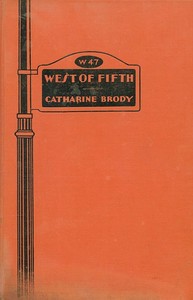
West of Fifth
Language: en397 downloads on Project Gutenberg
Subjects
Public-domain ebook sourced from Project Gutenberg #77749.
Public-domain ebook
Language: en397 downloads on Project Gutenberg
Subjects
Public-domain ebook sourced from Project Gutenberg #77749.
The opening · free to read
Even during the latter hour of lunch time the editorial room of the Dress Daily could never be quiet. The feel of the presses stayed like audible dust in the air and now and then heavy trucks, passing by, seemed to jar the building. But the desks of the Fashion Department were void of life; a solitary man pecked at a machine in the Woolens Department. All the stenographers except one were gossiping in the dressing room.
When the entrance door opened a draught made this one girl at the typewriter scowl and clutch her papers, and a piece of paper in the Fashion Department blew up and fell listlessly to the floor. Such vagrant sheets strewed the ground in poor imitation of autumn leaves.
The girl looked up. Because of a way of carrying her head, all her features, which were regular, seemed to tilt upward, even her small, cruelly firm mouth. She saw a man from the Advertising Department followed by a young woman in a sealskin coat. At once she made her shoulders uncompromising and began to click her typewriter. Her desk was first from the entrance; people insisted on stopping at it for directions.
The story about an exhibition of blouses--which, as a great favor, Mr. Milford had permitted her to visit during lunch time and write about herself--sprang into being willy-nilly. All the same, she had noticed the other girl.
"We might--wait--over there, Joe," this girl said, with a pause before and after the word "wait" that emphasized it slightly.
They sat down in the Fashion Department, facing the girl at the typewriter, and she heard a low murmur of conversation. She finished a page, busily rolled it from the machine and put it on the desk. She inserted another sheet and sat gazing at it, conscious in spite of herself of the voices, especially the low, deliberate, penetrating voice of the girl. Somebody looking for a job, she thought. All sorts of girls came to Mr. Milford for jobs. Then she shrugged, and wondered why she was bothering her head about this particular girl. "Anyhow, it can't be my job she's after. Nobody would want this lousy job."
Her fingers were still moving almost subconsciously on the keys when she heard the voice of the advertising man behind her, a bit deferential, for she had frightened him with coldness once before. "Can you tell me when Mr. Milford will be in?"
She glanced at him. "He never tells me," she said, with a slight smile to remove the pertness. The man smiled back, a little humbly, and she relented. "He usually comes in about this time."
The man seemed to take this as an entering wedge. He beckoned to the girl in the sealskin coat. She walked over, her enormous eyes, deep brown pools, so wide open, so steadily focused, that they appeared to cling to whatever was in the range of vision, fastening themselves ahead of her on the other girl's face. Her head was bent forward, as if with the weight of her eyes, and so were her shoulders.
"Miss Vestry," said the advertising man, "I want you to meet Miss Kline. Miss Vestry is Mr. Milford's secretary--and assistant," he concluded with unction.
Miss Kline made a move to draw her right hand out of its sealskin cuff. Miss Vestry only smiled briefly.
"Now I have to go downstairs for a while, Grace," said the advertising man. "Miss Vestry will take care of you."
The large eyes moved slowly toward him and clung to him.
"But--you'll be back, Joe? You know--I want you--to introduce me."
There was a curious halt between groups of her words which Anita Vestry had noticed.
"Sure, I'll be back."
The two girls faced each other only for a second. Miss Vestry turned to her machine. She could feel the eyes of this Miss Kline lingering on the back of her head, but she could not think of anything to say to her, even if she had wished to speak. She felt impatient, as if she wanted to shake her off. "Why doesn't she go and sit down?" Miss Kline took a few steps and stood by the side of the desk. The first page of the story lay face up. Her eyes immediately attached themselves to it. She picked up the page casually. Holding it at arm's length, with her head cocked to one side, she looked it over. When she was through she put the page down without comment, glanced at the continuation in the typewriter, then sauntered over to a chair by Mr. Milford's desk.
The breath that Miss Vestry had been holding in was expelled through her wide nostrils, distended to reject it. She seemed to rise several inches in her chair as, grabbing the sheet of paper on her desk, she turned it face down with a distinct, hard, angry thud as her hand fiercely struck the wood. She did not look at Miss Kline but she had a glimpse of eyes startled and wider than ever.
Miss Kline touched her on the arm. "I--didn't mean to be rude. I didn't think you'd mind. I'm--awfully sorry," she said hurriedly.
"Oh, very well," said Miss Vestry with a curl of her lip. At this moment Mr. Milford opened the door, followed by the advertising man. "There's Mr. Milford now," she said coldly, and went back to her work.
She heard the introductions, Mr. Milford's admiring voice. They had grouped themselves near her and, though she would not look up and pounded hard, taking pleasure in making as much noise as she could, she had glimpses of Mr. Milford's soggy cheeks, painfully shaven in that effort at spruce youthfulness which she so disliked about him; of the girl's tenacious eyes that, while she smiled at Mr. Milford, now and then cast a baffled glance in her direction. Finally they seated themselves around Mr. Milford's desk, and his shaking hands of an old man, which he tried to keep so firm and gallant, began to fuss with little disquiet motions among his papers. That was always his preliminary to dictation. Miss Vestry heard him say:
"I'll send you to Harry. He's an old friend of mine--great chap. He'll find work for a bright girl like you."
He called, in the tone of special dignity which he kept for her, "Miss Vestry, bring your book, please."
She picked up the notebook, opened it with a swift, professional gesture, and set her face in stony abstraction, as if she were on another planet, with words reaching her through the air from no one and nothing in particular--her special defense against that flow of easy inanities which fell from the lips of people in dictation and which she had to collect like so many choice pearls. The other girl's head was bent, her eyes intent on her lap. "That'll be all, Miss Vestry."
She put the book on her desk and walked by into the dressing room, to get away from them--from the girl's low voice, from the two men who now listened to her with attention and looked at her with a soothed softening of their faces and let their minds be filled for the while with her needs. The girls who came to Mr. Milford Anita Vestry disliked because of the nuisance of taking down and writing the letters of introduction, and then forgot. But this girl filled her with such an intense nervous dissatisfaction--was it envy?--that she sat and clenched her hands to control the loosened odds and ends of nerves that whirled within her. It was a state of discontent not uncommon with her, but this Miss Kline--not altogether by the inadvertent rudeness--had managed to make her lot seem so poor, so mean, so inferior, that it became a state beyond what she could bear.
The Dress Daily building stood a few steps from Fifth Avenue. It was a part of Fifth Avenue, however--the section of the clothing workers--which Grace Kline always wished to eliminate from her consciousness as soon as possible. These gloomy structures that shed almost a sour odor, these hurrying foreign feet brought thoughts that were not like the thoughts one had after crossing Madison Square and pausing before Brentano's. There was not in this air the sudden, resilient thoughtlessness, the expectant quiver, that made the heart beat faster, the walk more swift and alert after Thirty-fourth Street. Once, after some discussion about the atmosphere of Paris, it had occurred to her to wonder at the power which the light feet, the insubstantial minds of men and women had to impress themselves far, far beneath heavy pavements, high, high above in the intangible ether, to shape slabs of stone and sections of air so that, years after, centuries after, other people would thrill like hounds to the sense of old, permeating moods. At some times she caught with a stab of elation the feeling of being one of the persons who, alive to-day, were adding their slight memories to the store of memory which New York had from the past and would have to draw on in the future. This was such a day. It was cold, but the sky was a boundless blue, the wind raced with a stirring energy, and the air had that liquefied-diamond quality of the New York autumn.
As she waited for a bus, she turned her mind, by an effort of will which was becoming necessary to her in the state of harassment in which she lived, away from the wide-open, limitless blue. It frightened her, one could so easily get lost there. She turned her mind away and into herself and shut it within tightly. It was equivalent to closing the windows in a room. All the draperies that had been flying about, all her ideas, came to rest in smooth order. In the first place, it was two-thirty, so Harry Strauss, to whom she had the letter of introduction, would probably be in. In the second place, did she look well to see him? She opened her purse and consulted its mirror--not surreptitiously, for a beautiful girl need feel no shame to gaze in a glass. Her dark hair, under the black satin hat, perfectly softened the fine, regular curve of her brows. Her eyes, by their purely physical depth and width, possessed an irresistible suction, like the dark waters of deep wells. Her cheeks were long and too thin. They became hollow under the least strain. But the even, warm hue of her skin, to which the wind never brought color or the sun heat, which lay lightly over her face like a pearly, glowing cloud, concealed the thinness. There was a composed power in her face, in the lips which were softly put together. She was quite aware of the eyes of every man who turned without hope but in spite of himself to glance at her.
By one of those extravagant economies of people who have to make a prosperous appearance on small means, she had been forced to wear a fur coat a little early in the season. This fact bothered her for she was as scrupulous in the choice of her clothes as if they had been irreplaceable parts of her body. But her spring coat was too shabby and childish to go job hunting in and she could not afford a special autumn wrap. The hint of pale orange between the black of the sealskin and the black of the hat pleased her. That, at least, was perfect.
Harry Strauss's office was at Forty-fourth Street and Fifth Avenue. She coveted a job and could not help her heart's beating a little faster. But Grace Kline never felt really nervous about meeting new people, even prospective employers. Her face, she knew, served her as sufficient passport, assured her a certain welcome anywhere. As she watched the streets sidle by, she thought that she had not done badly for one day of job hunting. The acquaintances she had collected with this end in view had been kind to her. She already had one offer in case she found nothing better. If she really got work with Harry Strauss she would earn a good salary. How much? She ought to think of how much to ask. To keep her mind still shut--away from that boundless contingency which was ever before her like a landscape, luring her to wander in it without plan and only for the warm joy of the moment--she began hastily to design the clothes she would get, her winter's wardrobe, if Harry Strauss really hired her. The shop windows, passing by on both sides of the street, helped her. She scanned them with concentration and they assured her that these things could be sufficient, that these things could fill a mind. They called to her eagerly to trust them and they would tell her what to do and where to buy.
The book keeps going
Reading is free forever. Sign up and watch scenes appear while you read.



Scenes Storieta drew for other classics.
New illustrated classics
Once or twice a month: the latest books to get full character casts, scene art, and free comic editions. No account needed.