Public-domain ebook
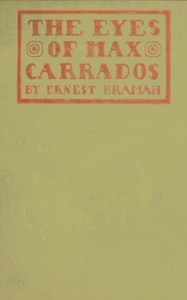
The eyes of Max Carrados
Language: en616 downloads on Project Gutenberg
Subjects
Public-domain ebook sourced from Project Gutenberg #77788.
Public-domain ebook
Language: en616 downloads on Project Gutenberg
Subjects
Public-domain ebook sourced from Project Gutenberg #77788.
The opening · free to read
Every generation not unnaturally “fancies itself,” and whatever is happening is therefore somewhat more wonderful than anything that has ever happened before. But for this present age there is, of course, a special reason why the exploits of the sightless obtain prominence, and why every inch won in the narrowing of the gulf between the seeing and the blind is hailed almost with the satisfaction of a martial victory. That the general condition of the blind is being raised, that they are, in the mass, more capable and infinitely less dependent than at any period of the past, is undeniable, and these things are plainly to the good; but when we think that blind men individually do more surprising feats and carry themselves more confidently in their blindness than has ever been done before, we deceive ourselves, in the superficiality that is common to the times. The higher capacity under blindness is a form of genius and, like other kinds of genius, it is not the prerogative of any century or of any system. Judged by this standard, Max Carrados is by no means a super-blind-man, and although for convenience the qualities of more than one blind prototype may have been collected within a single frame, on the other hand literary licence must be judged to have its limits, and many of the realities of fact have been deemed too improbable to be transferred to fiction. Carrados’s opening exploit, that of accurately deciding an antique coin to be a forgery, by the sense of touch, is far from being unprecedented.
The curious and the incredulous may be referred to a little book, first published in 1820. This is entitled Biography of the Blind, or the Lives of such as have distinguished themselves as Poets, Philosophers, Artists, &c., and it is by JAMES WILSON, “Who has been Blind from his Infancy.” From the authorities given (they are stated in every case), it is obvious that these lives and anecdotes are available elsewhere, but probably in no other single volume is so much that is informing and entertaining on this one subject brought together.
The coin incident finds its warrant in the biography of NICHOLAS SAUNDERSON, LL.D., F.R.S., who was born in Yorkshire in the year 1682. When about twelve months old he lost not only his sight but the eyes themselves from an attack of small-pox. In 1707 he proceeded to Cambridge, where he appears to have made some stir; at all events he was given his M.A. in 1711 by a special process and immediately afterwards elected Lucasian Professor of Mathematics. Of his lighter qualities Wilson says: “He could with great nicety and exactness perceive the smallest degree of roughness, or defect of polish, on a surface; thus, in a set of Roman medals he distinguished the genuine from the false, though they had been counterfeited with such exactness as to deceive a connoisseur who had judged from the eye. By the sense of touch also he distinguished the least variation; and he has been seen in a garden, when observations were making on the sun, to take notice of every cloud that interrupted the observation, almost as justly as others could see it. He could also tell when anything was held near his face, or when he passed by a tree at no great distance merely from the different impulse of the air on his face. His ear was also equally exact; he could readily distinguish the fourth part of a note by the quickness of this sense; and could judge of the size of a room, and of his distance from the wall. And if he ever walked over a pavement in courts or piazzas which reflected sound, and was afterwards conducted thither again, he could tell in what part of the walk he had stood, merely by the note it sounded.”
Another victim to small-pox during infancy was DR HENRY MOYES, a native of Fifeshire, born during the middle of the eighteenth century. “He was the first blind man who had proposed to lecture on chemistry, and as a lecturer he acquired great reputation; his address was easy and pleasing, his language correct, and he performed his experiments in a manner which always gave great pleasure to his auditors.... Being of a restless disposition, and fond of traveling, he, in 1785, visited America.... The following paragraph respecting him appeared in one of the American newspapers of that day:--‘The celebrated Dr Moyes, though blind, delivered a lecture upon optics, in which he delineated the properties of light and shade, and also gave an astonishing illustration of the power of touch. A highly polished plate of steel was presented to him with the stroke of an etching tool so minutely engraved on it that it was invisible to the naked eye, and only discoverable by a powerful magnifying glass; with his fingers, however, he discovered the extent, and measured the length of the line. Dr Moyes informed us that being overturned in a stage-coach one dark rainy evening in England, and the carriage and four horses thrown into a ditch, the passengers and drivers, with two eyes apiece, were obliged to apply to him, who had no eyes, for assistance in extricating the horses. “As for me,” said he, “I was quite at home in the dark ditch ... now directing eight persons to pull here, and haul there with all the dexterity and activity of a man-of-war’s boatswain.”’”
THOMAS WILSON, “the blind bell-ringer of Dumfries,” also owed his affliction to small-pox in childhood. At the mature age of twelve he was promoted to be chief ringer of Dumfries. Says our biographer: “He moreover excelled in the culinary art, cooking his victuals with the greatest nicety; and priding himself on the architectural skill he displayed in erecting a good ingle or fire. In his domestic economy he neither had nor required an assistant. He fetched his own water, made his own bed, cooked his own victuals, planted and raised his own potatoes; and, what is more strange still, cut his own peats, and was allowed by all to keep as clean a house as the most particular spinster in the town. Among a hundred rows of potatoes he easily found the way to his own; and when turning peats walked as carefully among the hags of lochar moss as those who were in possession of all their faculties. At raising potatoes, or any other odd job, he was ever ready to bear a hand; and when a neighbour became groggy on a Saturday night, it was by no means an uncommon spectacle to see Tom conducting him home to his wife and children.... At another time, returning home one evening a little after ten o’clock, he heard a gentleman, who had just alighted from the mail, inquiring the way to Colin, and Tom instantly offered to conduct him thither. His services were gladly accepted, and he acted his part so well that, although Colin is three miles from Dumfries, the stranger did not discover his guide was blind until they reached the end of their journey.”
Music, indeed, in some form, would seem to be the natural refuge of the blind. Among the many who have made it their profession, JOHN STANLEY was one of the most eminent. Born in 1713, he lost his sight at the age of two, not from disease, but by falling on a marble hearth, with a china basin in his hand. At eleven he became organist of All-Hallows’, Bread Street; at thirteen he was chosen from among many candidates to fill a similar position at St Andrew’s, Holborn. Eight years later “the Benchers of the Honorable Society of the Inner Temple elected him one of their organists.” The following was written by one of Stanley’s old pupils:--“It was common, just as the service of St Andrew’s Church, or the Temple, was ended, to see forty or fifty organists at the altar, waiting to hear his last voluntary; and even Handel himself I have frequently seen at both of those places. In short, it must be confessed that his extempore voluntaries were inimitable, and his taste in composition wonderful. I was his apprentice, and I remember, the first year I went to him, his occasionally playing (for his amusement only) at billiards, mississipie, shuffle-board, and skittles, at which games he constantly beat his competitors. To avoid prolixity I shall only mention his showing me the way, both on horseback and on foot, through the private streets in Westminster, the intricate passages of the city, and the adjacent villages, places at which I had never been before. I remember also his playing very correctly all Corelli’s and Geminiani’s twelve solos on the violin. He had so correct an ear that he never forgot the voice of any person he had once heard speak, and I myself have divers times been a witness of this. In April, 1779, as he and I were going to Pall Mall, to the late Dr Boyce’s auction, a gentleman met us who had been in Jamaica twenty years, and in a feigned voice said, ‘How do you do, Mr Stanley?’ when he, after pausing a little, said, ‘God bless me, Mr Smith, how long have you been in England?’ If twenty people were seated at a table near him, he would address them all in regular order, without their situations being previously announced to him. Riding on horseback was one of his favorite exercises; and towards the conclusion of his life, when he lived at Epping Forest, and wished to give his friends an airing, he would often take them the pleasantest road and point out the most agreeable prospects.”
All the preceding, it will be noticed, became blind early in life, and this would generally seem to be a necessary condition towards the subject acquiring an exceptional mastery over his affliction. At all events, of the twenty-six biographies (including his own) in which Wilson provides the necessary data, only six lose their sight later than youth, and several of these--as MILTON and EULER, for instance--are included for their eminence pure and simple and not because they are remarkable as blind men. Perhaps even HUBER must be included in this category, for his marvellous research work among bees (he it was who solved the mystery of the queen bee’s aerial “nuptial flight”) seems to have been almost entirely conducted through the eyes of his wife, his son, and a trained attendant, and not to depend in any marked way on the compensatory development of other senses. Of the twenty youthful victims, the cause of blindness is stated in fourteen cases, and of these fourteen no fewer than ten owe the calamity to small-pox.
To this general rule of youthful initiation Dr HUGH JAMES provides an exception. He was born at St Bees in 1771, and had already been practising for several years when he became totally blind at the age of thirty-five. In spite of this, he continued his ordinary work as a physician, even with increased success. If Dr James’s record under this handicap is less showy than that of many others, it is remarkable for the mature age at which he successfully adapted himself to a new life. He died at forty-five, still practising; indeed he died of a disease contracted at the bedside of a needy patient.
But for energy, resource and sheer bravado under blindness, no age and no country can show anything to excel the record of JOHN METCALF--“Blind Jack of Knaresborough” (1717-1810). At six he lost his sight through small-pox, at nine he could get on pretty well unaided, at fourteen he announced his intention of disregarding his affliction thenceforward and of behaving in every respect as a normal human being. It is true that immediately on this brave resolve he fell into a gravel pit and received a serious hurt while escaping, under pursuit, from an orchard he was robbing, but fortunately this did not affect his self-reliance. At twenty he had made a reputation as a pugilist.
The book keeps going
Reading is free forever. Sign up and watch scenes appear while you read.



Scenes Storieta drew for other classics.
New illustrated classics
Once or twice a month: the latest books to get full character casts, scene art, and free comic editions. No account needed.