Public-domain ebook
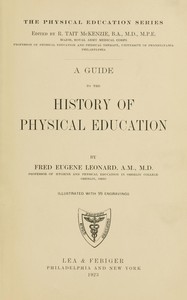
A guide to the history of physical education
Language: en5,459 downloads on Project Gutenberg
Subjects
Public-domain ebook sourced from Project Gutenberg #78009.
Public-domain ebook
Language: en5,459 downloads on Project Gutenberg
Subjects
Public-domain ebook sourced from Project Gutenberg #78009.
This work is a scholarly survey of the development of physical education, written by Fred Eugene Leonard, a professor who spent three decades gathering and translating European sources. The opening pages explain how, when Leonard first took a professorship, no comprehensive English‑language history existed, and how his own travels to Germany, Sweden, Switzerland and Britain allowed him to assemble a vast collection of original texts, illustrations, and lecture notes. The book is organized into two parts, European origins from the Greeks through the modern German and Scandinavian systems, then the transatlantic adoption and adaptation in the United States, each chapter drawing on first‑hand examinations of rare works and on the author’s own teaching experience at Oberlin and Harvard. The preface emphasizes the author’s intent to present a clear, critically sourced account of the major movements, figures, and curricula that have shaped physical education.
Leonard writes in a formal, academic voice typical of early‑20th‑century educational scholarship, blending detailed historical narrative with occasional personal reflections on his fieldwork. The prose is dense but precise, peppered with references to original German, Swedish and French publications, and supported by a wealth of lantern‑slide illustrations. Readers who appreciate meticulous historiography, such as educators, historians of sport, or anyone interested in the cultural roots of school gymnastics, will find the book rewarding. Those seeking a light‑hearted overview may prefer a more concise treatment, but anyone wanting a deep, source‑based exploration of how physical training evolved across continents will be well served.
The opening · free to read
PREFACE.
Thirty years ago, when the writer of these lines was called to a professorship in physical education, there existed no comprehensive survey of the field he was entering. The reports of Dr. Hartwell contained excellent summaries which suggested our debt to the past and to foreign lands, and fuller treatment of certain earlier periods in the United States; but the English language offered little else of value. Suitable preparation of courses in the principles and methods of physical education required more ample knowledge of what others had done and were doing, and the task of finding out and gathering together the best of the European literature bearing on the subject was at once begun and has been continued ever since. A summer trip to Germany in 1896 whetted an appetite which later found satisfaction in an entire year (1900-1901) on the Continent, where the large special collections at the Stockholm Central Institute of Gymnastics and the Berlin Turnlehrerbildungsanstalt supplied for the first time an opportunity to become familiar with the older books and periodicals. The year also contributed to the linguistic knowledge and experience needed for the handling of such material. The direct contact with historic spots and significant aspects of physical education in Europe which it brought was afterwards renewed and broadened by five months (February to June, 1913) spent at important centers in Switzerland, Germany, the three Scandinavian countries, and Great Britain.
Meanwhile the collection of material had progressed at a rapid rate, and from time to time as circumstances permitted chapters of a book-to-be were prepared and published, in irregular order, and biographical sketches which might later be incorporated in such a work as the present one. Thus it happens that only five of the twenty-eight chapters in this volume are altogether new, though all have been carefully revised and many of them largely rewritten within the last year and a half. The selection of topics, order of arrangement, and manner of presentation have been determined experimentally in courses given to students in Oberlin College since the spring of 1894, and for thirteen years (1899, 1902, and 1908-1919) at the Harvard University Summer School. The illustrations are chosen from nearly six hundred which have been employed in the form of lantern slides in these courses. With few exceptions the references in the text and footnotes are based on first-hand examination of the originals.
If we except Viktor Heikel’s Gymnastikens Historia (issued at Helsingfors in four parts, 1905-1909), comprehensive in plan but quite erratic in its treatment of the United States, no work undertaking to trace the history of physical education in Europe and America and to describe the chief present-day movements has appeared hitherto in any language. Euler’s standard Geschichte des Turnunterrichts and the lesser German manuals, while they are in general excellent guides so far as ancient and medieval Europe are concerned, and for the recent history in that particular country, have little or nothing to say of the rest of modern Europe, except as it has influenced Germany herself. This is less true of Euler’s monumental Encyklopädisches Handbuch des gesamten Turnwesens and the more recent Handbuch des gesamten Turnwesens of Dr. Rudolf Gasch, but in these, too, the space allotted to non-German subjects is altogether insufficient. Similarly Illeris and Trap’s brief Grundtræk af Gymnastikkens Historie covers chiefly Danish experience. For each country one must consult its own literature, and particularly the periodical publications, and he needs also to supplement his reading by personal observation and investigation on the ground in order to avoid distorted views and arrive at sound conclusions.
If this attempt to set forth clearly the characteristics of the different stages and phases through which physical education has passed, to introduce the persons who have contributed to its advancement, and to guide the reader to the best that has been written on the subject, shall lead to deeper and more general appreciation of the place which physical education should win and hold in general education, and to the adoption of wiser measures where it is introduced, the labor expended upon the volume will be well rewarded. Much has been omitted which might have been included. If inaccuracies are discovered the author will be glad to have his attention called to them.
F. E. L.
OBERLIN, OHIO, 1923.
EDITOR’S PREFACE.
The shore of physical education is strewn with the wrecks of systems and movements, many of them good in themselves, but left to drift when the personal support and enthusiasm of the founder was removed from the helm. It has only been when some great national crisis had to be faced and the minds of patriots and scholars were engaged in the effort to meet it, that systems have been evolved great enough to survive the death of their founder, the test of time and change in their national conditions. This is notably true of the gymnastics of Denmark, Sweden and Germany. Incomplete as systems of physical education without the addition of games, but logical and accurate in their application to the conditions they have had to meet, whenever similar conditions have arisen it is to them we have turned for inspiration and instruction, and nowhere was this better shown than in the great war of 1914, where crude masses of untrained and underdeveloped men had to be made quick and accurate in response to command and given that control of their bodies that is the true function of physical education in its highest sense.
To the sincere student of physical education nothing has a more sobering effect than the study of those advances made by the great men who have given their lives to their cause. He finds that most of the theories that come to him as new and startling have been thought before and have been either rejected or put into practice as well or better than he is likely to do, and so if he is a philosopher, he can avoid the inevitable failure of schemes that have been discarded and adapt from material of proved worth the material that suits his special conditions.
Such a study will save him from the outstanding characteristic of many exploiters of this subject, the unfounded claims for originality and novelty in their work. Small collections of free exercises are dignified as systems and published as such with apparent seriousness, slight variation of method is hailed as a great discovery, has its little day of notoriety and takes its place on the library shelves as a literary curiosity of interest only to the antiquarian, and the busy teacher has neither the time nor the inclination to separate the wheat from the chaff. Up to the present there have been but incomplete and fragmentary reports available for our guidance, often in translation, and frequently garbled by personal bias, so that the need has become more and more urgent for a complete and scholarly review of the growth and distribution of systems that are associated with certain names and certain periods.
Dr. Leonard is peculiarly fitted for such a great task. An enthusiastic scholar, with an intimate knowledge of the languages in which the originals were written, he has devoted the leisure and the vacations of thirty years to collecting, reading and making available rare and inaccessible works on the subject, for students of education in general and of physical education in particular. Repeated visits to Europe and pilgrimages to the shrines of the pioneers have given him the proper perspective, and this volume presents his conclusions as delivered in his yearly lecture courses at Oberlin and Harvard.
It comes appropriately early in a series of books designed to place physical education on an equality with other more strongly entrenched parts of a general educational system. The soul is indeed dead that does not react with a generous glow when reading the difficulties overcome and the work accomplished by the heroes of any field of endeavor, and what could be more inspiring at this time than to have set forth the conquests and defeats of those patriotic spirits whose lives have been given to upbuilding the health and fitness of the youth of the world, throughout the ages, as a guide and inspiration to us who have these same problems to meet at the present time.
R. TAIT MCKENZIE, Editor.
CONTENTS.
The book keeps going
Reading is free forever. Sign up and watch scenes appear while you read.



Scenes Storieta drew for other classics.
New illustrated classics
Once or twice a month: the latest books to get full character casts, scene art, and free comic editions. No account needed.