Public-domain ebook
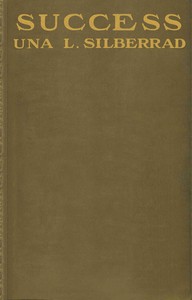
Success
Language: en4,399 downloads on Project Gutenberg
Subjects
Engineers -- FictionInventors -- FictionEngland -- Social life and customs -- 20th century -- Fiction
Public-domain ebook sourced from Project Gutenberg #78012.
Public-domain ebook
Language: en4,399 downloads on Project Gutenberg
Subjects
Public-domain ebook sourced from Project Gutenberg #78012.
Una L. Silberrad’s Success is a turn‑of‑the‑century social novel that places its inventive protagonist, Michael Annarly, amid the genteel drawing‑rooms of England’s industrial elite. The opening scene finds Annarly in a lingering conversation with Lady Sibyl Carson, their dialogue charged with admiration for his recent achievement, a new aerial torpedo, while the surrounding men discuss his reputation, his outsider status, and the jealousy his genius provokes. The narrative swiftly moves from the intimate fire‑side exchange to Annarly’s solitary night drive, where his thoughts shift from the technical triumph to the exhilaration of personal validation, framing the story as both a study of professional ambition and the social currents that surround it.
Silberrad writes in a measured, slightly ornate prose that reflects the Edwardian era’s preoccupation with class, invention, and gendered expectations. The voice is observant rather than melodramatic, offering a nuanced portrait of a brilliant but socially awkward engineer navigating a world that both reveres and resents his talent. Readers who enjoy character‑driven tales of scientific ambition, set against the backdrop of early‑20th‑century British society, will find the novel’s blend of technical intrigue and social commentary compelling.
The opening · free to read
Michael Annarly was talking to Lady Sibyl Carson. He had been dining with the Carsons, and he was staying on after the other guests, deep in talk with his hostess. He was the last to move, excepting, of course, those who were staying in the house. These were all men; Carson did not encourage the idea of women visitors in case they should want to go out with the guns, and Lady Sibyl had few friends of her own sex for whom she cared enough to insist on inviting. The men lounged by the fire in the room, part hall, part billiard-room, to which the company had retired when the more formal guests departed. Lady Sibyl and Annarly were some distance from the others, she in a deep-seated chair which toned in colour with the golden russet of her dress and hair and eyes. Annarly sat beside her in earnest talk, as he had sat ever since their coming into the hall; since then neither had conceded even a pretence of recognising the existence of other people. When the one or two local guests, who had lingered on, came to take leave of their hostess, she for the moment waked to a recollection of their existence, made a few remarks in a charming manner, and then obviously went back in mind to where she was before. Annarly, who in spite of his thirty years was not really well versed in the ways of the world, certainly not of this world, did not acquit himself even so well as that. He remained completely absorbed until a rather pronounced yawn from one of the group by the fireplace arrested his attention and reminded him of the lateness of the hour and the way he had outstayed other people. He rose to say good-bye.
Lady Sibyl rose too; her eyes were shining and the whole of her beautiful face was alive with the excitement and admiration which some women feel for success.
“Good-bye,” she said, and her voice thrilled with a note of pride as well as sympathy, “good-bye—and thank you! Thank you, for telling me. I am proud that you should have thought it worth while to tell me. I need not say that I am proud that you have accomplished it—I always knew you would! All the same”—she offered him her hand, and her voice dropped half a tone softer—“I’m glad.”
He took the hand, his unusually sensitive and telepathetic fingers gripping hers closely. She did not resent it, she was moved out of herself by what he had that evening told her.
“I may come on Saturday and tell you what they say?” he asked.
She nodded. “I shall be very impatient till then. I only hope they will treat you well, what I call well; I have bigger ideas than you, you know. When you give me leave to speak, I think I shall see if I cannot influence them. A woman can help sometimes.”
“Sometimes?” Their eyes met, and for the moment she had the feeling, perhaps he had too, that she had been half the inspiration of his work, or at least that her sympathy and interest had helped through the hardest places.
Carson broke in here. “You off, Annarly?” he said, quite unconscious of any thing he might be interrupting, and went on to speak of the state of the roads and the peculiarities of Annarly’s car.
“Who’s that chap?” Dawling, one of the men by the fire, asked, when he had gone.
“Annarly?” Carson said; “oh, he’s at Galhardy’s.”
Most of those present were that in a sense, or at least had some interest or nominal connection with the great foundries; one of the great foundries of Europe which, a town in itself, lay not far distant and was of more vital interest to the surrounding country than the British Constitution or any other human institution. Dawling himself had little interest in it, but, from intimate conversation with those who had, most of the more important names were familiar to him; Annarly’s he could not place among them: also, though not very acute, he had a vague consciousness that the man was not one of themselves.
“What is he?” he asked, “I don’t seem to have heard of him.”
“That’s because you’ve been out of England the last three years,” Brett, a smallish man in the corner, said. “Had you been here, you’d have known—from his own demonstration, if nothing else—that he is the greatest genius of modern times. I don’t quite know what one should call him: engineer, mathematician, electrician, mechanic, or Jack-of-all-trades, but it’s quite certain he’s a marvel.”
The sarcasm of the tone was so obvious that it was easy to see Brett, secretary to the board and private secretary to the chairman of directors of Galhardy’s, did not love this talented acquisition of the great firm. Even the unobservant Dawling saw that, and Lady Sibyl, who had gone to a bureau at the far end of the room, caught the intonation though not the words. She closed the bureau and came to the group by the fire.
“Are you talking of Mr. Annarly?” she said. “He is an extraordinary person, extraordinarily clever; much, much more able, I think, than any of you yet realise.”
She stood looking down at the blaze a moment, her eyes reflecting the flickering lights, and a thoughtful smile curving her lips.
Her husband grunted; he was not in the least jealous, it never occurred to him to be jealous of any poet, musician, scientist, or other man of brains with whom his wife chose to beguile her otherwise tedious intellectual solitude. It certainly did not occur to him to be jealous of Annarly. Though he was quite unlike all who had gone before him in favour, and was also possessed of tangible abilities which Carson himself could value, if not understand, he was no more one of themselves than the others were; no more one in ordinary life, the life of the house and the coverts, and so on.
Brett, from beyond his host, moved a little impatiently. “I am afraid you are too generous, Lady Sibyl,” he said. “I don’t think you’ll find it wise to accept Annarly entirely on his own valuation.”
“I don’t,” she answered, “I estimate him a great deal higher than that. Oh”—as she saw Brett’s expression—“I know some people think him conceited, but he is not. It is true he can do and understand things few others can, and he knows it; but he does not think highly of himself on that account—though perhaps rather poorly of those who can’t. That, with his way of refusing to comply with old ways that he sees no use for, might make him unpopular. But he does not overestimate his own ability; I think you will say that yourself soon.”
“I may,” Brett conceded, but his tone did not suggest conviction.
“He’s all right,” Carson said carelessly; “a bit short of the sense of proportion, thinks nothing on earth matters but his own job, and don’t always see straight about that, otherwise not bad.”
“Isn’t he?” said Brett, with a vindictive flicker of the eyelids. But he said it quietly, and as Lady Sibyl was then saying good night, no one paid any particular attention.
When she had gone Dawling observed, “The genius seems to know something about the gentle art of making enemies.”
“Annarly?” Carson said. “He’s all right, a bit big for his boots, but a clever devil.”
“How did he get in?”
It was a question of some interest; to get into Galhardy’s, with any prospect of achieving a position or income worth the having, was a more than difficult thing unless one were born to it, or acquired it by great influence, income, or marriage. It was quite evident from the attitude of all present that Annarly had not done it in any of these ways. Brett answered now, and his tone was sarcastic.
“By merit,” he said; “he got in by his own merit and singular genius some three years ago, and by that alone has risen to what he is. And contrived to get more rope, more power, and more money to fool with than any other man, though he might be ten years his senior and the nephew of a director. He is the pet of half the board—a pretty expensive pet, I should be sorry to say what he and his experiments have cost the firm—and the bane of the other half, and most other men in authority too.”
“H’m,” Dawling said; then asked, “Who put him in in the first instance?”
“It’s reported,” Carson answered, “that some woman brought him to the notice of one of the directors, old Joe, in fact, wasn’t it? At all events, he always says now that he found him himself, was struck of a heap by some invention he submitted, or something. Anyway, he was found, and found, or thought to be, the man for the aerial torpedo problem.”
“Is that his line?” Dawling asked, interested.
“That’s it. Not but what he’s reported to do plenty else beside—weaned on ballistics, I believe, and knows all that’s worth knowing about steel and guns—though he can’t hit a bunny at twenty yards. But it’s the torpedo business that he depends on; the directors expect him not only to perfect the means of discharging torpedoes at airships, but also to give them a suitable torpedo-head too. They’ve been expecting it some time, and he keeps ’em expecting; he’s a clever chap.”
“Krupps also expect it of him,” Lee-Brendon, an older man who had not heretofore spoken, observed. “So, I believe, do the other great firms.”
“Oh, I didn’t mean there’s nothing in it,” Carson explained, “he’ll get it all right, not much doubt about that; our directors don’t make mistakes where their own interests are concerned. They must have pretty good grounds for their faith in Annarly to let him have his head as they do. Not the least clever thing about him is that he’s been able to get it; ’tisn’t every man with no more than brains to back him, who could: I admire the chap for that, though it has made him, as I say, a bit big for his boots.”
He knocked the ashes out of his pipe as he spoke, as a signal that he at least was ready for bed.
He drove home through the soft darkness of a late September night, thinking no more of the night than of the car he drove (and could not really afford). Neither was he, and this was rarer with him, thinking of the difficulties of his work and the jealousies and obstacles which met, and must meet and often thwart, a brilliant young outsider in an old, close preserve. To-night he was not thinking of them or of ways to deal with, dodge, or surmount them; he was done with that now, clear of them, free of them and the need to consider them. He was thinking of a woman whose gown repeated the russet of the bracken-clad hills at this season of the year, and whose eyes, a tone darker, looked glowingly into his when she had bade him come again, and said she would be impatient till his coming. A woman whose voice had quivered with enthusiasm and given the commendation to be coveted when he had brought her, first of all people, word of the completion of his achievement. Through all his pulses ran the thrill of victory; not over her, though perhaps he believed in a tenderness for himself, but over fate and circumstances. She and her glowing sympathy were but as a crown set on the other achievement; but one that, for the first time, made him realise that it was victory. Before it was work—good work—not perfect to his ideal standard, but good, what he had looked to do and believed, although he as no other knew the enormous difficulties, that he would do. But it was no more than that till her kindling eyes and thrilling voice had shown it as victory. No longer only a sober, if important achievement of great mechanical skill and mathematical ability; no longer even an overcoming of obstacles, an outwitting of enemies, and surmounting of difficulties, but Success, Victory, the rare, heady thing.
The book keeps going
Reading is free forever. Sign up and watch scenes appear while you read.



Scenes Storieta drew for other classics.
New illustrated classics
Once or twice a month: the latest books to get full character casts, scene art, and free comic editions. No account needed.