About this book
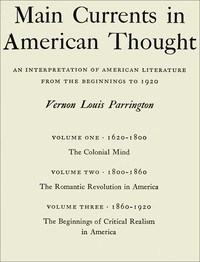
Parrington’s work is a sweeping scholarly survey of the ideas that have shaped American literature and public life from the colonial era to the early twentieth century. In his introduction he declares a “certain feeling of temerity” in tackling a field he believes has been largely neglected, and he frames the study as an exploration of how European intellectual currents, English Independency, French romantic theory, Whiggery, and later laissez‑faire economics, were transplanted into the New World and intertwined with native aspirations. The first volume, which opens the series, traces the clash between liberal doctrines of natural rights and the entrenched Calvinist theology of Puritan New England, using figures such as Roger Williams, John Cotton, and Thomas Jefferson to illustrate the development of a distinctly American liberalism. Throughout, Parrington emphasizes the political, theological, and economic dimensions of literary production, positioning the text as both a history of ideas and a reinterpretation that often runs counter to conventional conservative readings.
Written in a dense, lecture‑like prose typical of early‑20th‑century academic monographs, the book reflects a liberal, Jeffersonian perspective and assumes familiarity with the major philosophical and historical debates of the period. Its exhaustive footnotes and frequent references to contemporary scholars make it especially rewarding for graduate students, historians of ideas, and readers who enjoy a rigorous, interdisciplinary approach to American intellectual history. Those interested in the roots of American political thought, the interplay of European philosophies with colonial culture, or the evolution of literary criticism will find Parrington’s analysis both challenging and illuminating.