Public-domain ebook
The vidiot
by Ib Melchior
Language: en4,475 downloads on Project Gutenberg
Subjects
Public-domain ebook sourced from Project Gutenberg #78057.
Public-domain ebook
by Ib Melchior
Language: en4,475 downloads on Project Gutenberg
Subjects
Public-domain ebook sourced from Project Gutenberg #78057.
The story opens with a flamboyant claim that the Metropolitan Opera has never before “cast its mantle of magic over the science‑fiction landscape,” a promise fulfilled by Ib Melchior’s first fantasy tale. From the outset the narrative plunges into the backstage world of a live television studio, where a nervous Don Hartley is summoned by a terse secretary and thrust into a maze of technical jargon, camera rigs, and a desperate director’s plan to film a space‑opera on Ganymede. The opening pages trace the frantic preparation of cameras, dry‑ice fog, and a duplicated “Planeteer” before an accidental paper‑clip‑induced short circuit creates a mysterious black hole in the monitor that reveals a view beyond the set, first a fabricated spaceship, then the street outside the studio. The plot thus hinges on a single inventive invention, the “Hartleycam,” which promises to see through any obstacle, and on Hartley’s frantic scramble to protect his discovery from corporate claim.
Melchior writes with the brisk, dialogue‑heavy cadence of a 1950s television writer, peppering the prose with industry slang, technical instructions, and the rapid‑fire banter of crew members. The voice is both playful and tense, reflecting a period when live TV drama and early sci‑fi imagination collided. Readers who enjoy stories that blend gadget‑centric speculation with the claustrophobic atmosphere of a production lot, especially those fond of mid‑century pulp, vintage TV lore, and inventive “what‑if” scenarios, will find this tale’s blend of technical intrigue and speculative invention compelling.
The opening · free to read
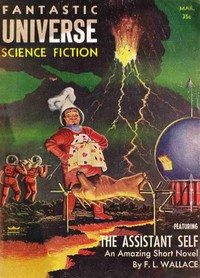
To the best of our knowledge the Metropolitan Opera stage has never before cast its mantle of magic over the science fiction landscape. But with the coming of Ib Melchior to our pages with his first fantasy story its legendary spell has been widened. For Mr. Melchior is the son of a singer so famous that to mention his name would be redundant. Quite as important, Ib Melchior is a motion picture producer as well as a writer, with several TV shows behind him, including the Perry Como Show on CBS. Much of his background and experience as a producer-director is mirrored forth in this most exciting yarn.
=There are a good many startling surprises in TV camera work. But if the universe reels--will an eager lad get a second chance?=
“Don Hartley!” The little blonde secretary’s eyes opened wide with curiosity as she repeated his name. She knows, then, thought Don.
“Just--just a minute,” she said. She picked up the phone and pressed the inter-office button. “Mr. Don Hartley to see you, sir,” she announced. Then after a pause, “Yes, sir.”
She replaced the receiver, and turned back to Don. “Won’t you please have a seat, Mr. Hartley. He’ll see you in a moment.”
Don sat uncomfortably on the edge of one of the heavy, leather-upholstered chairs. He looked around the beautifully appointed ante-office. The little secretary was trying in vain to be inconspicuous in her curiosity about him. He shifted self-consciously on the chair.
Was he in the right place? Had he really made the right decision? It was a damned difficult thing to figure out!
For the umpteenth time he let his mind wander back twenty-four hours--a measly twenty-four hours--when....
George Kenmore flipped the talk-back key: “Okay, everybody--wrap it up. That’s it for now. Be back here ready to go from the top in exactly one hour and a half.”
He turned to the technical director, a large, comfortable man who sat worrying a dead cigar on his left.
“And, Steve,” he warned, “don’t kill the cameras. Just cap them up so we don’t burn in. You and the boys be back here in one hour. I’ve got a little problem I want to fool around with. That duplicator effect on Ganymede.”
He leaned across the control desk toward the row of monitors in front of him on the lower level of the video control room, addressing himself to the top of a crew cut.
“And, Don,” he added, “be sure we have horizontal reverse scanning on Camera One. And I want to use the whipe--and also I want you to switch the matting amplifier into the circuit.”
The video technician looked up over his shoulder. “Okay, George. You know me. A director’s wish is my command! But they sure handed you a tough one this time.”
“What do you expect? After all we’re doing a space opera--on live TV. There are bound to be technical difficulties. As long as they don’t ask me for a close-up with the feet in we’ll lick any problem they can dream up. Right?”
“Right!” echoed Don brightly. “Anything the movie boys can do with process shooting and laboratory tricks we can do right here in the studio--and better. I’m with you!”
George picked up his earphones from the desk and spoke into the tiny mike. “Bill! Bill Sanders! Are you still on cans?”
Out on the studio floor one of the men waved his arm. George saw him through the double glass pane and continued: “Good! Tell the boys to let in the big black in two--in front of the spaceship set. And get the fog machine set. I’m going to use a half hour of fax rehearsal time when we get back for some experimenting. Has the dry ice arrived yet?”
On the floor Bill waved “yes.”
“Okay.”
“Tell me, George,” the T.D. asked. “What exactly is the effect you want in that Ganymede scene?”
George picked up a paper clip and absent-mindedly began twisting it around his pencil in a tight spiral. It was a silly habit of his, but an innocuous one.
“It’s like this,” he began to explain. “We’re on Ganymede--that’s one of Jupiter’s moons. The ‘Planeteer’ has landed and is walking around on the satellite in his space suit. We’ll play the whole thing in front of the black drop and put in electronic stars.”
He leaned over the desk. “Can do, Don?”
“Can do!”
“Fine! Now--the floor will be covered with dry ice fog. It’s supposed to be ammonia vapors or some such guck. So far so good.”
He rolled his little paper clip spiral off his pencil and started on another one.
“The ‘Planeteer’ is all alone, see? But suddenly another spacesuited figure joins him. It turns out to be _he himself_--and duplicated! And if that’s not enough, a third copy joins them--all three of them he himself. He’s supposed to look at himself, talk to himself, and walk in front of himself. We can’t use doubles because of those transparent space helmets. And what’s more, the three triplicated ‘Planeteers’ are supposed to make the exact same movements at the exact same time. The whole thing’s supposed to be some sort of hallucination.”
He stood up. “And speaking about hallucinations--I’m so hungry I’m going to get them if I don’t get something to eat. Coming, Steve?”
“Fine,” said the T.D.
The director leaned across the desk again. “And how about our vidiot? You want to join us, Don?” he asked.
Don cringed mentally at the nickname. Even though he knew it was only a good-natured rib at the video technicians he always winced at the term “vidiot.”
But he managed to sound unconcerned when he answered: “Guess not, George. I’m not hungry. Besides I’ve got a heavy date after the show. I’ll just stick around here.”
“See you later, then,” the director said as he and his T.D. left the control room. On the studio floor Bill, the floor manager, let a last look of inspection sweep the stage. Then he too walked out.
Studio 52 was deserted--except for Don Hartley.
Fine! That would give him a chance. He was pretty sure he knew what the director had in mind, and how he would solve his problem of triplication. If he could have everything set up when George returned the director was bound to send a note of commendation to Barnes, the big brass in the front office. Don was ambitious. He had his eye on the T.D. chair, even on that of the director himself. And who could know? Everything was possible.
Now. He’d use three cameras. Take the first picture of the “Planeteer” on Camera III--normal scanning. Then he’d split the screen vertically on the whipe amplifier, putting the image from Camera III on the right half of the screen. Then on Camera I he’d take another picture of the “Planeteer” and reverse the scanning horizontally so that right became left, and vice versa.
Then he’d put the image from Camera I on the left half of the screen, and he’d have two identical “Planeteers” looking at each other. That would work out all right. Now. On Camera II he’d take yet another picture of the “Planeteer,” and using the matting amplifier with primary picture on Camera II he could put the third “Planeteer” in front of the two others. It would work. He’d have to try it out.
Don walked out on the stage. From the prop room he got a space suit in a light blue color and propped it up on the Test Pattern stand in front of the black backdrop. That would be the “Planeteer.” Next he lined up his two pedestal cameras and swung in the huge boom camera so that all three had a full figure shot of the space suit.
He returned to the control room and completed his intricate hookup. It worked. One space suit “Planeteer” had become three!
The book keeps going
Reading is free forever. Sign up and watch scenes appear while you read.



Scenes Storieta drew for other classics.
New illustrated classics
Once or twice a month: the latest books to get full character casts, scene art, and free comic editions. No account needed.