Public-domain ebook
Preview
Language: en4,619 downloads on Project Gutenberg
Subjects
Public-domain ebook sourced from Project Gutenberg #78072.
Public-domain ebook
Language: en4,619 downloads on Project Gutenberg
Subjects
Public-domain ebook sourced from Project Gutenberg #78072.
Frank Belknap Long’s “Preview” is a short‑story that blends science‑fiction concepts with a meta‑cinematic set‑up. The narrative opens inside a darkened theater where the enigmatic Mr. Scanlon pitches a “superseding experience” to a skeptical audience, promising a stripped‑down realism that will eclipse ordinary perception. As the screen flickers to life, a Western tableau of Robert Mitchum riding through the Black Hills is abruptly hijacked by bizarre, otherworldly intrusions, a tentacled creature, a shape‑shifting actress, and a sudden disappearance of the presenter himself. The opening scene therefore establishes a layered spectacle: a conventional Hollywood tableau that quickly dissolves into chaotic, alien interference, hinting at a story that questions the boundaries between illusion and reality.
The piece is written in the exuberant, dialogue‑heavy style of mid‑1950s pulp magazines, where rapid shifts and flamboyant exposition create a feverish, almost theatrical tone. Readers who enjoy speculative mash‑ups, satire of Hollywood conventions, and the energetic prose of classic genre magazines will find Long’s work rewarding, especially those who appreciate a story that toys with perception as much as with plot.
The opening · free to read
Have you ever sat in a movie theater and permitted your imagination to take you far beyond the events depicted on the screen? Perhaps we all do this at times. But this tragedy in minuscule should give you pause and cure you of the habit forever. The flying saucer folk may just happen to be watching you.
=Mr. Scanlon had reasons of his own for insisting on a preview. But what they were nobody knows!=
“What every discerning theatergoer is searching for,” said Mr. Scanlon, “is a kind of sixth-sense heightening of perception. I choose to call it a superseding experience--a blotting out of the mundane and familiar and the substitution of the totally unexpected. In short, a superior vision of reality. Stella, you see, is a ‘stripped’ actress.”
Mr. Scanlon looked about him, and smiled. “No, gentlemen. I’m not being Rabelaisian, or thinking of the burlesque stage. She’s a ‘stripped’ actress in the sense that the kind of realism I’ve been talking about is her guiding star. Everything else--every shred of romantic or sentimental tinsel--has been stripped away.”
“But, Mr. Scanlon! Surely--”
“Gentlemen, I think you’ll agree that her first liaison with Hollywood has carried her to heights undreamed of in your philosophy--if drama critics can legitimately be said to possess a philosophy.”
“But, Mr. Scanlon--”
“Gentlemen, be patient. Relax. You’ll never see another preview like this, and you must enjoy it to the full. There go the lights.”
The lights dimmed and the long, cinemascopic screen brimmed with a deep-toned miracle of radiance.
Into the Black Hills on a white charger rode Robert Mitchum. The epoch which was to resound with his deeds of valor was not immediately determinable. But from the peaceful aspect of the landscape everyone took it for granted that it was B.C. (Before Custer)--until the new techniques of sound dispersal which convey an illusion of torment in depth went into action. From every nook and cranny of the theater rifles cracked in earsplitting synchronization.
It was no run-of-the-hill Western. Every part was played to perfection, against the kind of historically realistic background that had made “Shane” and a scant dozen lesser pictures classics of their kind.
The critics flanking Mr. Scanlon realized this, and unlimbering their fastidious brows they started scribbling.
“There she is,” said Mr. Scanlon. “Gentlemen, this should be your most rewarding moment.”
Into the center of that scenic magnificence stepped Stella. Her blonde loveliness was peculiarly her very own, and it was easy to see that everything was just right for her.
“No powder, no cream, no lipstick,” murmured Mr. Scanlon.
“But surely, Mr. Scanlon, she’s made up for the screen--”
“Historically makeup would have been an anachronism,” Mr. Scanlon pointed out. “The women of that age had to get along as best they could. Remember Calamity Jane? She was as ugly as a warthog, but her lovers were legion.”
There was a brief dimming of the radiance. And then, into the Black Hills on a pulsing shape of darkness rode--
“It’s Humpty Dumpty!” someone gasped.
“No.”
“No, it’s got tentacles. Can’t you see? They must have been shooting one of those science fiction pictures on another set. One of the extras must have strayed by accident--”
“And he’s waving them. Look!”
“Good grief, how did that bomb crater get there?”
“It’s unbelievable! She’s changing into a seal!”
The divine Stella was indeed changing. But no seal--or mermaid--had ever gone flapping over the Western hills on eight dangling appendages, blue-green in hue.
Of course the hills were no longer the Black Hills of the Dakotas. But no one could ask Mr. Scanlon about that because he had disappeared. One moment he had been leaning forward in his seat, alert and smiling. Then he was gone. He had simply vanished--dwindled and faded into nothingness like an unstable isotope assailed by some invisible energy source.
No narrative is complete if it does not terminate with some sort of explanation. But how could there be one when no man or woman on Earth would ever know where Mr. Scanlon went, or why he had insisted on a preview in the first place?
How could there be one when there was no one to remember--no one to recall how They landed in numbers from their flat, saucer-like ships exactly one week later, and took care to strip from the minds of men all proudly treasured knowledge of the many-splendored things of Earth?
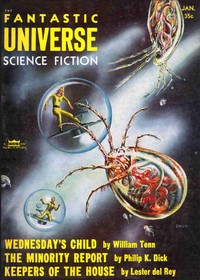
This etext was produced from Fantastic Universe, January 1956 (Vol. 4, No. 6). Extensive research did not uncover any evidence that the U.S. copyright on this publication was renewed.
Obvious errors in punctuation have been silently corrected in this version, while spelling and hyphenation have been kept as is.
The book keeps going
Reading is free forever. Sign up and watch scenes appear while you read.



Scenes Storieta drew for other classics.
New illustrated classics
Once or twice a month: the latest books to get full character casts, scene art, and free comic editions. No account needed.