Public-domain ebook
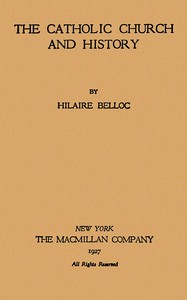
The Catholic Church and history
Language: en4,559 downloads on Project Gutenberg
Subjects
Public-domain ebook sourced from Project Gutenberg #78085.
Public-domain ebook
Language: en4,559 downloads on Project Gutenberg
Subjects
Public-domain ebook sourced from Project Gutenberg #78085.
The work is a concise apologetic treatise in which Hilaire Belloc sets out to dismantle the historical objections leveled against the Catholic Church’s claim to divine and infallible authority. From the very first pages he explains that his aim is not to marshal positive evidence for the Church, but to show that the arguments drawn from history, whether the moral accusations that the Church has taught falsehoods, the claim that it has relied on deceitful material, or the broader contention that it is a human institution rather than a divine one, fail to undermine that claim. The essay is organized into two main parts: a three‑fold moral critique of the Church’s alleged historical errors, followed by an intellectual critique that confronts both Protestant and general agnostic positions. Belloc frames his discussion as a defensive response to what he regards as the most formidable modern attack: the historical scepticism that portrays the Church as merely another human religion.
Belloc writes in the measured, polemical prose of an early‑20th‑century Catholic scholar, employing formal logic and a systematic layout of premises before advancing his argument. His style is dense and argumentative, assuming a reader comfortable with theological debate and familiar with the contours of apologetics. Those who will appreciate the book are readers interested in the intellectual history of Catholicism, students of religious controversy, or anyone seeking a historically grounded, rational defense of the Church’s authority rather than a devotional or devotional text.
The opening · free to read
The object of the author has been to state and summarise in a brief, succinct form the arguments drawn from History in opposition to the claim of the Catholic Church: that is, to the claim put forward by that Church to speak with Divine and Infallible Authority. The author insists upon the point that he is not attempting a positive apologetic drawn from History in favour of this claim, but a rebutting of the evidence drawn from History opposed to this claim. He is engaged in examining the value of the arguments drawn from History to prove that the Catholic Church has varied or erred in her teaching or has made it depend upon immoral methods, and in showing that they have no force.
The little book is divided into two parts, the first dealing with the three moral arguments: (1) that the Church has made pronouncements which History can prove to be false; (2) that the Church can be proved by History to have used material which she knew to be false; (3) that the Church, being proved by history to be not only organised but increasingly organised from the beginning of its existence, is thereby shown to be different from the simple thing which a divine institution of the sort should be.
Secondly, the intellectual argument, to wit, that the Church can be proved by History to be man-made, not God-made. This the author divides into two sections: (1) the Protestant argument that there was some original good message told by Jesus Christ, which the Church has gradually corrupted and from the origin of which she has deviated; (2) the general agnostic argument that the Church can be proved historically to be but one of many religions, to have grown up like any other religion, with the same illusions and similar rites and mysteries, and is therefore man-made--which last form of attack the author regards as to-day by far the most serious.
The general subject “The Catholic Church and History” might be treated from a hundred different positions. Perhaps the most important in the eyes of the cultured man of our day is the question whether the Catholic Church is, or is not, proved by the general story of European history for the last two thousand years to have been a beneficent influence. That question, however, I cannot touch upon because the question whether the Church be beneficent or no is, to a Catholic, subsidiary to the point whether its claim to be the very truth is valid or no. If this claim is justified, then certainly the Church must be beneficent. If it be proved beneficent, that will indeed be some support of its claim; but a weak one, because we cannot even judge whether it be beneficent or no until we have decided what we think better and what worse--and this issue cannot be decided until we are certain of our philosophy, that is, of our religion.
It is another and more important point to discuss whether the Church in her long history has, or has not, shown exceptional signs of holiness and of supernatural power, which are an evidence of her claim. There are also, as I have said, very many other points of discussion which the general title suggests.
I have confined myself to one, and one only, to wit, the rebutting of a certain argument drawn from History against the Church. I have done so for the reason that, in my eyes at least, much the most formidable assault delivered against the Catholic Church to-day is the assault delivered from the historical argument. There remains (as I have said in the Essay that follows) much of the old Protestant argument, to wit, that an original excellent establishment or message of divine origin was corrupted in the course of the centuries and that the Roman Communion still defends that corruption, so that its claim to authority fails. This I have attempted to meet. But of far more weight in my judgment, at the present moment, is the general argument that, regarding History as a whole and adding to it what little we can guess, and what very little we positively know, about man before he began to establish records, the Faith is but an illusion, parallel to many another such illusion to which men have been subject by the process of projecting their own imaginations upon the void of the universe.
This I am convinced is the chief attack which we of the Faith have to meet in modern times. The modern white world, the world of the European races and their oversea expansion, is rapidly becoming divided into two fairly definite camps: those who accept the full mission of the Catholic Church and those who are convinced, by the study of geology and recorded History, that the Catholic Church is but one more example of man’s power of self-delusion.
Two questions may be asked of me by those who should read the analysis which makes up my booklet. First, why have I confined myself to rebutting, that is, to a negative position, instead of advancing positive evidence from History in favor of the Catholic claim (evidence drawn from holiness, continuity, unity, etc.)? Secondly, why have I given but a portion, and not the largest portion, of my space to what I have called the most important part of the attack, to wit, the attack from general pre-History and History, the purely Sceptical attack which I deal with at the end of my Essay? My answer to these two questions is as follows:
First, that, in my judgment, the action of the Catholic Church is here a defensive action. The opponent takes it for granted that History and pre-History _dis_prove the Catholic claim. He must be met as one attacking.
Secondly, that though the general Sceptical attack is by far the more important, yet it needs less space in writing for the meeting of it than does the discussion of the old Protestant attitude. The reason is that the issue between the Faith and mere scepticism is narrower and sharper, and at the same time more general. If you are debating whether the Church declined or was corrupted you must go into more historical detail. You must in some degree, even in so short an essay as this, be concrete. But on the other and larger issue you have a very simple and direct “yes” or “no”; which is, briefly, the answer to that old, eternal question “whether religion be from God or from man”; and upon the answer to that question depends the future of our civilisation.--_The Editor._
1. By the term “The Church” I mean the Catholic Church; and by the Catholic Church I mean that visible society real, one, and clearly present before the world to-day, which is in communion with the Apostolic See of Rome, and accepts not only the supremacy of that see but also the Infallibility of its occupant when, as shepherd and teacher of all Christians, and speaking in that capacity, he defines a matter in faith or morals.
2. The Church claims Divine Authority. She says:
“I alone know fully and teach those truths essential to the life and final happiness of the soul. I alone am that Society wherein the human spirit reposes in its native place; for I alone stand in the centre whence all is seen in proportion and whence the chaotic perspective of things falls into right order. Mankind cannot feed upon itself--for that is death at last. I alone provide external sustenance from that which made mankind. The soil of my country alone can fully nourish mankind. Here, in me, alone is reality. For I alone am not man-made but am of direct divine foundation and am by my divine Founder perpetually maintained.”
3. Against this claim many forms of rejection are found, each with its type of argument: as, that the claim conflicts with the ascertained results of Physical Science: that it advances a particular affirmation not based on the only proofs admissible by reason: that the objector discovers in the Church not the marks of holiness which should accompany such a claim, but rather of evil, etc.
Among the chief objections is the objection from History. It is affirmed that the records of the past, the better they are known and the more closely they are examined, make the more certainly for the rejection of the Church’s claim to Divine Authority, to unique inspiration. These records (it is affirmed) show the Church to be of merely human origin. They yield manifold evidence that illusion, myth and even craft have built up her structure. Her rites are of the kind imagined by men in all ages and places wherever men have abandoned themselves to emotional images divorced from reason. Her doctrines are spun out of nothingness by men engaged upon mere systems invented to explain irrational statements. Her objects of worship are but projections of the worshipper’s mind and have no real existence.
History, it is said, can prove all this. We can trace illusion growing from step to step: the mythical and legendary gradually accepted for fact; the doubtful, vague, uncertain, tentative dream hardening into fixed and absurd dogma. Supposed contemporary evidence, enlightened History with modern apparatus, proved to be subsequent interpolations. The writings traditionally ascribed to witnesses turn out--under the examination of History--to be of a very different and later date. Beyond all this and clinching the argument is the discovery through History that men have always thus created for themselves wholly fanciful beings whom they have worshipped always in much the same fashions. There has been a long process of self-deception from which humanity in its advance is gradually freeing itself, and in this process the Catholic Church is but the last phase.
It is this objection, the argument from History, that I propose to refute. Certain other of the main objections--the objection from Reason, the objection from Philosophy, the objection from Physical Science--are dealt with in other works in this series. I am dealing with the historical objection alone. I propose to show, not that History may convince any man of the Church’s claim, but that the supposed argument from History against that claim has failed. I propose to enquire upon the validity of the objection from History.
(1) The refutation of any argument against the Faith is not a demonstration of the truth of the Faith. It is the removal only of an obstacle to the Faith. For the Faith is not arrived at by demonstration, but by demonstration it is shown to be at least tenable. The Faith is not a conclusion which all can reach by the formal action of reason, but a revelation to be defended by reason. The Faith is not a theory, but a thing. It is rational, but not deductively arrived at. There is no process whereby all mankind can be convinced of it as of an abstract proposition. But there is a process whereby all mankind can be convinced that each particular proposition against it has failed.
This principle in what is called “Apologetics” (that is, writings in defence of Catholic truth) is so generally neglected that it is of the first importance to make it quite clear at the opening of any discussion upon revealed religion.
A man who can see colours will never be able to prove colour to a colour-blind man. He can show that the colour-blind man’s arguments--e.g., that colours do not exist because if they did they would affect surface--are false. If he proceeds to establish the presence of colours positively, he must do so by analogy, by convergent evidence, by the manifest action of others, by the proved nature of other senses than that of sight. He can only prove (in the strict deductive sense of the word “prove”) that the sense of colour is rational, acceptable without violence to the human mind; but that it is present he must establish by other methods.
The book keeps going
Reading is free forever. Sign up and watch scenes appear while you read.



Scenes Storieta drew for other classics.
New illustrated classics
Once or twice a month: the latest books to get full character casts, scene art, and free comic editions. No account needed.