Public-domain ebook
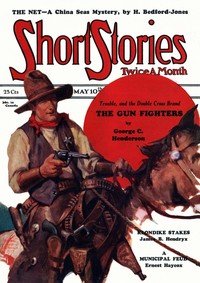
A municipal feud
Language: en4,506 downloads on Project Gutenberg
Subjects
Public-domain ebook sourced from Project Gutenberg #78086.
Public-domain ebook
Language: en4,506 downloads on Project Gutenberg
Subjects
Public-domain ebook sourced from Project Gutenberg #78086.
A municipal feud is a Western short story that follows the uneasy partnership of two itinerant men, Joe Breedlove and Indigo Bowers, as they ride across an arid landscape toward a town that promises both business and conflict. The opening places the pair on a ridge at dawn, describing the vivid colors of the terrain before moving into their contrasting personalities: Joe’s easygoing, shrewd optimism and Indigo’s nervous, quarrelsome nature. Their dialogue reveals a recent encounter in which each has rescued the other, establishing a bond that is both “strangely mated” and fraught with tension. The narrative quickly shifts to their arrival in a town, first unnamed, later identified as Jingle Bell, where a brewing dispute with the neighboring settlement of Big Elk erupts into gunfire, barroom brawls, and a chaotic siege of the local saloon. The story’s focus remains on the interplay of friendship, rivalry, and the rough justice of frontier towns.
Haycox writes in a colloquial, late‑19th‑century style that captures the cadence of Western speech while maintaining a literary flair. The prose is rich with sensory detail, from the “flaming” colors of the sunrise to the “metallic kiss” on Indigo’s back, and it blends humor with a gritty realism that mirrors the era’s pulp magazines. Readers who enjoy character‑driven Westerns, especially those that explore the dynamics of male camaraderie amid lawless towns, will find this tale engaging. Its vivid dialogue and fast‑moving action appeal to fans of classic frontier narratives and to anyone interested in early American short‑story craftsmanship.
The opening · free to read
Joe Breedlove and his newly-found partner, Indigo Bowers, halted on the ridge to survey the country below and beyond them. The chariot of dawn thundered out of the east and every peak and bluff stood in clear outline, flaming with the careless interweaving of the raw primary colors; silver sparkled along the creek bottoms, scarlet and chrome ran side by side on the butte faces. Away in the remote distance a bright blue sky fused with the earth’s dun margin. It was like a bird’s-eye map splashed with pigment and Joe’s eyes kindled at the sight of so much prodigal beauty.
“Providence rises, and the earth is filled with light,” he murmured, rolling a brown paper cigarette.
“It just looks like another hot day to me,” grumbled Indigo Bowers. Indigo was a thin, undersized bundle of nerves. Upon his wizened face--where little wrinkling crow’s feet loved to dwell--was an abiding distrust of the world as he found it. His past life was a page written with the red ink of battle, feud and sudden violence, for Indigo was constitutionally unable to keep out of a quarrel, whether of his own making or somebody else’s.
“Take the beam out o’ yore eye, Indigo,” said Joe, smiling. No man on earth could withstand that smile; it was the shrewd, tolerant smile of a man who very well knew how devious were the ways of a wicked world and yet would not let that knowledge sour him. Joe Breedlove was tall and lean and as bronzed as the cigarette papers which came attached to his sack of smokin’ tobacco. The hair showing beneath his Stetson was prematurely silvered, his eyes were quite blue and mirroring an easygoing philosophy of existence.
“I ain’t got nothin’ in my eyes but sand an’ gravel,” retorted Indigo, “and I’ve swallered enough alkali water to corrode a boiler.”
They were a strangely mated pair and the wonder of all wonders was that they managed to endure each other. Joe Breedlove had met Indigo a month back on the trail when Indigo was in one of his characteristic difficulties--being chased by a posse. Joe had helped him out of it and a little later had in turn been given an assisting hand by Indigo. After that some chemical affinity had drawn them together. And for a month they had ridden southward, bound nowhere in particular, with nothing much in their minds.
Joe Breedlove stretched a long arm to the southeast. “Over yonder is a town. I was raised in it. There’s a piece of business I’ve got to finish up. Let’s ride.”
“Wait a minute,” said Indigo. “What town is it?”
“Big Elk.”
Indigo shook his head decisively. “I can’t go there.”
“Why not?” asked Joe.
“I was there once,” explained Indigo, and for some reason he felt called upon to draw his pointed features into a poker expression. He saw Joe grinning at him and he flared up. “Laugh, you idiot! You know blamed well I’m a peaceful man. I nev’ do butt my head into trouble unless I’m invited. But it is shorely funny how folks pick on me.”
“Well, that makes the fifth town hand-runnin’ we’ve had to circle because you’d been in ’em before,” mused Joe Breedlove. “If this keeps up we’ll have to go east o’ the Mississippi. It’s a mercy how you can develop friction in these municipal corporations. They see you an’ they start shootin’.”
“I’m not a hand to be picked on,” started Indigo with dignity.
“Guess we’ve got to separate for a couple days, then,” decided Joe. “I’ve got a chore to finish in Big Elk. Supposin’ I meet you here two sleeps from now?”
“If it’s a fight you aim to finish,” began Indigo wistfully, “I wouldn’t mind travellin’ along with you----”
“No, it’s peaceful.”
“All right, then,” decided Indigo. “Two sleeps from now, at this very spot. I’ll mosey around somewhere and fill up on ham an’ eggs.”
Joe Breedlove turned down the ridge side. “Try to keep out of trouble, Indigo.”
“I won’t start nothin’,” promised Indigo. “But I won’t avoid nothin’, either.”
The last part of the sentence was mumbled to Indigo’s own self. He watched Joe descend the slope and thread a patch of pines; then he turned toward the east and began a day’s wandering across a series of blistering hot upland pastures. At noon he stopped to eat a cold snack and inhale a brown paper cigarette, feeling somewhat bereaved. After this, he forged on, his horse casting longer shadows to the fore. And in that gloaming hour betwixt sunset and dark he sighted the scattered lights of a town bearing a little to his starboard quarter. He tacked and drifted down upon a street-end, stopping in the shadows. There was something Napoleonic in the manner he sat on his horse and memorized the relative positions of the livery stable, the hotel, the restaurant and the saloon--as well as the second-story porches and those little niches of darkness wherein a man might find shelter in time of stress.
“Well,” said he, advancing on the restaurant, “mebbe nothin’ will happen.”
He posted his horse and went inside, ordering a goodly portion of those comestibles which had haunted his imagination during the past month of wandering. He also ordered a brace of eggs--but he didn’t eat them. He merely summoned them out of the kitchen so that he might not forget what eggs looked like. The rest of the meal vanished and was duly paid for, though Indigo never got so engrossed in his feeding as not to observe certain other patrons closely examining him. It was not a new experience to Indigo; he stared grimly at the bottom of his coffee cup and reminded himself that Joe had bade him be peaceful. Having polished off a second mug of coffee, he repaired to the sidewalk and aimed his footsteps toward the mellow lights of the saloon.
“It don’t tickle my humor none to be gawped at,” he grumbled.
“Just a minute, brother.”
He had arrived in front of the saloon. A pair of fellows slipped through the shadows, flanking him. He saw others standing on the porch, watching this move.
“Step inside a minute. We’d like to pass a few words.”
“My time is my own,” stated Indigo, with commendable restraint. “If you got anything on yore chest, boost it off.”
“Step inside.”
“Why should I?”
“Why shouldn’t yuh?” Something unmistakably metallic kissed Indigo’s backbone. Always recognizing the moral force of the drop, Indigo stoked his temper with a few inflammable thoughts and passed into the hotel room, to be quickly surrounded by a small crowd. One particular individual with General Grant whiskers and a pair of gimlet eyes addressed him bluntly. “Where you from?”
This sort of thing touched Indigo to the quick. “You kinda annoy me,” said he. “Yore eyes interfere and yore nose is too short to reach into my business. Back up.”
The self-elected spokesman worked his jaws for a moment and looked significantly about. “It won’t help you none to stir up the vinegar,” he warned Indigo. “I’m askin’ you once more--where you from?”
Indigo cocked his head at an angle and began nodding it from side to side as the words poured out of him. “Listen, Albert, I’ve rode into better towns than this, but I don’t recolleck havin’ entered any worser ones. You gents think yore pretty smart, picking on a stranger thisaway. Jus’ let me assert yore tamperin’ with high explosives. I’ll pull this shebang to its rotten foundations an’ let in a little air, which is some badly needed. You make me sick. What’s the name of this shrivelled up gopher hole?”
“That’s what I thought,” boomed the inquisitor. “You got a lot of brass, comin’ over here from Big Elk to spy us out! All right, boys, we’ll hang a few signs on ’im and send ’im back with our compliments!”
“You shore will suffer from plague and sudden decimation if you do,” stated Indigo severely. He saw that this agitated the crowd, which was curious, considering he had spoken only the literal truth. Civic pride was an unreasonable thing. “Just another imitation town,” he continued. “_I_ ain’t from Big Elk if that will help you any. The farther south I rides the worse these corporate junk heaps get. What’re you so daggone proud about? I don’t see nothin’ to stimulate me none.”
The spokesman stepped forward, shaking his finger. “You’ll be humble----”
He was shoved aside by another man, who looked searchingly at Indigo. “Listen, ain’t yore name Indigo Bowers?”
“Yeah,” agreed Indigo sourly.
The new spokesman grinned. “Thought so. You was the fella that wrecked the Gloria saloon over at Big Elk, three years ago July.”
The book keeps going
Reading is free forever. Sign up and watch scenes appear while you read.



Scenes Storieta drew for other classics.
New illustrated classics
Once or twice a month: the latest books to get full character casts, scene art, and free comic editions. No account needed.