Public-domain ebook
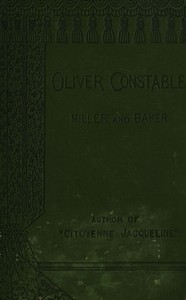
Oliver Constable, miller and baker, Vol. 1 (of 3)
by Sarah Tytler
Language: en746 downloads on Project Gutenberg
Subjects
Public-domain ebook sourced from Project Gutenberg #78299.
Public-domain ebook
by Sarah Tytler
Language: en746 downloads on Project Gutenberg
Subjects
Public-domain ebook sourced from Project Gutenberg #78299.
The opening · free to read
FRIARTON MILL.
OLD mills which were built to be worked by water power are mostly picturesque objects in the landscape. They command without fail certain advantages of situation. Certainly they are not likely to possess extensive views, where they stand in the low lands which claim a fall of water. But water is their specialty, and where there is water, there is generally wood. My readers must call up without any difficulty before their minds’ eyes pleasant pictures of such mills with their placid dams and flashing weirs, their great mill wheels and their noisy clappers, their dusty sacks and their equally dusty millers, so proverbial for their white coats as to have lent a popular name to one pollen sprinkled auriculus. Mill and water, wheel and man, are all set in a green leafy nook which forms the broadest possible contrast to the grey bare downs on which the windmill extends its giant arms and swings its flapping sails. Picture and song have enshrined the old water mills from the days when Constable the painter loved to represent on canvas such a Suffolk mill as that which was familiar to his youth, to the later days when Tennyson wrote his idyll of the Miller’s Daughter.
Of all mills which had their sites chosen with reference to water, though the millers—not anticipating Mr. Ruskin’s objections—had long before the present day, by the help of machinery, set seasons of drought at defiance, none was more thoroughly picturesque in its own line of picturesqueness, pleasanter to all the senses, more homelike, restful and sweet, like a thrush’s nest or a tuft of primroses, than Friarton Mill in Holmshire. It was so evidently agreeable to the eye, and had attained to such an amount of fame for this desirable quality, that it had been suffered to remain where it had been built in primitive easy-going times, within a stone’s throw of the park of Copley Grange, and in full view of the manor-house. In fact it had been found that, after the fashion of those happy accidents which create leaning towers and whispering galleries, and which can never be copied with any certainty of success, the indifference to æsthetics which had made the old squire of Copley Grange permit the miller of his day to erect his mill at his liege lord’s elbow, had been oddly enough rewarded by furnishing the Squire’s descendants or successors with one of the choicest bits of what we may call landscape vertu—a home lion which, as the modern squires were not needy men, and had further acquired the modern culture of beauty to their finger tips, they would not have lacked for a good many broad acres. If the reigning miller and owner of Friarton Mill had been Vandal enough to propose to demolish it—which he could have done since his fathers had bought it and certain pasture fields of the original suzerain—he would have awakened the liveliest consternation in the breasts of his social superiors.
The loss of Friarton Mill would have gone far to destroy the picturesque charm of Copley Grange, with all its advantages of wood and water. For, to the deep regret of its youngest sons and daughters, their ancestor under the second George had taken it upon him with no consideration for the tastes and feelings of his great-great-grandchildren to pull down a gem of a rambling, inconvenient, half-ruinous Elizabethan manor-house. And he had replaced it with a distressingly heavy, square pile of masonry, in which he and the architect had actually thought of little save of expressing pompously their ideas of space and comfort. The little which went beyond these prosaic requirements had borne the doubtful fruit of an Italian portico. It had been voted elegant and classical by the contemporaries of the unfortunate squire who was thus severely reflected upon by his heirs. In a few more years it might rise again into value. It might be prized as a proof of past style, of the tendency of the day, serving as a key to the prevalence of fiddle brown in artists’ work, and to the choice of subjects in Richard Wilson’s paintings, or as an indication of something else equally interesting. But in the present day, with which after all this generation has most to do, it was regarded as an incongruous humbug.
The living representative of the family at Copley Grange had done what he could to remedy the fatal error of his ancestor. He had succeeded, when he came of age, to the savings of a long minority. He was also the manager in chief of a large endowment which a pious and charitable predecessor had bequeathed to support a Copley Grange row of almshouses. By a most fortuitous circumstance, if not by a clear interposition of Providence, as the young Squire was disposed to think, this endowment had been legally disputed, and had remained in abeyance till the lawyers picked as much flesh as they could off its bones, so that the rearing of the fabric, which was to be emblematic to all time, fell to a nineteenth-century man. He improved the circumstance. Instead of building a set of ordinary red brick cottages with little cottage kailyards, which might have fitly housed and afforded recreation to twenty old Copley Grange labourers and their aged partners, he let in a little light on the crass ignorance of the destroyer of the Elizabethan manor-house, by building in the immediate vicinity of Copley Grange a terrace of dainty little structures, all gables and mullioned windows, and stacks of chimneys—with pleasure-grounds having thickets and lawns to correspond, which took several experienced gardeners, told off for the purpose, to keep them in order. Finally he built a tiny alms-house chapel on the strictest principles of mediæval architecture. The carving within and without, the painted glass, the frescoes, the Latin texts which might have been Greek or Hebrew to the daily worshippers, the peal of bells, supplied a boast to the county guide-book.
It is another question whether the poor old bodies, whose number was now limited to eight, and whose taste could hardly be supposed to have reached the stage at which that unlucky forefather of the Squire’s had committed his solecism, did not feel far from home, aggrieved, and made mountebanks of in their new quarters. The arrangements, which included endless draughty corners, and troublesome, perilous steps up and steps down, were purely perplexing and affronting to the occupants of the almshouses. These pensioners were taken out of ugly houses on a level with their capacities, and therefore more to their minds. The old men and women, too old to learn, were elected according to the reigning Squire and his wife’s will and pleasure, and somewhat with reference to the worn out labourers’ venerable beards and their wives’ smooth silver braids of hair, or to the couples’ reasonable disposition to avail themselves of blackthorn sticks and silver-rimmed spectacles, as well as to their general good behaviour, and what might be reckoned upon in the matter of their punctual and decorous attendance at the chaplain’s daily services.
Naturally, perhaps, the recipients of the Squire’s bounty were not particularly grateful for the manner of its bestowal. They were too practical and hard pressed to refuse a refuge which after all was far before the poor-house. But old Mrs. Scud expressed boldly the secret sentiments of six out of the eight women when she declared she ‘wished Squire’s lady would try a day’s washing herself, and see if she would like it, in a nasty cold common wash-house which anybody might halve and quarter, and who wanted that imperent, pushing Mrs. Webb, or sly Anne Sole, to come in and take a invitory of their old men’s wussen shirts, and their own darnedest stockings, when they had been accustomed to wash nice and comfortable in private on their own warm hearth-stone where nobody could come and spy, without the missus of the house’s leave? Ah! she were missus of her house in them days, and not bound to say her prayers at the gentlefolks’ pleasure. What good could that do to her poor old soul, she would like to know? It “might lend a lift” to her betters’ souls, since they were always in luck, but forced prayers never did no good to them as said them, that she would take her Bible oath on.’
And old Mr. Fry (the members of the stranded colony were each strictly Mr. and Mrs. among themselves, unless in the case of a miserable spinster who had missed her mark, like Anne Sole) daringly defined the opinions of his brethren when he protested he would give all ‘them fandangles of shrubberies and grass that were of no good save to the screeching birds of the air as he was not allowed to put a finger on, for his old cabbage bed, where, as everybody knew, he had riz the whitest-hearted cabbages in the parish, not to say for his pig-stye, where, when he could do a double day’s work, and was well-to-do—never thinking what he would come to—as some there could bear him witness, he had fed prime pigs as were a pleasure to look at.
So it became another question whether the owner of Copley Grange had altogether fulfilled the intention—always supposing it to have been kindly and not ostentatious or selfish in disguise—of his forerunner, as he was fully persuaded he had done, while he fumed over the thanklessness and discontent of the poor, or whether he had served himself and ridden his hobby to the death, by way of loving his neighbour.
When all was done, the Copley Grange Almshouses were only a modern antique, and the Squire had too much taste not to prefer the real antique of Friarton Mill, which was not his property, indeed, but was set down within a stone’s throw of his grounds. As he took care to keep on the best terms with the miller, the Squire flattered himself, it was as safe almost, as though it were in his own hands. He was at liberty to take his guests over it at all hours, in the course of the shortest of strolls, and he had so managed a vista of old thorn trees that the mill formed the loveliest vignette from the grand drawing-room windows.
There was no inscription on the building, and there is no existing architecture which could decide the date when Friarton Mill was built. Popular tradition, which always tends to the age of good Queen Bess, as if it had been golden and not iron in English annals, loosely attributed that date to the mill. Undoubtedly, it was so old that even its unsophisticated millers had grown proud and careful of its age, as a man who will ignore and trample upon his years at sixty, nay, at threescore and ten, will boast of them, and cherish them tenderly from eighty upwards. Everything about the mill, except the iron machinery which was kept out of sight, was white powdered or silvery grey, or rich brown, or toned in sage or olive green, dull crimson, and dusky orange by stonecrops and lichens, as no art-school design could tone colours. The building stood as near the water as an old Venetian palace is to its canal. The site must have been untenable in an English climate to any miller who was not proof against the chest complaints and rheumatisms that English flesh is heir to, had not the water which in floods lapped the mill walls been the flow just below the weir. It was always rapid in its current, thus carrying off a large proportion of its own vapour, never stagnated in pools, nor, even when there was least water, dried up in portions of its channel, throwing off unwholesome miasma in the process. Another protection to the miller and his family was, that his two-storied, stone-roofed, dwelling house, built at right angles to the mill, stood by the whole breadth of its court back from the water where the ground rose, and a natural drainage filtered away the damp in the soil. Actual evidence removed all reproach of slimy or mildewed unwholesomeness from Friarton Mill, or, for that matter, from the mansion-house of Copley Grange, which stood only a little farther from what was still called ‘the Brook,’ or ‘Buller’s Brook.’ No races of men or women in the parish had been, in the memory of the oldest Friarton man (and he was to be found in the Copley Grange Almshouses), stronger and longer-lived, in the main, than the two families which had for generations dwelt in the mill and the manor-house.
The book keeps going
Reading is free forever. Sign up and watch scenes appear while you read.



Scenes Storieta drew for other classics.
New illustrated classics
Once or twice a month: the latest books to get full character casts, scene art, and free comic editions. No account needed.