Public-domain ebook
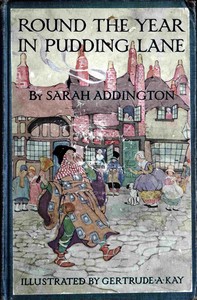
Round the year in Pudding Lane
Language: en1,358 downloads on Project Gutenberg
Subjects
Public-domain ebook sourced from Project Gutenberg #78322.
Public-domain ebook
Language: en1,358 downloads on Project Gutenberg
Subjects
Public-domain ebook sourced from Project Gutenberg #78322.
Round the year in Pudding Lane is a whimsical children’s tale that weaves together familiar nursery‑rhyme characters with a wintery adventure in a small American village. The story opens on a bleak, snow‑free January, where the children of Pudding Lane endure endless lessons while dreaming of the first flakes. When the snow finally arrives, the youngsters rush to build a collective snow‑man, each contributing a quirky detail, from Simple Simon’s misplaced shoes to Jack and Jill’s long arms. The narrative then follows the shy newcomer Polly Flinders as she confronts her own loneliness, the cold, and the inevitable melting of the snow‑man she helped create. The plot stays firmly within the opening scene’s focus on the children’s play, the community’s reactions, and Polly’s heartfelt attempt to rescue the frozen figure.
The voice is lively and conversational, echoing the cadence of early‑20th‑century American children’s books. The prose mixes playful rhyme, gentle satire, and a touch of moral reflection, while the dialogue bursts with the exuberance of schoolyard chants. Readers who enjoy stories that blend familiar nursery‑rhyme figures with a modest, home‑grown drama, especially those who appreciate a nostalgic, slightly tongue‑in‑cheek tone, will find this charming episode of Pudding Lane an engaging read.
The opening · free to read
It had been a poor year for snow men that winter in Pudding Lane. November had brought not one single flake of snow (though I don’t see what good one flake would have done, anyway). December had been almost as bad. Even at Christmas there had been only the thinnest smattering of snow, which, like bread that has only a little sugar on it, is worse than none at all.
But here it was January, a gray, moisty, misty day that certainly looked and felt like nothing else in the world but snow. So that it was no wonder the children of Pudding Lane kept rolling their eyes at the world outside as they were having their lessons that morning.
“One, two, buckle my shoe,” recited Santa to Mrs. Claus. The snow would surely come any minute now. “Three, four, shut the door.” Would it be big dry flakes or little watery ones? Little watery ones were no earthly good, of course. “Five, six, pick up sticks--”
“A, B, C, tumble-down D,” chanted Judy to the Old Woman Who Lived in a Shoe. Was that a flake of snow she saw through a buttonhole of the Shoe there? No, only a bit of paper drifting by. “E, F, and a pick-him-up G,” she continued.
Even Simple Simon was having a lesson.
“Thirty days hath September,” he began, but poor Simon never got any farther than that in the rhyme, for he never could remember that April came next. April ought not to follow right after September, even in a poem, he thought.
So they went on, every one of them, for Old King Cole had given emphatic orders that lessons were to be held at any cost, every single morning, in every single home in Pudding Lane. And then, right in the middle of everything, it began to come, the snow that all the children had been waiting for all the winter long.
Jill saw it first, for Jill was the kind of girl that could see several things at once, so that, although it looked very much as if Jill had her eyes nailed down tight to her spelling book, she really was looking through the window out of the tail of her eye. Some people are like that, especially girls.
But Jill saw the snow only half a second before the other children saw it. For the next thing the mothers of Pudding Lane knew, their pupils were all running to the windows and jumping up and down and shrieking with delight. It began to look as if school were over for the day, willy-nilly, as Mrs. Claus said. She, for one, couldn’t manage five boys during the first snowstorm of the year.
Well, sure enough, school was over for the day, for the next minute the Town Crier was seen coming down Pudding Lane, ringing his bell and shouting, “The King says let the children out; the King says let the children out, the first snow of the year!” Seriously, now, was there ever such a good king as that merry Old Soul? Or such a wise one? Not many kings would understand that a snowstorm is more important than lessons.
You should have seen the Snow Man those children made! Such a fine figure of manhood as he was, with sturdy, stout legs and a pipe in his mouth (the candlestick maker wondered where in the world his pipe had disappeared to!) and a snub nose such as snow men always, always have. Why is it, do you suppose, that snow men never have handsome Roman noses like Mother Goose’s, or tip-tilted ones like Jill’s, or long lean noses like the candlestick maker’s? Merely a family trait, I suppose. In fact, if I ever met a snow man with a long nose, I’d rather suspect him of not belonging to the real snow family, wouldn’t you?
But this one was a true descendant of the inner circle of snow men. Little Boy Blue stuck on his ears. Jack and Jill made his arms--long arms they were, that fell from his shoulders in a most realistic manner. Simple Simon put Mr. Claus’s green carpet slippers at the bottom of the Snow Man’s legs. (And you should have seen Mr. Claus running around the house in his bare feet that night, poor man.) Simple Simon got the right shoe on the left leg, and the left shoe on the right leg, but that only made the Snow Man look funnier than ever, and Simon was indeed proud that he had done his job so cleverly. Yes, every child in Pudding Lane had a hand in that Snow Man, except Polly Flinders.
And Polly, of course, would not come out. Not that she was not invited. Santa Claus, who was the most polite boy in Pudding Lane, made a special trip to the Flinderses’ to get her, for it was thought that Polly, being a newcomer to the village, might feel a little shy. But although Polly liked Santa Claus very much and was really most anxious to play with the other children, and most anxious, too, to get acquainted with the Snow Man, still, on account of her toes, Polly had to refuse Santa’s invitation. So Santa ran back to his little friends and Polly, after waving them good-by, returned to her cinders.
She did not stay by the fire long, however, for the shouts and laughter of the children rang out like chimes through Pudding Lane that day, and she could not keep herself from going to the window to watch them. For the truth about Polly Flinders was that, though she did choose to stay close by her fire rather than to play outdoors with the children, she really was a very lonely little girl. She got tired of herself and she got tired of her dolls and books. She even got tired of her cinders. So Polly really was not very happy by her fireside, after all. It was too bad about her toes, really.
When the children saw Polly at the window on this day, they waved and laughed and beckoned her to come out. Polly waved back and smiled, too, but still she could not bear the thought of the cold, so she shook her head sadly and presently they forgot all about her as they went on playing. And finally the lonely little Polly went back to the fire again.
It was dark and cold when the children of Pudding Lane at last left their Snow Man and went home. They had fought snow battles and built snow houses and dug snow tunnels. They had plowed up the fields of snow until it looked like some winter planting time. But the day closed at last and they had to go home to supper and to bed.
Only Polly Flinders, as night came on, remembered the poor Snow Man who was left there in the ruins alone on the cold winter night. She could hardly eat her supper for thinking about him, and she shivered closer to the fire, as she considered how cold it must be out there for the Snow Man, who himself was not a very warm fellow to begin with.
So Polly thought about him all evening, and still she could not forget him when it came time for bed and her mother came in to take her upstairs. Polly begged to stay up longer.
“But it’s very late,” objected her mother.
In the end, however, she went off to bed without Polly, shaking her head and saying to Mr. Flinders that she never did see such a girl for the cinders.
As Polly sat by the fire, she kept thinking of the Snow Man and kept on feeling so sorry for him that she even cried a little to herself, as the clock ticked and the cinders clinked in the grate. She went to the window to look out at him. There he stood in the cold light of a frosty moon, alone, neglected, freezing. Oh, dear, how unhappy he looked. He wasn’t funny any more, but pitiable and pathetic, like any other outcast.
Polly stood by the window a long time, watching him tearfully. Then through her tears, she saw, or thought she saw, the Snow Man move. He seemed to raise his arms to her in a gesture of pleading. The Snow Man was motioning to her to come to him! The Snow Man wanted her help!
Quick as a flash Polly turned from the window and rushed to the door. Quick as a wink she had flung the door open and was running down the path to Pudding Lane and across the lane to the Snow Man. She quite forgot her toes, did Polly. She forgot the cold and the snow. She forgot everything except that the poor Snow Man needed somebody to help him and that she was the somebody. When she got to the Snow Man, she spoke to him breathlessly.
“I’ve come to take you in to the fire,” she told him. “I know how wretched it is to be cold and lonely. I suffer from the cold myself, Mr. Snow Man, and I’m rather lonely too.”
The Snow Man did not reply, but stood there immovable, his long arms hanging listlessly, his pipe askew, his hat set rakishly on one ear. Polly surveyed him and spoke again.
“Can you walk?” she asked him. He was still silent.
Polly touched him softly. He was hard and as solid as rock. She never would be able to budge him. She put her arms around him. Ooooh, how cold he was! She really must hurry and get him in to the fire, or he would be frozen past all help.
What should she do? He was freezing, freezing! She must not leave him there another minute. But he was too big to carry and too stiff to walk. Polly looked around desperately. There was only that icy moon above and the fields of snow about her and the still cold of night. No help was in sight. Not a candle shone out from a single window. Not a soul was awake in that respectable little village. Alas, Polly began to think that her visit to the Snow Man was all in vain, that she could not rescue him, after all.
And then, just as she was despairing of her mission, she spied Jack Horner’s little red sled near one of the snow forts. It was the very thing! She would take the Snow Man home on that sled. She would take him to her own fire and there warm him until he was quite comfortable.
Hastily she began to drag the sled over to the Snow Man. Quickly she commenced the delicate operation of putting the Snow Man on the sled. And it was a delicate operation, indeed. For the Snow Man’s joints, if he ever had any, were as stiff as sticks, and the Snow Man’s muscles, if he had muscles, were as useless as a doll’s. He was very heavy and hard to move, as Polly put her arms around him and tried it. Moreover, the Snow Man, although so frozen and hard, had a tendency to break at places. Polly was very, very careful as she tugged and pulled at him, but there! his left arm snapped off clear up to the shoulder, and--oh, dear, there went his right thumb, plunged into the snow at his feet.
“Excuse me, excuse me,” whispered Polly to the Snow Man in distress. “I didn’t mean to, really.”
But it did not seem to hurt the Snow Man very much to lose an arm and a thumb, for he did not bat an eyelash, though maybe that was because he didn’t have an eyelash to bat.
At last Polly had him on the sled, lying on his back, feet foremost, pipe in the air. Only the green carpet slippers were left behind in the snow, for somehow they wouldn’t stick. At last, after much hard pulling, Polly had the sled with the Snow Man right in front of her very door. And at last, after more tugging and working, she had him standing upright in front of her own warm cinders, which she now poked up into a fine bright blaze again. Then she smiled radiantly at the Snow Man.
“Now you’ll be all right,” she assured him. “You’ll get all warm and happy again, Mr. Snow Man.”
But, my goodness, was the Snow Man crying? It certainly looked like it. Those were surely drops of water on his face. It looked, too, as if he needed a handkerchief. Polly hastily got out hers and applied it to the Snow Man’s nose.
The book keeps going
Reading is free forever. Sign up and watch scenes appear while you read.



Scenes Storieta drew for other classics.
New illustrated classics
Once or twice a month: the latest books to get full character casts, scene art, and free comic editions. No account needed.