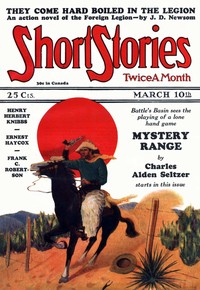
The day promised to be fine as Joe Breedlove mounted and swung out of Prairieville. He had breakfasted well, there was money in his belt, and a sound animal carried him. It was late October; rose flame spread all along the eastern rim and the air was clear, thin and sparkling. Down in the brakes the trees glowed yellow and crimson. The ridges, wet by a recent rain, showed a verdant tinge. It was a morning to make a man heady with the surge of his blood and the expansion of his spirits.
Even so, Joe Breedlove rode off in a pensive state of mind. He had seen an old and chosen friend married the day before. Married and settled on a ranch. And, while rejoicing at his comrade’s luck, he saw the finger of destiny point him out henceforth as a lone rider, a solitary wanderer. Hereafter he would sit beside the night fire alone, watch the distant stars alone. Once he would not have minded, for early youth has a way of being self-sufficient. Joe, going along his thirties, felt the need of friends. It was the way he was built.
He rode with a smile on his lean face, the smile of a man who looked at the world with shrewd and tolerant eyes, of one who loved life but was never for a moment fooled by it. That, as a matter of fact, was the substance of Joe Breedlove; his was the nature to make allowances for all frail and mortal things, asking in return very little for himself. He was quite tall and ridden down to hard, slender muscle. His features were broad, generous; and his hair, where it showed beneath the Stetson, had a silver color that made him seem older than he was.
Thus he rode onward, busied with his thoughts and with the signs about him. It was a rugged, barren land as it reached southward, and to the casual observer nothing much met the eye. But to Joe Breedlove, versed in the country, it was an unfolding story. Here a lobo crossed the trail, his pads broad and plain in the dust. Alongside were the flanking prints of accompanying pilot coyotes. Twenty yards to the left he caught a flash of coiled orange and black under a sage bush. High overhead and farther along a buzzard wheeled in a steady circle, the sign it had sighted carrion on the ground. Joe watched the bird as he traveled, a kind of impersonal curiosity in his mind. But he would presently have forgotten it had he not quite of a sudden arrived at a wide flurry of hoofprints cutting athwart the trail. A cavalcade of men, traveling fast, had come out of the left ridge not long before and aimed straight for the rugged land farther west.
Breedlove studied these prints at some length, a kind of soft chuckle in his throat. “Six--eight men in a hellbent hurry. Now what you suppose? Minions o’ the law or gents escapin’ the wrath o’ justice? Not that it makes any difference, but it might be profitable to know.”
He didn’t know this country, but stray report indicated it was somewhat tough. Down at the southern end of the valley there was a town called Canyon and the name of it was a byword as much as five hundred miles northward where men in jest often said, “I’m goin’ to kill me a sheriff some day an’ go to Canyon.” The theory rightly or wrongly being that this act was a necessary qualification to citizenship in the place.
Joe Breedlove lifted his eyes again to the buzzard which by now had dropped lower and traversed a narrower circle. He wasn’t certain, but he thought dust still hung over the cavalcade’s trail in the west. Again the chuckle welled up. He swung his horse to the left, aiming at the buzzard’s mark. “They say trouble comes to a fella that’s got trouble in his heart. Well, pony, we’re as pure of conscience as the driftin’ snow. Nev’less we ain’t goin’ no place so lessee what’s over there. It might be interestin’.”
To the left he traveled, threading gullies, climbing the ridge’s side. Stony pockets lined the ridge, ringed here and there by stunted pines. As he came beneath the buzzard’s arc he took great care not to appear stealthy, slowing the pony and whistling the mournful bars of some old song. Likewise he kept well up on the ridge where he might be seen, and although his glance absorbed everything he appeared to be half asleep in the saddle.
“Buzzards,” he opined casually, “ain’t nowise healthy animals, but they tell a lot.” Then he straightened a little. He had arrived at another of the depressions. In its bottom was a dead paint horse, saddle and gear stripped from it. But it hadn’t been dead long and Joe Breedlove, looking across the rim to where the pines bunched together, nodded his silvered head ever so slightly. He dropped into the depression and from the saddle read a plain, commonplace tale. The animal had broken its leg in a gopher hole and had been put away with a bullet. Breedlove raised his head to the pines and spoke aloud.
“If you got me covered up there, jes’ forget it. I ain’t after yore skelp. Plenty to do watchin’ my own.”
And he rolled himself a cigarette, waiting. Several moments passed. Then the brush rustled and a man came from concealment, sliding down the slope, gun in his fist. He was a thin, undersized bundle of nerves with a fiery, impatient face. It was far from a handsome face, yet it bore no apparent depravity or wickedness. Breedlove, placidly smoking, set the man down as just another of those bantams who were forever bridling at injustice. Apparently the fellow had a gambler’s spirit, for after a cursory glance toward Breedlove he dropped his gun into the holster, shoved his hat back over a jet black cowlick and began to swear in melodious, flowing syllables. Even a bullwhacker would have acknowledged the artistry, the complete adequacy of that cursing. Breedlove smiled in benevolent, approving interest.
“Some men,” he remarked, “are shore born with the gift. Nothin’ lubricates the soul like a little well-chosen profanity.”
“Was yuh ever in Canyon?” asked the stranger in a high-pitched voice.
“No,” admitted Breedlove, “I’m from the north. But I was rapidly vergin’ tords that point.”
The small one made expressive gesture with his hands. “Stay away, stay away, brother. Nineveh an’ Tyre--they don’t compete. Nossir, they don’t nowise compete with Canyon. A sink o’ iniquity, a stinkin’ hog waller, a condemned blotch o’ scurvy on nature’s benign countenance.” He looked at Breedlove almost meekly. “_Amigo_, I ain’t tongue-tied, but I’d shore have to improvise on the English langwidge to name an’ classify that Siwash smellin’, snake-belly crawlin’, festerin’ heap o’ boards what----”
“Ample,” interposed Breedlove. “Plumb ample. I would gather Canyon had done you some great wrong.”
The small man’s voice had a way of breaking and rising to falsetto in anger or excitement. It squeaked now like a pair of rusty hinges. “Wrong? Did yuh say wrong, amigo? Huh, what it done to me was a-plenty!” He kicked at the loose stones with his feet, adding somberly, “But I guess I did a few things m’self. Did yuh see a passel o’ beetle-faced gents sashayin’ acrost the landscape down yonder?”
“I saw tracks cuttin’ westward about two miles.”
The wiry one looked gloomily at his horse. “Uhuh. They’re a-follerin’ a dead trail I laid down. Me, I’d been out of this stagnatin’ country, by now, if the paint hoss hadn’t struck a hole an’ sent me to hell and gone on my coco.” He squatted down and laid a brown hand on the animal’s neck. “He shore was a good hoss, too.”
Something inside Breedlove grew warm and friendly. He announced, through a ring of smoke, “Name’s Joe Breedlove. Bound south. Nothin’ in p’ticular. Jes’ a-travelin’.”
“I dunno what they took me for,” muttered the small one, rising on his haunches. “I was a-mindin’ my own fool business, which ain’t usual for me, but nev’less I was readin’ my own hole cards. Thunder, but trouble jus’ popped up like a gusher comin’ in! Out goes the lights an’ bang goes the furniture. Well, when a man ain’t wanted he’d orter have sense enough to depart. Which was what I proceeded to do even if the dang’ fools tried to impede my progress.”
“Some towns is mos’ unusually clannish thataway. It takes a can opener to get in an’ a crowbar to get out.”
“Uhuh,” said the wiry one. He flashed a sidewise glance at Breedlove. There was something about this tall, serene man that inspired trust. It may have been the directness of his glance or it may have been the shrewd yet unsoured humor hovering in the corners of his broad mouth. At any rate, he invited confidence. The small one announced solemnly that it had been his aim and intent to hit for the Box U and find work with the beef roundup. Men, he added, called him “Indigo” Bowers.
Silence for a moment. Then Breedlove stretched forward his right hand and they shook. “All right, Indigo.”
“All right, Joe.”
The formalities were completed, a rough and ready partnership formed. Indigo studied the sweep of the valley through the trees. “What would you do,” he inquired casually, “if a tin horn sport insinuated yuh was holdin’ more aces than the law required? Yuh a-knowin’ all the time this gent had a sleeve full o’ said aces an’ was jus’ tryin’ to initiate an argument for private purposes?”
Breedlove studied the matter at full length, likewise watching the valley below. “I believe I’d enter some sorta protest to the management. Nobody’s got a call to be ill-mannered.”
Indigo seized upon this with a show of eagerness, as if it had justified his acts. “That’s jus’ exactly what I did. But I didn’t kill the guy. Nossir, I aimed high an’ to one side. If he died it was because of his own weak constitution an’ none o’ my fault. Why should they blame me because some gent went into an argument with impaired health?” Then his manner and tone changed. “You skin out of here, Joe. Them bloodhounds are back-trackin’. They’ll reach here in no time.”
Breedlove also had seen the dust cloud growing out of the west. He slipped from the saddle and motioned to Indigo. “Hop aboard. Skin out. When the storm’s blown over come back.”
“Hell, no,” objected Indigo. “Those guys ain’t civil.”
“They don’t know me from Adam,” said Breedlove. “I’ll say you ambushed me and took my horse. Hit over toward that broken top and I’ll steer ’em north.”
Indigo gave Breedlove one quick glance and swung up. “All right. But I’ll have an eye on ’em. If I see you bein’ led off in chains, I’ll turn this country to cinders.”
“A soft answer,” smiled Breedlove, “punctures many a bloated temper.”
“Mebbe so,” was Indigo’s dubious reply. “I ain’t never tried it.” Then he was up the hollow and out of sight. Breedlove moved half along the slope, buried his gun beneath a flat rock and settled back to smoke in peace.
The posse came upon him somewhat sooner than he had expected. In fact it was just three cigarettes later that he heard a rustling noise to his rear and an abrupt command to elevate his elbows. He complied, though not in silence.
“Pull in yore neck,” he advised the unseen gentleman. “Can’t a man study nature without interruption?”
Men dropped into the depression from various angles. Indigo Bowers had called them beetle-faced and it would have been difficult for Joe Breedlove to have improved on the term. Foremost among these pursuers was one who had a pair of excessively bowed props and a bull voice. He aimed a question at Breedlove in a conversational tone, yet the echo of it fled among the trees and filtered down toward the valley.