When the baby is born there is no place to put it: it is born, it will in time die, therefore there is no sense in enlarging the world by so many miles and minutes for its accommodation. A temporary scaffolding is set up for it, an altar to ephemerality--a permanent altar to ephemerality. This altar is the Myth. The object of the Myth is to give happiness: to help the baby pretend that what is ephemeral is permanent. It does not matter if in the course of time he discovers that all is ephemeral: so long as he can go on pretending that it is permanent he is happy.
As it is not one baby but all babies which are laid upon this altar, it becomes the religious duty of each to keep on pretending for the sake of all the others, not for himself. Gradually, when the baby grows and learns why he has been placed on the altar, he finds that he is not particularly interested in carrying on the pretence, that happiness and unhappiness are merely an irregular succession and grouping of moments in him between his birth and his death. Yet he continues to support the Myth for others’ sake, and others continue to support it for his. The stronger grows the inward conviction of the futility of the Myth, the stronger grows the outward unity and form of the Myth. It becomes the universal sense of duty, the ethics of abstract neighbourliness. It is the repository for whatever one does without knowing why; it makes itself the why. Once given this function through universal misunderstanding, it persists in its reality with the perseverance of a ghost and continues to demand sacrifices. It is indifferent what form or system is given to it from this period to that, so long as it be given a form and a system by which it may absorb and digest every possible activity; and the grown-up babies satisfy it by presenting their offerings as systematized parts of a systematized whole.
The Myth may collapse as a social whole; yet it continues by its own memory of itself to impose itself as an æsthetic whole. Even in this day, when the social and historical collapse of the Myth is commonly recognised, we find poets and critics with an acute sense of time devoting pious ceremonies to the æsthetic vitality of the Myth, from a haunting sense of duty which they call classicism. So this antiquated belief in truth goes on, and we continue to live. The Myth is the art of living. Plato’s censorship of poets in the interests of the young sprang from a realization of the fact that poetry is in opposition to the truth of the Myth: I do not think he objected to poetry for the old, since they were nearly through with living.
Painting, sculpture, music, architecture, religion, philosophy, history and science--these are essentially of the Myth. They have technique, growth, tradition, universal significance (truth); and there is also a poetry of the Myth, made by analogy into a mythological activity. Mythological activities glorify the sense of duty, force on the individual a mathematical exaggeration of his responsibilities.
Poetry (praise be to babyhood) is essentially not of the Myth. It is all the truth it knows, that is, it knows nothing. It is the art of not living. It has no system, harmony, form, public significance or sense of duty. It is what happens when the baby crawls off the altar and is ‘Resolv’d to be a very contrary fellow’--resolved not to pretend, learn to talk or versify. Whatever language it uses it makes up as it goes and immediately forgets. Every time it opens its mouth it has to start all over again. This is why it remains a baby and dies (praise be to babyhood) a baby. In the art of not living one is not ephemerally permanent but permanently ephemeral.
Because most people are not sufficiently employed in themselves, they run about loose, hungering for employment, and satisfy themselves in various supererogatory occupations. The easiest of these occupations, which have all to do with making things already made, is the making of people: it is called the art of friendship. So one finds oneself surrounded with numbers of artificial selves contesting the authenticity of the original self; which, forced to become a competitive self, ceases to be the original self, is, like all the others, a creation. The person, too, becomes a friend of himself. He no longer exists.
Words have three historical levels. They may be true words, that is, of an intrinsic sense; they may be logical words, that is, of an applied sense; or they may be poetical words, of a misapplied sense, untrue and illogical in themselves, but of supposed suggestive power. The most the poet can now do is to take every word he uses through each of these levels, giving it the combined depth of all three, forcing it beyond itself to a death of sense where it is at least safe from the perjuries either of society or poetry.
Language and Laziness
Language is a form of laziness; the word is a compromise between what it is possible to express and what it is not possible to express. That is, expression itself is a form of laziness. The cause of expression is incomplete powers of understanding and communication: unevenly distributed intelligence. Language does not attempt to affect this distribution; it accepts the inequality and makes possible a mathematical intercourse between the degrees of intelligence occurring in an average range. The degrees of intelligence at each extreme are thus naturally neglected: and yet they are obviously the most important.
Prose is the mathematics of expression. The word is a numerical convenience in which the known and the unknown are brought together to act as the meeting-place of the one who knows and the one who does not know. The prose word accomplishes no redistribution of intelligence; it merely declares the inequality, and so even as expression it has no reality, it is an empty cipher.
Poetry is an attempt to make language do more than express; to make it work; to redistribute intelligence by means of the word. If it succeeds in this the problem of communication disappears. It does not treat this problem as a matter of mathematical distribution of intelligence between an abstract known and unknown represented in a concrete knower and not-knower. The distribution must take place, if at all, within the intelligence itself. Prose evades this problem by making slovenly equations which always seem successful because, being inexact, they conceal inexactness. Poetry always faces, and generally meets with, failure. But even if it fails, it is at least at the heart of the difficulty, which it treats not as a difficulty of minds but of mind.
This Philosophy
This philosophy, this merchant-mindedness: how much have we here? what sum? And of what profit? Somewhere, in the factories of reality, all this has been produced which now floods the market of wisdom, awaiting its price-ticket. What is science? yard-measure and scale to philosophy, expert-accountant, bank clerk. What is poetry? miserable, ill-fed, underpaid, ununionized labourer, pleased to oblige, grateful for work, flattering himself that poverty makes him an aristocrat.
Only what is comic is perfect: it is outside of reality, which is a self-defeating, serious striving to be outside of reality, to be perfect. Reality cannot escape from reality because it is made of belief, and capable only of belief. Perfection is what is unbelievable, the joke.
WHAT IS A POEM?
In the old romanticism the poem was an uncommon effect of common experience on the poet. All interest in the poem centred in this mysterious capacity of the poet for overfeeling, for being overaffected. In Poe the old romanticism ended and the new romanticism began. That is, the interest was broadened to include the reader: the end of the poem was pushed ahead a stage, from the poet to the reader. The uncommon effect of experience on the poet became merely incidental to the uncommon effect which he might have on the reader. Mystery was replaced by science; inspiration by psychology. In the first the poet flattered himself and was flattered by others because he had singular reactions to experience; in the second the object of flattery makes himself expert in the art of flattery.
What is a poem? A poem is nothing. By persistence the poem can be made something; but then it is something, not a poem. Why is it nothing? Because it cannot be looked at, heard, touched or read (what can be read is prose). It is not an effect (common or uncommon) of experience; it is the result of an ability to create a vacuum in experience--it is a vacuum and therefore nothing. It cannot be looked at, heard, touched or read because it is a vacuum. Since it is a vacuum it is nothing for which the poet can flatter himself or receive flattery. Since it is a vacuum it cannot be reproduced in an audience. A vacuum is unalterably and untransferably a vacuum--the only thing that can happen to it is destruction. If it were possible to reproduce it in an audience the result would be the destruction of the audience.
The confusion between the poem as effect and the poem as vacuum is easily explained. It is obvious that all is either effect or it is nothing. What the old romanticism meant by an uncommon effect was a something that was not an effect, an over-and-above of experience. Although it was really not an effect, it was classified as an effect because it was impossible to imagine something that was not an effect. It did not occur to anyone to imagine nothing, the vacuum; or, if it did, only with abhorrence. The new romanticism remedied this inaccuracy by classifying the poem as the cause of an effect--as both cause and effect. But as both cause and effect the poem counts itself out of experience: proves itself to be nothing masquerading as something. As something it is all that the detractors of poetry say it is; it is false experience. As nothing--well, as nothing it is everything in an existence where everything, being effect of effect and without cause, is nothing.
Whenever this vacuum, the poem, occurs, there is agitation on all sides to destroy it, to convert it into something. The conversion of nothing into something is the task of criticism. Literature is the storehouse of these rescued somethings. In discussing literature one has to use, unfortunately, the same language that one uses in discussing experience. But even so, literature is preferable to experience, since it is for the most part the closest one can get to nothing.
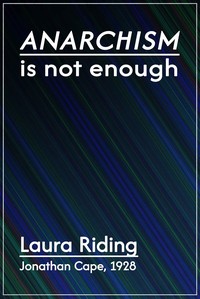
The only productive design is designed waste. Designed creation results in nothing but the destruction of the designer: it is impossible to add to what is; all is and is made. Energy that attempts to make in the sense of making a numerical increase in the sum of made things is spitefully returned to itself unused. It is a would-be-happy-ness ending in unanticipated and disordered unhappiness. Energy that is aware of the impossibility of positive construction devotes itself to an ordered using-up and waste of itself: to an anticipated unhappiness which, because it has design, foreknowledge, is the nearest approach to happiness. Undesigned unhappiness and designed happiness both mean anarchism. Anarchism is not enough.
The book keeps going
Keep reading, and see it illustrated
Reading is free forever. Sign up and watch scenes appear while you read.
Scenes Storieta drew for other classics.