Public-domain ebook
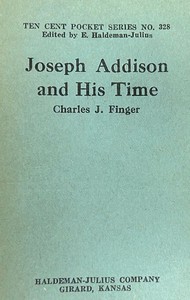
Joseph Addison and his time
Language: en727 downloads on Project Gutenberg
Subjects
Public-domain ebook sourced from Project Gutenberg #78492.
Public-domain ebook
Language: en727 downloads on Project Gutenberg
Subjects
Public-domain ebook sourced from Project Gutenberg #78492.
The opening · free to read
THE MAN AND HIS FRIEND.
The main facts in Addison’s life could be compressed within the compass of an ordinary telegram, thus:
Joseph Addison was born in Wiltshire, England, in 1672, had a grammar school education, and went to Oxford University. Between the ages of twenty-seven and thirty-one he traveled in Europe. Later, he held public offices, but, in 1710 devoted himself seriously to literature, and, in five years, gained lasting fame. He died in 1719.
If, in the style of the modern journalist, you chose to add a spice of mild scandal, you might say that he was married to the Countess of Warwick, but the union was not a happy one. Should a little extra tang be required, it would be quite in order to say that on occasion he drank too much.
Or, supposing that you were very narrow and chose to run a dark smear across his name, you might make much of the fact that he sometimes loaned money to his best friend, Richard Steele, and on one such occasion, sent the sheriff’s officer with an order for the debtor’s arrest, two days after the loan had been made. This story, be it said, you may not find in any existing biography, at least I have not been able to find it, but, nevertheless, it is true, for Dick Steele told it to his friend Richard Savage the poet, who, in turn, told it to Doctor Johnson. Then, of course, James Boswell got hold of it and gave it to the world.
Still, as you know and as I know, and as Nietzsche said, men’s wickedness is much less than the fame of it, so, rightly understood and fairly told, even this, which might be denounced by the thoughtless as an act of base treachery, turns out to be a very ordinary affair, the like of which might easily have befallen me. For the fact is that Richard Steele was Richard Steele, a mighty good fellow, as also was Addison. You see the character of the man as soon as you look at his picture. Ruddy and strong, full of boisterous health is he, one in whom the sap of life rises swiftly. At a glance you see that he can laugh heartily, like Rabelais, like Scarron. If you are supersensitive, if you are timid, you would not go abroad with him, for he is, it is plain to be seen, one who would take you into taverns, into baignoires on occasion, into places where are jovial companions who love a good song, or a jolly story over a bottle. With his kind, you may wind up the night with either a broken head or a belly full, but which ever it was, you would have had a good time. And Addison, a quieter sort, a fine, sensitive type, liked his Irish friend. They had been school boys together, and, later, college chums. They were the same age, too. It was a friendship like that of William of Orange for Bentick, or Queen Anne for Lady Churchill. But Dick Steele was not born with a silver spoon in his mouth, and being a genius, was bold, reckless of life, of health, of which the unco’ guid call honor. So his wealthy relative cast him off before he had graduated from college, and he became a kind of vagrant. He joined the army, soon tired of the discipline, bought himself out, and lived by his wits. He loved women and he loved wine, but he loved wine more than women. He was an easy going, good natured adventurer with a strong literary gift and a tremendous imagination. Like Tom Jones, he lived his life in a manner far from perfect, knew it and regretted it. He had spurts of virtue, he made good resolutions, then straightway forgot all about them and went on in the same old way. Give him a guinea and immediately he went about to find a friend to share it. A good meal and an evening spent in jolly company seemed to him a far more attractive way to dispose of gold than the uninteresting payment of tradesmen’s bills. Besides, do what he would, at one time in his career, to pay off all that he owed seemed an utter impossibility. So, as a palliative measure, he would borrow from Peter to pay Paul.
But Richard Steele was also a letter writer. His winning personality, his charm of manner shone on the written page. He was as irresistible as Micawber, as charming as Esmond. Judge for yourself. I take, almost at random, four letters of twenty. They are written to his wife, and, as most men know, to write to a wife is not easy, and less so when one is long overdue, or too late for dinner, and, to boot, a little far gone in one’s cups. Then it requires both dexterity and diplomacy. The letters are, of course, of subsequent date to the Addison loan affair, but serve to show the peculiar, persuasive qualities of the writer.
To Mrs. Steele.
Monday, seven at night, Sept. 27, 1708.
The book keeps going
Reading is free forever. Sign up and watch scenes appear while you read.



Scenes Storieta drew for other classics.
New illustrated classics
Once or twice a month: the latest books to get full character casts, scene art, and free comic editions. No account needed.