
Storieta illustrated edition
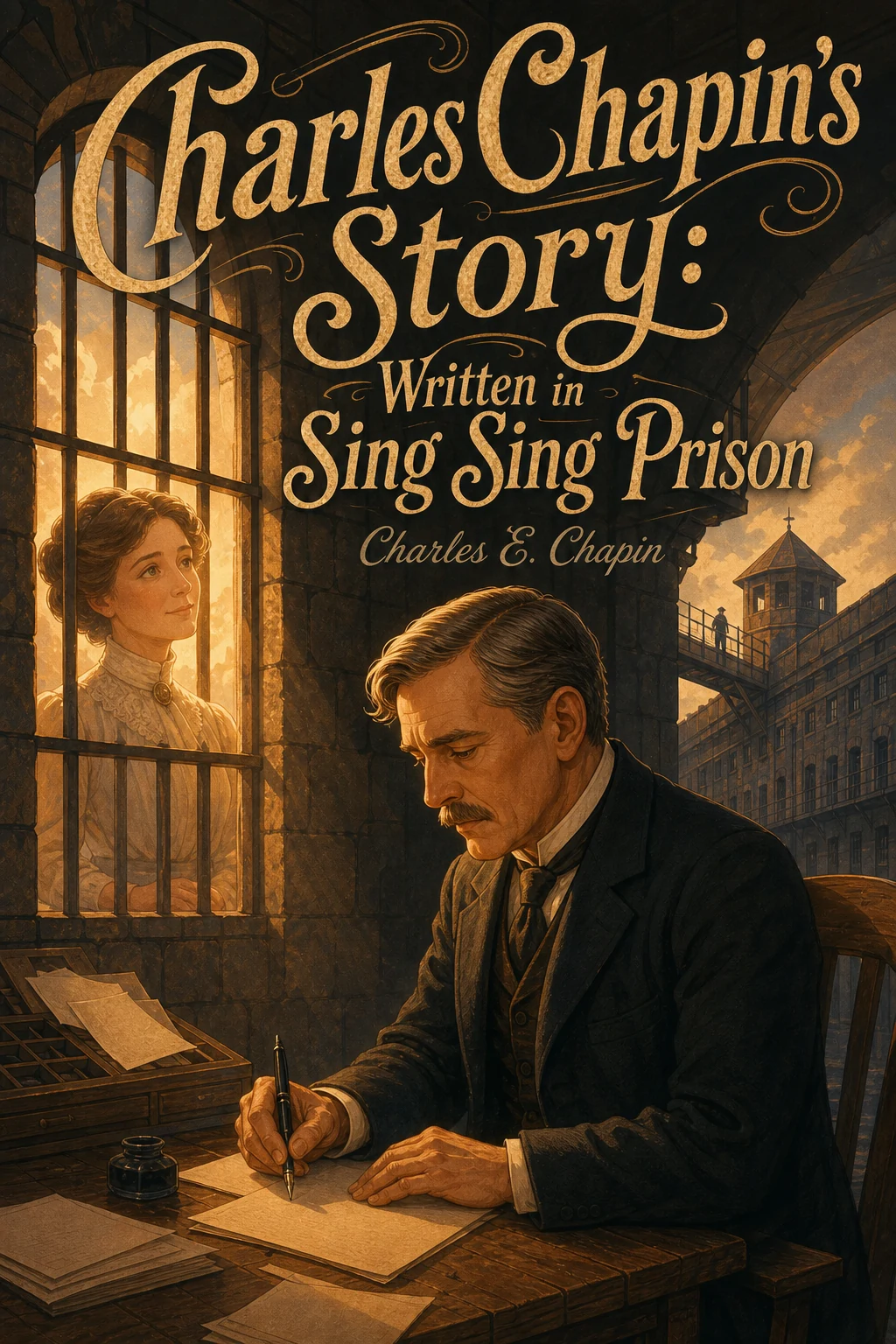
Charles Chapin's story: Written in Sing Sing Prison
by Charles E. Chapin
EnglishDownload EPUB
Journalism, United StatesChapin, Charles E., 1858-1930
Public-domain ebook sourced from Project Gutenberg #78544.
Storieta illustrated edition
by Charles E. Chapin
EnglishDownload EPUB
Public-domain ebook sourced from Project Gutenberg #78544.
Written in Sing Sing Prison, Charles Chapin’s story is a candid autobiographical account shaped by catastrophe, confinement, and a long career in American journalism. Chapin, formerly city editor of the New York Evening World, reflects on forty years as a newspaper man while describing the monotony, solitude, regret, and enforced inward life of imprisonment. The book also places his experience within a broader meditation on how society treats people behind bars, asking readers to see the prisoner as a continuing human presence rather than an outcast. Its subject is grave, but the purpose is not merely to recount a notorious case: it is an effort to understand a life, its failures, and the possibility of rebuilding meaning amid ruin.
The prose is direct, solemn, and intensely reflective, combining the practiced observation of a veteran newspaperman with the moral seriousness of early twentieth-century prison writing. Chapin’s narrative is framed by arguments about justice, punishment, suffering, and human dignity, while personal memories give those ideas emotional weight. The period’s newspaper world, reform debates, and language of moral responsibility are central to its atmosphere. It will appeal to readers interested in journalism history, criminal justice, prison memoirs, and psychologically searching accounts of remorse and endurance.
The opening · free to read
“The defendant was indicted on September 18, 1918, for murder in the first degree, in that he had killed his wife Nellie, with a pistol, by shooting her in the head. At the time of the killing defendant was, and for several years prior thereto had been, the city editor of the New York Evening World. He is sixty years of age. He and his wife whom he killed had been married for thirty-nine years, and the uncontradicted testimony is to the effect that their relations had been singularly devoted.”
The tragic and unusual case of Charles E. Chapin, now serving a term of life imprisonment in Sing Sing, will be well remembered by newspaper readers. The paragraph quoted above is from the report of a Commission which passed upon the sanity of the defendant.
At the time of the tragedy Mr. Chapin wrote a letter to a newspaper associate in part as follows:
“For some time I have been conscious that I am on the verge of a nervous breakdown. I have fought against it continually, but the pains in my head grow more acute, and I realize now that the time is fast approaching when I will collapse entirely. I dread to think of passing the remainder of my life in a sanitarium so I am doing the only thing I can think of to escape such a calamity. I know how wrong it is, but I cannot go on suffering as I have for months. It takes greater courage than I possess. I have tried to think out what is best to do, and cannot bear the thought of leaving my wife to face the world alone, so I have resolved to take her with me.”
The defendant then went to Prospect Park, a revolver in his pocket, intending to end his life. In a newspaper he saw the headline, “Charles Chapin Wanted For Murder.” Going to the nearest police station, he gave himself up.
That, in brief, is the story of the tragedy which terminated the career of the author of this book.
In calling the reader’s attention to the following pages it may be well to strike at once the personal note and explain my acquaintance with the writer. I am not an official visitor at Sing Sing Prison. I am not a philanthropist. In philanthropy as now practiced I have only a limited confidence. Had I not had a personal reason for going to the House of Sorrow I should have felt it an intrusion, almost an impertinence, to have forced myself where men have at least the right not to be stared at while undergoing their agony.
I met Charles Chapin at the request of another prisoner at Sing Sing--a young man doing a life-term for a similar transgression of the law--whom I had come to know by correspondence. A story of mine having attracted his attention he was kind enough to write me. After an exchange of letters I went “up the river” to see him, finding a tall, stalwart, manly, bright-faced lad of twenty-six who had gone there at twenty-two. This meeting was the starting point of an affection which has become one of the precious things in my life.
The writer of this book had been at Sing Sing but a very short time when my younger friend asked me if I would see the new arrival. Here again my own books had prepared the way for me, and, as far as the conditions permitted, our coming together was not different from what it would have been had we met at a club. My recollection is that we talked of the public interests of the day, of literature, and of the scene around us. As to the last there was not a murmur of complaint. In subsequent meetings we have kept to the same tone, though we could not have become as friendly as we are without an element of what I may call mutual solicitude stealing into our intercourse.
My object in bringing up this point is to underscore the fact that when it comes to human dealing there is no difference between the man whom we somewhat hideously call a convict and anybody else. We arrest him, we try him, we sentence him, we lock him behind bars--and having in our own thought thrust him outside the human race we fancy that it must seem to him a matter of course to be in the limbo of outcast souls.
But not at all! Arrested, tried, sentenced, buried in a cell, he is to himself as much a man, and the very same man, as ever he was. As truly as men at liberty he finds the prisoner’s life abnormal. Normality, after all, is only what we are accustomed to. Short of perfection it is not a standard in itself. For the individual normal life is the life to which he has trained himself, and no two lives have been trained alike. Normality is an inner principle more than it is an outer one. Outwardly, through a sort of moral cowardice, we conform as best we can to accepted patterns which inwardly we reject; but it is the inner ideal by which we truly live. There are honored men by the million all over the world whose methods would render them abnormal to most of their fellow-citizens were the bluff to be called. We do not call the bluff, and we dare not, for the reason that the vast majority of us fear that in any such unmasking we ourselves should be exposed.
At the same time hidden wrong, however concealed by our social false-fronts, demands an expiation. We are so constituted--uprightness is so much the native principle of the human being--that our universal departure from the only norm there is cannot go unrecognized. Unconsciously, subconsciously, and even to some extent consciously, we call for sacrifice and propitiation. The more dogged our refusal to repent and reform the more persistent our demand for something or someone to suffer in our stead.
Modern American slang has coined a word for this, doubtless because the need cried out for expression. Like all slang it is the voice of the man in the street, finding the right outlet for his pent-up soul where the scholar and lexicographer have walked round it. In this case, however, modern and ancient instinct have been one, and in our slang word of to-day we link up with a mighty tradition and go back to our first recognition of the soul’s necessities.
We speak of the man on whom the hard consequences fall as--the goat. So did the people who first read the results of wrong in terms of tragedy. The burden of their sin was intolerable. Unwilling to see that they could throw off that burden by giving up the sin they sought means whereby they might go on committing the sin and escape the penalty. So once a year they took a goat and laid their sin upon his head, sending him off into the wilderness to get rid of him. He became the scape-goat who bore their punishment so that they could begin with a clean slate again. It was naïve, childish, but significant.
And in the convict, I am driven to believe, modern civilization is not looking for the brother to be treated wisely because his weakness is so obvious and his suffering so great. If that were all the way would be found as soon as there was a will. The difficulties of dealing with the prison and prisoner are, to my mind, largely inventions. When we consider what gigantic obstacles we have overcome when it was to our interest to overcome them anything here is child’s play. We shake our heads and pull long faces chiefly to get dust into our own eyes, so that we may better carry out the purpose we really have at heart.
That purpose is to find a goat. Is not that the underlying motive of the world-wide cruelty that has made the prison of the Christian the nearest thing to Calvary? Is not that the reason why the most philanthropic and tender-hearted among us can mentally look on at barbarities such as have rarely been surpassed on earth and never turn a hair? In the prisoner we have found our goat. He is suffering not for his own sins alone, but for ours. Naïvely, childishly, but significantly, we outrage every human instinct within him, so that our own secret self-reproach may be appeased. The world as it is, society as we have formed it, must have a goat; and we seize the weakest and most defenseless thing on which we can lay our hands.
I should say right here that I am not speaking from personal knowledge. I know only what every other member of the public knows--what has been written of in newspapers and books, exposed in plays and moving pictures, and never contradicted. I am aware too that efforts at humanizing the prison system have been made here and there, and the Sing Sing of to-day is a proof of them. But they have been made by individuals and have never had the public back of them. When the public, through its elected representatives, have been able to intervene it has been largely to nullify or put a stop to anything meant to mitigate the poor goat’s suffering. Our women, our clergymen, our reformers will cry out against atrocities four thousand miles away, and not lift a finger to stop the operation of the third degree--to cite nothing else--against their own countrymen at their own gates. Here perhaps one should say in the words of One more tolerant than I, “These things ought ye to have done and not leave the other undone.”
It is the more amazing then to see the human sacrifice coming through his crucifixion with exaltation in his face and a new life in his heart. That happens. It happens rarely enough, God knows, but the miracle comes to pass. It has happened in the case of the boy friend I have already mentioned. It has happened in other instances, some of which I myself have known. I have watched it happening in the case of him whose book I am now commending to the public.
To reconstruct a sane and helpful life when all that is left of the self is what one has in common with the animal is an indication of a mighty principle of growth. The writer of these pages is not the man who went “up the river” two years ago. The book reads as though its author had climbed through smiling hills only to fall over a frightful precipice. Possibly; and yet one might fall over a precipice to find oneself in a valley of fruits and flowers, even if among them there are bitter herbs. That is the new life which out of anguish the man is creating for himself and helping to shed about him. The reader will not have finished this book when he has read to the last line, not any more than we have done with a life when we scan its record on a tombstone. The best part of it will lie in the invisible pages through which the tale goes on.
A friend came to visit me. We were seated in the visitors’ room at Sing Sing. It was the first time we had met since that fateful day when the structure I had spent a lifetime in rearing, crashed down upon me and buried me beneath the ruins. I told him something of my life in prison; the dreary monotony of it, the loneliness, the hours of bitter regret, the long nights of solitude, the heartache, the desolation.
In the new life in which I found myself there were duties to be performed during the day, or I must have gone mad with the morbid thoughts that were always surging through my brain. But there were the long evenings and longer nights, sleepless nights in a cell that is no bigger than a dead man’s grave.
I told my friend that I had sought distraction in books. I had plenty of time for reading and more than twelve thousand volumes to choose from. Books were almost my only companions. But sometimes I would read for an hour without retaining a word and frequently I would have to turn back and read the pages again, for I had read only with my eyes; my mind was focused elsewhere. Thoughts of that dreadful tragedy were ever running between the lines of the printed pages. Ofttimes something I read would bring memories and a flood of tears. For even a felon can weep. Oscar Wilde, in the most sorrowful story I have ever read, De Profundis, into which the imprisoned poet poured the tears of his tortured soul, wrote these lines:
“When a day comes that a man in prison does not weep, it is not when he is happy but when his heart is hard.” And yet there are men who argue that imprisonment is not an adequate punishment. They have never tried it.
“Why don’t you turn to writing during some of your leisure hours,” suggested my friend. “Why don’t you write a book?”
“About what?”
“Write an autobiography.”
“I haven’t that much egotism left.”
“Tell the story of your forty years as a newspaper man.”
That night in my cell my thoughts kept me awake. Forty years a newspaper man! Memories began to crowd in upon me. It seemed as if even the smallest events of my life were flashing through a kinetoscope. Whatever else had happened to me, my memory was unimpaired. Events and persons and names through all my forty years of newspaper activity came back to me as vividly as if they had been crowded into the past few months. Thoughts come quickly in the solitude of a prison cell.
Forty years! Looking forward, with the inexperienced eyes of youth, forty years seems a long stretch of time, the span of a life of fullness. Looking backward, when one is sixty and is at the end of his journey, forty years is but a succession of yesterdays that multiplied so rapidly they were come and gone almost without realization. How much action was crowded into those forty years. How much happiness, how much sorrow; what ambitious hopes, what bitter disappointments. Sometimes achieving success, often humiliated by failure. Striving always for fame and riches, acquiring a fleeting glimpse of both, and in the end cast upon the scrap heap of humanity, abandoned and forgotten, dead yet alive.
There is no self-pity in what I write. My heart may be torn with anguish, my mind tormented with regret, but there has never been one moment since I came to prison that I have pitied myself or permitted the pity of others to depress me. I know why I am here and what brought it about. I know that if I were not here I should not be living. I know that if I had died and the dear one I loved had survived she would be suffering greater privation than I ever can. Nothing else matters.
The day after my friend suggested that I write a book, I chanced to read a bit of philosophy that was written by Samuel Smiles. “It is good for men to be roused into action by difficulty, rather than to slumber away their lives in useless apathy and indolence,” wrote this fine philosopher. In the same essay he expressed this thought: “There are natures which blossom and ripen amidst trials that would only wither and decay in an atmosphere of ease and comfort.”
Solitude drives some men mad; it sharpens the wits of others. There are many instances of courageous men who have turned confinement in prison into a great personal achievement. More faint-hearted ones, crushed and defeated by self-pity, drifted quickly into a condition of impotent inertia. Hopeless and without ambition, they withered and died.
Some of the greatest books in all literature were written in the solitude of confinement, written by men who suffered greater hardships than I shall perhaps ever know, for they were in prison in the days when men were treated with inhuman cruelty, before the searchlight of publicity had penetrated into the loathsome dungeons where they were chained and tortured. They are long since dead. What they wrote still lives and will endure as long as books are read. Thoughts expressed in words are imperishable.
When I realized what had been achieved by such illustrious men as Cervantes and Dante and John Bunyan and Defoe and Lovelace and Cooper and Campanella and countless others, I was lifted out of despondent lethargy and fired with ambition to try and do something besides cry. It is so easy to cry in prison.
I began to write. In memory I lived my life over again. My manuscript grew into many pages and the occupation of mind it gave often lifted me out of myself and my gloomy surroundings. I think it may have saved me from the worst possible fate that could have befallen me. I wrote on from day to day without fixed purpose. I had no thought of ever publishing my story. I was content that it gave me something to do and that in doing it the iron within was rising to crush out morbid thoughts.
About the time my story was nearing completion, Major Lewis E. Lawes came to Sing Sing as Warden, a man of heart and understanding, the right man in a big job. Because I had previously had experience in newspaper making, he asked me to become editor of the institutional paper, the Sing Sing Bulletin. A request from the Warden is equivalent to an order and it was my duty to comply as obediently as if I had been ordered to duty on the coal dump. Major Lawes did not make his order compulsory. He simply pointed out that it might be an opportunity for me to do something useful, something that might be of lasting benefit to others. It is fine to make believe that one is still of some use in the world, even though he fails.
I published the first chapter of my autobiography in our prison paper and some of my associates here urged me to continue it. My good friend Basil King, who wrote that wonderful story, The City of Comrades, read my manuscript. His advice prompted me to send it to a publisher. That is how my story now comes to you.
C. E. C. SING SING, May, 1920.
Newspapering, of a kind, commenced for me in a thriving little Western town when I was just fourteen years old, and had started out to climb from the bottom the long ladder that leads up through education and experience to fame and fortune. In this little town I was attracted by a sign in the window of a newspaper office. A boy was wanted to deliver papers.
I applied at the front counter for the job and was directed to the circulation manager, who critically sized me up and declared that I wouldn’t do. He needed strong boys, he said, boys who were husky enough to pack a heavy bundle of newspapers over a route several miles in length and deliver them to subscribers before they sat down to breakfast.
I was a little chap, even for my age, but I had grit and persuaded the man to give me a trial. It was my duty to be in the pressroom at 3.30 o’clock every morning, take papers from the press as fast as they were printed, fold to regulation form, and start off with several hundred strapped to my shoulder, delivering to the homes of subscribers as I went along. It was a five-mile tramp before breakfast and in almost the hilliest town I ever saw. Many of the streets on my route were so steep that one took almost as many steps upward as forward and in the winter months I would often flounder through snow that was waist deep.
My wages were four dollars a week. I realized that I could not pay expenses and save up for my education on this slender income, so I set to work to find ways of increasing it. Opportunity came knocking at my door within a week. In the same building with the newspaper was a telegraph office and one morning when I returned from delivering papers the operator called me in and asked if I would carry an important message to the home of a United States Senator. It was from President Grant, he said, and could not be delayed. His regular messenger boy hadn’t shown up.
I readily consented and I recall how chesty I felt as bearer of a Presidential message on which the fate of the nation might hang. My importance grew on me as I trudged along and finally I broke into a run. When the maid came to the door and said the Senator wasn’t up I insisted that she show me to his bedchamber.
I was led upstairs to where the Senator was sleeping his wits away, perhaps dreaming of that big land swindle with which his name was afterward so scandalously linked. I rapped several times without a response. The door was ajar and I could get a glimpse of him in his bed, the blankets pulled over his head as if to deaden the sound of his noisy snoring.
Getting no reply to my repeated knocking I pushed the door open, went boldly into the room, and yanked the bedclothing from the sleeper. He awoke with a start and glared at me as if he were going to bite.
“Wake up, Senator,” I exclaimed, not a bit abashed, “I have an important telegraph message for you from President Grant.” I know that I must have swelled up as I thrust it into his outstretched hand.
He read it and began to laugh.
“How did you know that it is important?” he asked.
The book keeps going
Reading is free forever. Sign up and watch scenes appear while you read.



Scenes Storieta drew for other classics.

Charles Chapin's story: Written in Sing Sing Prison stays free to read. A free account keeps it in your library, with 25 credits to illustrate scenes as you go.