Public-domain ebook
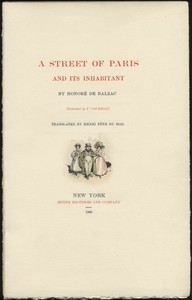
A Street of Paris and Its Inhabitant
Language: en564 downloads on Project Gutenberg
Subjects
Public-domain ebook sourced from Project Gutenberg #8150.
Public-domain ebook
Language: en564 downloads on Project Gutenberg
Subjects
Public-domain ebook sourced from Project Gutenberg #8150.
The opening · free to read
Paris has curved streets, streets that are serpentine. It counts, perhaps, only the Rue Boudreau in the Chaussee d'Antin and the Rue Duguay-Trouin near the Luxembourg as streets shaped exactly like a T-square. The Rue Duguay-Trouin extends one of its two arms to the Rue d'Assas and the other to the Rue de Fleurus.
In 1827 the Rue Duguay-Trouin was paved neither on one side nor on the other; it was lighted neither at its angle nor at its ends. Perhaps it is not, even to-day, paved or lighted. In truth, this street has so few houses, or the houses are so modest, that one does not see them; the city's forgetfulness of them is explained, then, by their little importance.
Lack of solidity in the soil is a reason for that state of things. The street is situated on a point of the Catacombs so dangerous that a portion of the road disappeared recently, leaving an excavation to the astonished eyes of the scarce inhabitants of that corner of Paris.
A great clamor arose in the newspapers about it. The government corked up the "Fontis"--such is the name of that territorial bankruptcy--and the gardens that border the street, destitute of passers-by, were reassured the more easily because the tax list did not weigh on them.
The arm of the street that extends to the Rue de Fleurus is entirely occupied, at the left, by a wall on the top of which shine broken bottles and iron lances fixed in the plaster--a sort of warning to hands of lovers and of thieves.
In this wall is a door, the famous little garden door, so necessary to dramas and to novels, which is beginning to disappear from Paris.
This door, painted in dark green, having an invisible lock, and on which the tax collector had not yet painted a number; this wall, along which grow thistles and grass with beaded blades; this street, with furrows made by the wheels of wagons; other walls gray and crowned with foliage, are in harmony with the silence that reigns in the Luxembourg, in the convent of the Carmelites, in the gardens of the Rue de Fleurus.
If you went there, you would ask yourself, "Who can possibly live here?"
Who? Wait and see.
One day, about three in the afternoon, that door was opened. Out of it came a little old man, fat, provided with an abdomen heavy and projecting which obliges him to make many sacrifices. He has to wear trousers excessively wide, not to be troubled in walking. He has renounced, long ago, the use of boots and trouser straps. He wears shoes. His shoes were hardly polished.
The waistcoat, incessantly impelled to the upper part of the gastric cavities by that great abdomen, and depressed by the weight of two thoracic bumps that would make the happiness of a thin woman, offers to the pleasantries of the passers-by a perfect resemblance to a napkin rolled on the knees of a guest absorbed in discussion at dessert.
The legs are thin, the arm is long, one of the hands is gloved only on most solemn occasions and the other hand ignores absolutely the advantage of a second skin.
That personage avoids the alms and the pity that his venerable green frock coat invites, by wearing the red ribbon at his button-hole. This proves the utility of the Order of the Legion of Honor which has been contested too much in the past ten years, the new Knights of the Order say.
The battered hat, in a constant state of horror in the places where a reddish fuzz endures, would not be picked up by a rag picker, if the little old man let it fall and left it at a street corner.
Too absent-minded to submit to the bother that the wearing of a wig entails, that man of science--he is a man of science--shows, when he makes a bow, a head that, viewed from the top, has the appearance of the Farnese Hercules's knee.
Above each ear, tufts of twisted white hair shine in the sun like the angry silken hairs of a boar at bay. The neck is athletic and recommends itself to the notice of caricaturists by an infinity of wrinkles, of furrows; by a dewlap faded but armed with darts in the fashion of thistles.
The constant state of the beard explains at once why the necktie, always crumpled and rolled by the gestures of a disquiet head, has its own beard, infinitely softer than that of the good old man, and formed of threads scratched from its unfortunate tissue.
Now, if you have divined the torso and the powerful back, you will know the sweet tempered face, somewhat pale, the blue ecstatic eyes and the inquisitive nose of that good old man, when you learn that, in the morning, wearing a silk head kerchief and tightened in a dressing-gown, the illustrious professor--he is a professor--resembled an old woman so much that a young man who came from the depths of Saxony, of Weimar, or of Prussia, expressly to see him, said to him, "Forgive me, Madame!" and withdrew.
This silhouette of one of the most learned and most venerated members of the Institute betrays so well enthusiasm for study and absent-mindedness caused by application to the quest of truth, that you must recognize in it the celebrated Professor Jean Nepomucene Apollodore Marmus de Saint-Leu, one of the most admirable men of genius of our time.
She seemed to be fifty years of age, and her dress indicated that she was one of those servants who are invested with full authority in household affairs.
She was darning stockings.
The man of science came back and said naively:
"Yes, Madame Adolphe, I have my handkerchief."
"Have you your spectacles?" she asked.
The man of science felt the side pocket of his waistcoat.
"I have them," he replied.
"Show them to me," she said. "Often you have only the case."
The professor took the case out of his pocket and showed the spectacles with a triumphant air.
"You would do well to keep them on your nose," she said.
M. de Saint-Leu put on his spectacles, after rubbing the glasses with his handkerchief.
Naturally, he thrust the handkerchief under his left arm while he set his spectacles on his nose. Then he walked a few steps towards the Rue de Fleurus and relaxed his hold on the handkerchief, which fell.
"I was sure of it," said Madame Adolphe to herself. She picked up the handkerchief and cried:
"Monsieur! Monsieur!"
"Well!" exclaimed the professor, made indignant by her watchfulness.
"I beg your pardon," he said, receiving the handkerchief.
"Have you any money?" asked Madame Adolphe with maternal solicitude.
"I need none," he replied naively, explaining thus the lives of all men of science.
"It depends," Madame Adolphe said. "If you go by way of the Pont des Arts you need one sou."
"You are right," replied the man of science, as if he were retracing instructions for a voyage to the North Pole. "I will go through the Luxembourg, the Rue de Seine, the Pont des Arts, the Louvre, the Rue du Coq, the Rue Croix-des-Petits-Champs, the Rue des Fosses-Montmartre. It is the shortest route to the Faubourg Poissonniere."
"It is three o'clock," Madame Adolphe said. "Your sister-in-law dines at six. You have three hours before you--Yes--you'll be there, but you'll be late." She searched her apron pocket for two sous, which she handed to the professor.
The book keeps going
Reading is free forever. Sign up and watch scenes appear while you read.



Scenes Storieta drew for other classics.
New illustrated classics
Once or twice a month: the latest books to get full character casts, scene art, and free comic editions. No account needed.