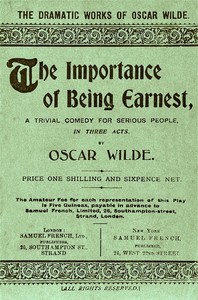
Morning-room in Algernon’s flat in Half-Moon Street. The room is luxuriously and artistically furnished. The sound of a piano is heard in the adjoining room.
[Lane is arranging afternoon tea on the table, and after the music has ceased, Algernon enters.]
ALGERNON. Did you hear what I was playing, Lane?
LANE. I didn’t think it polite to listen, sir.
ALGERNON. I’m sorry for that, for your sake. I don’t play accurately—any one can play accurately—but I play with wonderful expression. As far as the piano is concerned, sentiment is my forte. I keep science for Life.
LANE. Yes, sir.
ALGERNON. And, speaking of the science of Life, have you got the cucumber sandwiches cut for Lady Bracknell?
LANE. Yes, sir. [Hands them on a salver.]
ALGERNON. [Inspects them, takes two, and sits down on the sofa.] Oh! . . . by the way, Lane, I see from your book that on Thursday night, when Lord Shoreman and Mr. Worthing were dining with me, eight bottles of champagne are entered as having been consumed.
LANE. Yes, sir; eight bottles and a pint.
ALGERNON. Why is it that at a bachelor’s establishment the servants invariably drink the champagne? I ask merely for information.
LANE. I attribute it to the superior quality of the wine, sir. I have often observed that in married households the champagne is rarely of a first-rate brand.
ALGERNON. Good heavens! Is marriage so demoralising as that?
LANE. I believe it is a very pleasant state, sir. I have had very little experience of it myself up to the present. I have only been married once. That was in consequence of a misunderstanding between myself and a young person.
ALGERNON. [Languidly_._] I don’t know that I am much interested in your family life, Lane.
LANE. No, sir; it is not a very interesting subject. I never think of it myself.
ALGERNON. Very natural, I am sure. That will do, Lane, thank you.
LANE. Thank you, sir. [Lane goes out.]
ALGERNON. Lane’s views on marriage seem somewhat lax. Really, if the lower orders don’t set us a good example, what on earth is the use of them? They seem, as a class, to have absolutely no sense of moral responsibility.
[Enter Lane.]
LANE. Mr. Ernest Worthing.
[Enter Jack.]
ALGERNON. [Stiffly_._] I believe it is customary in good society to take some slight refreshment at five o’clock. Where have you been since last Thursday?
JACK. [Sitting down on the sofa.] In the country.
ALGERNON. What on earth do you do there?
JACK. [Pulling off his gloves_._] When one is in town one amuses oneself. When one is in the country one amuses other people. It is excessively boring.
ALGERNON. And who are the people you amuse?
JACK. [Airily_._] Oh, neighbours, neighbours.
ALGERNON. Got nice neighbours in your part of Shropshire?
JACK. Perfectly horrid! Never speak to one of them.
ALGERNON. How immensely you must amuse them! [Goes over and takes sandwich.] By the way, Shropshire is your county, is it not?
JACK. Eh? Shropshire? Yes, of course. Hallo! Why all these cups? Why cucumber sandwiches? Why such reckless extravagance in one so young? Who is coming to tea?
ALGERNON. Oh! merely Aunt Augusta and Gwendolen.
JACK. How perfectly delightful!
ALGERNON. Yes, that is all very well; but I am afraid Aunt Augusta won’t quite approve of your being here.
JACK. May I ask why?
ALGERNON. My dear fellow, the way you flirt with Gwendolen is perfectly disgraceful. It is almost as bad as the way Gwendolen flirts with you.
JACK. I am in love with Gwendolen. I have come up to town expressly to propose to her.
ALGERNON. I thought you had come up for pleasure? . . . I call that business.
JACK. How utterly unromantic you are!
The book keeps going
Keep reading, and see it illustrated
Reading is free forever. Sign up and watch scenes appear while you read.
Scenes Storieta drew for other classics.