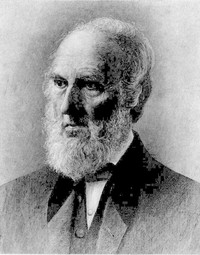
[8] From a review of "ANDERSONVILLE, A STORY OF SOUTHERN MILTTARY PRISONS," published serially in the Toledo "Blade" in 1879, and afterwards in book form.
"There is a deep fascination in the subject of Andersonville--for that Golgotha, in which lie the whitening bones of 13,000 gallant young men, represents the dearest and costliest sacrifice of the war for the preservation of our national unity. It is a type, too, of its class. Its more than hundred hecatombs of dead represent several times that number of their brethren, for whom the prison gates of Belle Isle, Danville, Salisbury, Florence, Columbia, and Cahaba open'd only in eternity. There are few families in the North who have not at least one dear relative or friend among these 60,000 whose sad fortune it was to end their service for the Union by lying down and dying for it in a southern prison pen. The manner of their death, the horrors that cluster'd thickly around every moment of their existence, the loyal, unfaltering steadfastness with which they endured all that fate had brought them, has never been adequately told. It was not with them as with their comrades in the field, whose every act was perform'd in the presence of those whose duty it was to observe such matters and report them to the world. Hidden from the view of their friends in the north by the impenetrable veil which the military operations of the rebels drew around the so-called confederacy, the people knew next to nothing of their career or their sufferings. Thousands died there less heeded even than the hundreds who perish'd on the battlefield. Grant did not lose as many men kill'd outright, in the terrible campaign from the Wilderness to the James river--43 days of desperate fighting--as died in July and August at Andersonville. Nearly twice as many died in that prison as fell from the day that Grant cross'd the Rapidan, till he settled down in the trenches before Petersburg. More than four times as many Union dead lie under the solemn soughing pines about that forlorn little village in southern Georgia, than mark the course of Sherman from Chattanooga to Atlanta. The nation stands aghast at the expenditure of life which attended the two bloody campaigns of 1864, which virtually crush'd the confederacy, but no one remembers that more Union soldiers died in the rear of the rebel lines than were kill'd in the front of them. The great military events which stamp'd out the rebellion drew attention away from the sad drama which starvation and disease play'd in those gloomy pens in the far recesses of sombre southern forests."
From a letter of "Johnny Bouquet," in N. Y. "Tribune," March 27, '81.
"I visited at Salisbury, N. C., the prison pen or the site of it, from which nearly 11,000 victims of southern politicians were buried, being confined in a pen without shelter, exposed to all the elements could do, to all the disease herding animals together could create, and to all the starvation and cruelty an incompetent and intense caitiff government could accomplish. From the conversation and almost from the recollection of the northern people this place has dropp' d, but not so in the gossip of the Salisbury people, nearly all of whom say that the half was never told; that such was the nature of habitual outrage here that when Federal prisoners escaped the townspeople harbor'd them in their barns, afraid the vengeance of God would fall on them, to deliver even their enemies back to such cruelty. Said one old man at the Boyden House, who join'd in the conversation one evening: 'There were often men buried out of that prison pen still alive. I have the testimony of a surgeon that he had seen them pull'd out of the dead cart with their eyes open and taking notice, but too weak to lift a finger. There was not the least excuse for such treatment, as the confederate government had seized every sawmill in the region, and could just as well have put up shelter for these prisoners as not, wood being plentiful here. It will be hard to make any honest man in Salisbury say that there was the slightest necessity for those prisoners having to live in old tents, caves and holes half-full of water. Representations were made to the Davis government against the officers in charge of it, but no attention was paid to them. Promotion was the punishment for cruelty there. The inmates were skeletons. Hell could have no terrors for any man who died there, except the inhuman keepers.'"
Death of a Pennsylvania Soldier
_Frank H. Irwin, company E, 93rd Pennsylvania--died May 1, '65--My letter to his mother_--Dear madam: No doubt you and Frank's friends have heard the sad fact of his death in hospital here, through his uncle, or the lady from Baltimore, who took his things. (I have not seen them, only heard of them visiting Frank.) I will write you a few lines--as a casual friend that sat by his death-bed. Your son, corporal Frank H. Irwin, was wounded near fort Fisher, Virginia, March 25th, 1865--the wound was in the left knee, pretty bad. He was sent up to Washington, was receiv'd in ward C, Armory-square hospital, March 28th--the wound became worse, and on the 4th of April the leg was amputated a little above the knee--the operation was perform' d by Dr. Bliss, one of the best surgeons in the army--he did the whole operation himself--there was a good deal of bad matter gather'd--the bullet was found in the knee. For a couple of weeks afterwards he was doing pretty well. I visited and sat by him frequently, as he was fond of having me. The last ten or twelve days of April I saw that his case was critical. He previously had some fever, with cold spells. The last week in April he was much of the time flighty--but always mild and gentle. He died first of May. The actual cause of death was pyaemia, (the absorption of the matter in the system instead of its discharge.) Frank, as far as I saw, had everything requisite in surgical treatment, nursing, &c. He had watches much of the time. He was so good and well-behaved and affectionate, I myself liked him very much. I was in the habit of coming in afternoons and sitting by him, and soothing him, and he liked to have me--liked to put his arm out and lay his hand on my knee--would keep it so a long while. Toward the last he was more restless and flighty at night--often fancied himself with his regiment--by his talk sometimes seem'd as if his feelings were hurt by being blamed by his officers for something he was entirely innocent of--said, "I never in my life was thought capable of such a thing, and never was." At other times he would fancy himself talking as it seem'd to children or such like, his relatives I suppose, and giving them good advice; would talk to them a long while. All the time he was out of his head not one single bad word or idea escaped him. It was remark'd that many a man's conversation in his senses was not half as good as Frank's delirium. He seem'd quite willing to die--he had become very weak and had suffer'd a good deal, and was perfectly resign'd, poor boy. I do not know his past life, but I feel as if it must have been good. At any rate what I saw of him here, under the most trying circumstances, with a painful wound, and among strangers, I can say that he behaved so brave, so composed, and so sweet and affectionate, it could not be surpass'd. And now like many other noble and good men, after serving his country as a soldier, he has yielded up his young life at the very outset in her service. Such things are gloomy--yet there is a text, "God doeth all things well"--the meaning of which, after due time, appears to the soul.
I thought perhaps a few words, though from a stranger, about your son, from one who was with him at the last, might be worth while--for I loved the young man, though I but saw him immediately to lose him. I am merely a friend visiting the hospitals occasionally to cheer the wounded and sick.
W. W.
The Armies Returning
May 7.--Sunday.--To-day as I was walking a mile or two south of Alexandria, I fell in with several large squads of the returning Western army, (Sherman's men as they call'd themselves) about a thousand in all, the largest portion of them half sick, some convalescents, on their way to a hospital camp. These fragmentary excerpts, with the unmistakable Western physiognomy and idioms, crawling along slowly--after a great campaign, blown this way, as it were, out of their latitude--I mark'd with curiosity, and talk'd with off and on for over an hour. Here and there was one very sick; but all were able to walk, except some of the last, who had given out, and were seated on the ground, faint and despondent. These I tried to cheer, told them the camp they were to reach was only a little way further over the hill, and so got them up and started, accompanying some of the worst a little way, and helping them, or putting them under the support of stronger comrades.
May 21.--Saw General Sheridan and his cavalry to-day; a strong, attractive sight; the men were mostly young, (a few middle-aged,) superb-looking fellows, brown, spare, keen, with well-worn clothing, many with pieces of water-proof cloth around their shoulders, hanging down. They dash'd along pretty fast, in wide close ranks, all spatter'd with mud; no holiday soldiers; brigade after brigade. I could have watch'd for a week. Sheridan stood on a balcony, under a big tree, coolly smoking a cigar. His looks and manner impress'd me favorably.
May 22.--Have been taking a walk along Pennsylvania avenue and Seventh street north. The city is full of soldiers, running around loose. Officers everywhere, of all grades. All have the weatherbeaten look of practical service. It is a sight I never tire of. All the armies are now here (or portions of them,) for to-morrow's review. You see them swarming like bees everywhere.
The Grand Review
For two days now the broad spaces of Pennsylvania avenue along to Treasury hill, and so by detour around to the President's house, and so up to Georgetown, and across the aqueduct bridge, have been alive with a magnificent sight, the returning armies. In their wide ranks stretching clear across the Avenue, I watch them march or ride along, at a brisk pace, through two whole days--infantry, cavalry, artillery--some 200,000 men. Some days afterwards one or two other corps; and then, still afterwards, a good part of Sherman's immense army, brought up from Charleston, Savannah, &c.
Western Soldiers
May 26-7.--The streets, the public buildings and grounds of Washington, still swarm with soldiers from Illinois, Indiana, Ohio, Missouri, Iowa, and all the Western States. I am continually meeting and talking with them. They often speak to me first, and always show great sociability, and glad to have a good interchange of chat. These Western soldiers are more slow in their movements, and in their intellectual quality also; have no extreme alertness. They are larger in size, have a more serious physiognomy, are continually looking at you as they pass in the street. They are largely animal, and handsomely so. During the war I have been at times with the Fourteenth, Fifteenth, Seventeenth, and Twentieth Corps. I always feel drawn toward the men, and like their personal contact when we are crowded close together, as frequently these days in the street-cars. They all think the world of General Sherman; call him "old Bill," or sometimes "uncle Billy."