The opening · free to read
Second Series
PUBLISHER’S NOTE.
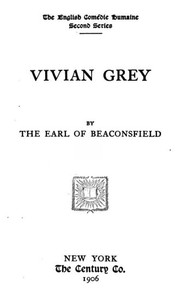
As a novelist, Benjamin Disraeli belongs to the early part of the nineteenth century. “Vivian Grey” (1826-27) and “Sybil” (1845) mark the beginning and the end of his truly creative period; for the two productions of his latest years, “Lothair” (1870) and “Endymion” (1880), add nothing to the characteristics of his earlier volumes except the changes of feeling and power which accompany old age. His period, thus, is that of Bulwer, Dickens, and Thackeray, and of the later years of Sir Walter Scott--a fact which his prominence as a statesman during the last decade of his life, as well as the vogue of “Lothair” and “Endymion,” has tended to obscure. His style, his material, and his views of English character and life all date from that earlier time. He was born in 1804 and died in 1881.
Disraeli was barely twenty-one when he published “Vivian Grey,” his first work of fiction; and the young author was at once hailed as a master of his art by an almost unanimous press.
In this, as in his subsequent books, it was not so much Disraeli’s notable skill as a novelist but rather his portrayal of the social and political life of the day that made him one of the most popular writers of his generation, and earned for him a lasting fame as a man of letters. In “Vivian Grey” is narrated the career of an ambitious young man of rank; and in this story the brilliant author has preserved to us the exact tone of the English drawing-room, as he so well knew it, sketching with sure and rapid strokes a whole portrait gallery of notables, disguised in name may be, but living characters nevertheless, who charm us with their graceful manners and general air of being people of consequence. “Vivian Grey,” then, though not a great novel is beyond question a marvelously true picture of the life and character of an interesting period of English history and made notable because of Disraeli’s fine imagination and vivid descriptive powers.
The book keeps going
Keep reading, and see it illustrated
Reading is free forever. Sign up and watch scenes appear while you read.
Scenes Storieta drew for other classics.