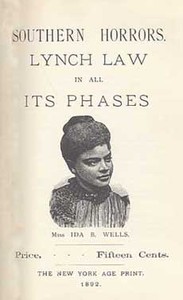
Immediately after the awful barbarism which disgraced the State of Georgia in April of last year, during which time more than a dozen colored people were put to death with unspeakable barbarity, I published a full report showing that Sam Hose, who was burned to death during that time, never committed a criminal assault, and that he killed his employer in self-defense.
Since that time I have been engaged on a work not yet finished, which I interrupt now to tell the story of the mob in New Orleans, which, despising all law, roamed the streets day and night, searching for colored men and women, whom they beat, shot and killed at will.
In the account of the New Orleans mob I have used freely the graphic reports of the New Orleans Times-Democrat and the New Orleans Picayune. Both papers gave the most minute details of the week's disorder. In their editorial comment they were at all times most urgent in their defense of law and in the strongest terms they condemned the infamous work of the mob.
It is no doubt owing to the determined stand for law and order taken by these great dailies and the courageous action taken by the best citizens of New Orleans, who rallied to the support of the civic authorities, that prevented a massacre of colored people awful to contemplate.
For the accounts and illustrations taken from the above-named journals, sincere thanks are hereby expressed.
The publisher hereof does not attempt to moralize over the deplorable condition of affairs shown in this publication, but simply presents the facts in a plain, unvarnished, connected way, so that he who runs may read. We do not believe that the American people who have encouraged such scenes by their indifference will read unmoved these accounts of brutality, injustice and oppression. We do not believe that the moral conscience of the nation--that which is highest and best among us--will always remain silent in face of such outrages, for God is not dead, and His Spirit is not entirely driven from men's hearts.
When this conscience wakes and speaks out in thunder tones, as it must, it will need facts to use as a weapon against injustice, barbarism and wrong. It is for this reason that I carefully compile, print and send forth these facts. If the reader can do no more, he can pass this pamphlet on to another, or send to the bureau addresses of those to whom he can order copies mailed.
Besides the New Orleans case, a history of burnings in this country is given, together with a table of lynchings for the past eighteen years. Those who would like to assist in the work of disseminating these facts, can do so by ordering copies, which are furnished at greatly reduced rates for gratuitous distribution. The bureau has no funds and is entirely dependent upon contributions from friends and members in carrying on the work.
Ida B. Wells-Barnett Chicago, Sept. 1, 1900
+shot an Officer+
The bloodiest week which New Orleans has known since the massacre of the Italians in 1892 was ushered in Monday, July 24, by the inexcusable and unprovoked assault upon two colored men by police officers of New Orleans. Fortified by the assurance born of long experience in the New Orleans service, three policemen, Sergeant Aucoin, Officer Mora and Officer Cantrelle, observing two colored men sitting on doorsteps on Dryades street, between Washington Avenue and 6th Streets, determined, without a shadow of authority, to arrest them. One of the colored men was named Robert Charles, the other was a lad of nineteen named Leonard Pierce. The colored men had left their homes, a few blocks distant, about an hour prior, and had been sitting upon the doorsteps for a short time talking together. They had not broken the peace in any way whatever, no warrant was in the policemen's hands justifying their arrest, and no crime had been committed of which they were the suspects. The policemen, however, secure in the firm belief that they could do anything to a Negro that they wished, approached the two men, and in less than three minutes from the time they accosted them attempted to put both colored men under arrest. The younger of the two men, Pierce, submitted to arrest, for the officer, Cantrelle, who accosted him, put his gun in the young man's face ready to blow his brains out if he moved. The other colored man, Charles, was made the victim of a savage attack by Officer Mora, who used a billet and then drew a gun and tried to kill Charles. Charles drew his gun nearly as quickly as the policeman, and began a duel in the street, in which both participants were shot. The policeman got the worst of the duel, and fell helpless to the sidewalk. Charles made his escape. Cantrelle took Pierce, his captive, to the police station, to which place Mora, the wounded officer, was also taken, and a man hunt at once instituted for Charles, the wounded fugitive.
In any law-abiding community Charles would have been justified in delivering himself up immediately to the properly constituted authorities and asking a trial by a jury of his peers. He could have been certain that in resisting an unwarranted arrest he had a right to defend his life, even to the point of taking one in that defense, but Charles knew that his arrest in New Orleans, even for defending his life, meant nothing short of a long term in the penitentiary, and still more probable death by lynching at the hands of a cowardly mob. He very bravely determined to protect his life as long as he had breath in his body and strength to draw a hair trigger on his would-be murderers. How well he was justified in that belief is well shown by the newspaper accounts which were given of this transaction. Without a single line of evidence to justify the assertion, the New Orleans daily papers at once declared that both Pierce and Charles were desperadoes, that they were contemplating a burglary and that they began the assault upon the policemen. It is interesting to note how the two leading papers of New Orleans, the Picayune and the Times-Democrat, exert themselves to justify the policemen in the absolutely unprovoked attack upon the two colored men. As these two papers did all in their power to give an excuse for the action of the policemen, it is interesting to note their versions. The Times-Democrat of Tuesday morning, the twenty-fifth, says:
Two blacks, who are desperate men, and no doubt will be proven burglars, made it interesting and dangerous for three bluecoats on Dryades street, between Washington Avenue and Sixth Street, the Negroes using pistols first and dropping Patrolman Mora. But the desperate darkies did not go free, for the taller of the two, Robinson, is badly wounded and under cover, while Leonard Pierce is in jail.
For a long time that particular neighborhood has been troubled with bad Negroes, and the neighbors were complaining to the Sixth Precinct police about them. But of late Pierce and Robinson had been camping on a door step on the street, and the people regarded their actions as suspicious. It got to such a point that some of the residents were afraid to go to bed, and last night this was told Sergeant Aucoin, who was rounding up his men. He had just picked up Officers Mora and Cantrell, on Washington Avenue and Dryades Street, and catching a glimpse of the blacks on the steps, he said he would go over and warn the men to get away from the street. So the patrolmen followed, and Sergeant Aucoin asked the smaller fellow, Pierce, if he lived there. The answer was short and impertinent, the black saying he did not, and with that both Pierce and Robinson drew up to their full height.
For the moment the sergeant did not think that the Negroes meant fight, and he was on the point of ordering them away when Robinson slipped his pistol from his pocket. Pierce had his revolver out, too, and he fired twice, point blank at the sergeant, and just then Robinson began shooting at the patrolmen. In a second or so the policemen and blacks were fighting with their revolvers, the sergeant having a duel with Pierce, while Cantrell and Mora drew their line of fire on Robinson, who was working his revolver for all he was worth. One of his shots took Mora in the right hip, another caught his index finger on the right hand, and a third struck the small finger of the left hand. Poor Mora was done for; he could not fight any more, but Cantrell kept up his fire, being answered by the big black. Pierce's revolver broke down, the cartridges snapping, and he threw up his hands, begging for quarter.
The sergeant lowered his pistol and some citizens ran over to where the shooting was going on. One of the bullets that went at Robinson caught him in the breast and he began running, turning out Sixth Street, with Cantrell behind him, shooting every few steps. He was loading his revolver again, but did not use it after the start he took, and in a little while Officer Cantrell lost the man in the darkness.
Pierce was made a prisoner and hurried to the Sixth Precinct police station, where he was charged with shooting and wounding. The sergeant sent for an ambulance, and Mora was taken to the hospital, the wound in the hip being serious.
A search was made for Robinson, but he could not be found, and even at 2 o'clock this morning Captain Day, with Sergeant Aucoin and Corporals Perrier and Trenchard, with a good squad of men, were beating the weeds for the black.
The New Orleans Picayune of the same date described the occurrence, and from its account one would think it was an entirely different affair. Both of the two accounts cannot be true, and the unquestioned fact is that neither of them sets out the facts as they occurred. Both accounts attempt to fix the beginning of hostilities upon the colored men, but both were compelled to admit that the colored men were sitting on the doorsteps quietly conversing with one another when the three policemen went up and accosted them. The Times-Democrat unguardedly states that one of the two colored men tried to run away; that Mora seized him and then drew his billy and struck him on the head; that Charles broke away from him and started to run, after which the shooting began. The Picayune, however, declares that Pierce began the firing and that his two shots point blank at Aucoin were the first shots of the fight. As a matter of fact, Pierce never fired a single shot before he was covered by Aucoin's revolver. Charles and the officers did all the shooting. The Picayune's account is as follows:
Patrolman Mora was shot in the right hip and dangerously wounded last night at 11:30 o'clock in Dryades Street, between Washington and Sixth, by two Negroes, who were sitting on a door step in the neighborhood.
The shooting of Patrolman Mora brings to memory the fact that he was one of the partners of Patrolman Trimp, who was shot by a Negro soldier of the United States government during the progress of the Spanish-American war. The shooting of Mora by the Negro last night is a very simple story. At the hour mentioned, three Negro women noticed two suspicious men sitting on a door step in the above locality. The women saw the two men making an apparent inspection of the building. As they told the story, they saw the men look over the fence and examine the window blinds, and they paid particular attention to the make-up of the building, which was a two-story affair. About that time Sergeant J.C. Aucoin and Officers Mora and J.D. Cantrell hove in sight. The women hailed them and described to them the suspicious actions of the two Negroes, who were still sitting on the step. The trio of bluecoats, on hearing the facts, at once crossed the street and accosted the men. The latter answered that they were waiting for a friend whom they were expecting. Not satisfied with this answer, the sergeant asked them where they lived, and they replied "down town," but could not designate the locality. To other questions put by the officers the larger of the two Negroes replied that they had been in town just three days.