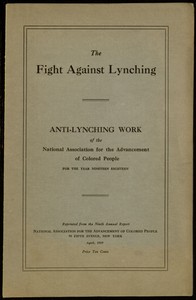
The anti-lynching work of the National Association for the Advancement of Colored People is carried on as a part of the activities of the Association under the direction of the Association's Anti-Lynching Committee, whose names appear elsewhere.
This work was made possible in the beginning through an initial contribution of $1,000 made by Mr. Philip G. Peabody, of Boston, Mass., in the fall of 1916, toward a fund of $10,000 to be used in a vigorous campaign against the lynching evil. The Association's president, Mr. Moorfield Storey, contributed a second $1,000 and as the result of a wide-spread appeal an amount slightly in excess of $10,000 over and above the cost of the appeal was subscribed. The Association is endeavoring to raise approximately $10,000 annually to carry on this work.
The principal activities of the anti-lynching campaign include:
Investigation of as many of the lynchings as possible.
Publication and distribution of the investigator's findings and of other data concerning lynching.
Inquiries and protests whenever lynchings occur, to governors, sheriffs and other state and local authorities by telegraph and letter, and, in selected cases, amounting in the aggregate to a considerable number, appeals to leading chambers of commerce urging them to demand that their governors and other officials take legal action against lynchers.
Press publicity of such inquiries and protests and of the results of the Association's investigations and other matter of current "news" interest in order thus to create public sentiment against lynching.
Research into the facts regarding past lynchings.
Collection of press and editorial comment on lynching in general and on particular lynchings.
Study of causes and remedies for lynching.
Efforts to secure specific legislation to prevent lynching.
Continuous agitation of the subject through the columns of the Association's organ, The Crisis and through meetings and addresses upon every appropriate occasion.
Generally to keep the evil of lynching before the American people as a live issue and to offer a constructive program for its abolition.
The Association, through its president and secretary, acting for the Anti-Lynching Committee, took the initiative in promoting a National Conference on Lynching which will be held in New York City on the fifth and sixth of May, 1919, for the purpose of focusing the attention of the nation on this blot upon America's fair name and of working out an effective, constructive program for its abolition. This conference has been called by one hundred and twenty leaders of American opinion, it being judged best that the conference be called by distinguished Americans rather than by the Association itself, or the Anti-Lynching Committee, in order that the appeal might not be hampered in the minds of anyone by its association with the work of an organization devoted to the interests of the Negro, and to which there might be opposition on that account.
Among the signers of this call are the attorney general of the United States, five governors, one of them, Governor Hugh M. Dorsey of Georgia, a southern governor, four ex-governors, one of these, Hon. Emmet O'Neal of Alabama, from the South, two ex-attorney generals of the United States, nine university presidents, the president of the American Bar Association, a number of leading lawyers of national reputation of the country, including Elihu Root and Charles Evans Hughes, Cardinal Gibbons and leading churchmen and representative colored leaders. Nineteen of the signers of the call are representatives leaders of southern white liberal opinion.
The Association urgently appeals for financial support in its constructive efforts to stamp out lynching in the United States.
The Fight Against Lynching
"I therefore very earnestly and solemnly beg that the governors of all the states, the law officers of every community, and above all, the men and women of every community in the United States, all who revere America and wish to keep her name without stain or reproach, will co-operate, not passively merely, but actively and watchfully to make an end of this disgraceful evil. It cannot live where the community does not countenance it."
July 26, 1918. WOODROW WILSON.
Comment by the Way
An increased executive and clerical staff has permitted the Association to devote more time and thought to its Anti-Lynching work and to conduct a more energetic campaign for legal trial of Negro alleged offenders, than in any previous year of the Association's history. Lynching is rapidly becoming a national issue. Under the stress of war time, mob violence has menaced communities heretofore relatively immune. Four white men were lynched in 1918. And yet, when all the facts are summed up, and we would be the last to minimize the evil of mob violence or to excuse it in the least degree, the lynching of Negroes by whites is the outstanding fact in the situation.
Sixty-three Negroes are known to have died at the hands of white mobs during 1918, as we point out in succeeding pages. These lynchings might well be regarded as evidences of civil war were it not that up to this time the Negroes have not retaliated in kind. In the absence of combined action by Negroes forcibly to protect members of their race, the lynching of black men and women by white men for all causes and no cause, so far as crimes are concerned, can only be compared, although in lesser degree, to Russian pogroms against Jews under the Tzarist regime, or to Turkish attacks upon the Armenians.
We would deeply deplore the forcible defense of Negroes by other Negroes, since it would perhaps lead to sanguinary conflicts between the lower element of whites and the Negroes, but no sane observer can fail to reflect that either white men, who make and enforce the laws, must stop mob attacks upon black men, no matter what reason may be given for the attacks, or confess themselves unable to maintain law and order and protect all citizens from unlawful attack. No class of citizens can be denied the protection of the law with impunity.
The National Association for the Advancement of Colored People fights this evil, as others in its program, with spiritual and legal weapons. Its appeal is to the heart, the mind, the conscience of America. It insists upon "ordered law and humane justice," to quote a phrase used by President Wilson in his appeal to the country against lynching. It has hoped that the better South would rouse itself and wipe out this terrible blot upon its honor. But the wait has been a long one. Can the Negro depend upon securing his day in court so long as he has no say as to who sits upon the bench, in the jury box, or who becomes the sheriff or chief of police? Think it over in the light of experience, ye voters and students of history and politics!
Previous to 1918
The records show that from 1885 to 1917, both inclusive, approximately 3,740 lynchings have occurred in the United States. Two thousand seven hundred and forty-three (2,743) of this number have had colored persons as victims and nine hundred and ninety-seven (997) have been white. The relative percentages of white and colored victims for the 33 years covered is 26 per cent, white; 74 per cent, colored.
Assuming that the record for the earlier years is less accurate than for the later period, because of many factors (all lynching figures are probably minimum), the figures for the 18 years, 1900 to 1917, both inclusive, are given. Fourteen hundred and twenty-seven (1,427) lynchings are recorded for the period named. Twelve hundred and forty-one (1,241) of these (86.7 per cent) were Negroes; 186 (13.3 per cent) were white. The relative decrease of white victims is marked.
The victims of the East St. Louis mob riots of July, 1917, are excluded, as are those of the mob riot at Chester, Pa. The number of victims at East St. Louis has been estimated at as many as 175. In the report of the Congressional Investigating Committee (House Document No. 1,231, 65th Congress, 2nd Session) the Committee says that "at least 39 Negroes and 8 white people were killed outright, and hundreds of Negroes were wounded and maimed."[2]
During 1918
During 1918, 63 Negroes and 4 white persons were lynched, as established by well authenticated evidence.[3] The Executive Office has been advised of a probable increase of this figure by 12 cases of which it is said that confirmation of lynching can be obtained, but, as the Executive Office has been unable to investigate these cases, they have, of course, been excluded from our figures.
An Association staff member, while in the South studying special problems, was informed by reliable colored people in Georgia that twelve unreported cases (in the press or elsewhere) have occurred since the Association investigated the Brooks and Lowndes Counties, Georgia, lynching orgy of May, 1918, and that the only apparent effect in Georgia of the President's lynching pronouncement of July 26th last, has been an apparently concerted agreement on the part of press and authorities to keep all news regarding lynchings out of the Georgia press. Lending some color to this charge, is the fact that, so far as we are aware, no Georgia daily has at any time since May, 1918, published any account of the investigation made by the Association or of the fact that 17 names of mob leaders were put in the hands of Governor Dorsey, despite the considerable press comment in the press of other states.
One of our Texas branches (Houston) reported the case of one alleged victim of a mob who was buried secretly and no publicity given to the facts. The branch's president had written to the acting-governor requesting an investigation of the circumstances.[4] Finally, some lynchings which do not get into the press, are not carried beyond the immediate neighborhood, sometimes a very small one, unless there is some unusual feature to distinguish the event.