What I say is involuntary, because the subject has been brought into the House from another quarter, as the gentleman himself admits. I would leave that institution to the exclusive consideration and management of the States more peculiarly interested in it, just as long as they can keep within their own bounds. So far, I admit that Congress has no power to meddle with it. As long as they do not step out of their own bounds, and do not put the question to the people of the United States, whose peace, welfare and happiness are all at stake, so long I will agree to leave them to themselves. But when a member from a free State brings forward certain resolutions, for which, instead of reasoning to disprove his positions, you vote a censure upon him, and that without hearing, it is quite another affair. At the time this was done, I said that, as far as I could understand the resolutions proposed by the gentleman from Ohio, (Mr. Giddings,) there were some of them for which I was ready to vote, and some which I must vote against; and I will now tell this House, my constituents, and the world of mankind, that the resolution against which I would have voted was that in which he declares that what are called the slave States have the exclusive right of consultation on the subject of slavery. For that resolution I never would vote, because I believe that it is not just, and does not contain constitutional doctrine. I believe that, so long as the slave States are able to sustain their institutions without going abroad or calling upon other parts of the Union to aid them or act on the subject, so long I will consent never to interfere. I have said this, and I repeat it; but if they come to the free States, and say to them, you must help us to keep down our slaves, you must aid us in an insurrection and a civil war, then I say that with that call comes a full and plenary power to this House and to the Senate over the whole subject. It is a war power. I say it is a war power, and when your country is actually in war, whether it be a war of invasion or a war of insurrection, Congress has power to carry on the war, and must carry it on, according to the laws of war; and by the laws of war, an invaded country has all its laws and municipal institutions swept by the board, and martial law takes the place of them. This power in Congress has, perhaps, never been called into exercise under the present Constitution of the United States. But when the laws of war are in force, what, I ask, is one of those laws? It is this: that when a country is invaded, and two hostile armies are set in martial array, the commanders of both armies have power to emancipate all the slaves in the invaded territory. Nor is this a mere theoretic statement. The history of South America shows that the doctrine has been carried into practical execution within the last thirty years. Slavery was abolished in Columbia, first, by the Spanish General Morillo, and, secondly, by the American General Bolivar. It was abolished by virtue of a military command given at the head of the army, and its abolition continues to be law to this day. It was abolished by the laws of war, and not by municipal enactments; the power was exercised by military commanders, under instructions, of course, from their respective Governments. And here I recur again to the example of Gen. Jackson. What are you now about in Congress? You are about passing a grant to refund to Gen. Jackson the amount of a certain fine imposed upon him by a Judge, under the laws of the State of Louisiana. You are going to refund him the money, with interest; and this you are going to do because the imposition of the fine was unjust. And why was it unjust? Because Gen. Jackson was acting under the laws of war, and because the moment you place a military commander in a district which is the theatre of war, the laws of war apply to that district.
I might furnish a thousand proofs to show that the pretensions of gentlemen to the sanctity of their municipal institutions under a state of actual invasion and of actual war, whether servile, civil or foreign, is wholly unfounded, and that the laws of war do, in all such cases, take the precedence. I lay this down as the law of nations. I say that military authority takes, for the time, the place of all municipal institutions, and slavery among the rest; and that, under that state of things, so far from its being true that the States where slavery exists have the exclusive management of the subject, not only the President of the United States, but the Commander of the Army, has power to order the universal emancipation of the slaves. I have given here more in detail a principle which I have asserted on this floor before now, and of which I have no more doubt than that you, sir, occupy that chair. I give it in its development, in order that any gentleman from any part of the Union may, if he thinks proper, deny the truth of the position, and may maintain his denial; not by indignation, not by passion and fury, but by sound and sober reasoning from the laws of nations and the laws of war. And if my position can be answered and refuted, I shall receive the refutation with pleasure; I shall be glad to listen to reason, aside, as I say, from indignation and passion. And if, by the force of reasoning, my understanding can be convinced, I here pledge myself to recant what I have asserted.
Let my position be answered; let me be told, let my constituents be told, the people of my State be told--a State whose soil tolerates not the foot of a slave--that they are bound by the Constitution to a long and toilsome march under burning summer suns and a deadly Southern clime for the suppression of a servile war; that they are bound to leave their bodies to rot upon the sands of Carolina, to leave their wives widows and their children orphans; that those who cannot march are bound to pour out their treasures while their sons or brothers are pouring out their blood to suppress a servile, combined with a civil or a foreign war, and yet that there exists no power beyond the limits of the slave State where such war is raging to emancipate the slaves. I say, let this be proved--I am open to conviction; but till that conviction comes, I put it forth not as a dictate of feeling, but as a settled maxim of the laws of nations, that, in such a case, the military supersedes the civil power; and on this account I should have been obliged to vote, as I have said, against one of the resolutions of my excellent friend from Ohio, (Mr. Giddings,) or should at least have required that it be amended in conformity with the Constitution of the United States.
THE WAR POWER OVER SLAVERY.
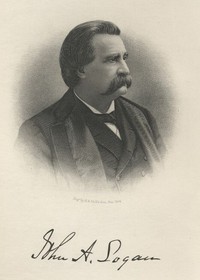
We published, not long ago, an extract from a speech delivered by John Quincy Adams in Congress in 1842, in which that eminent statesman confidently announced the doctrine, that in a state of war, civil or servile, in the Southern States, Congress has full and plenary power over the whole subject of slavery; martial law takes the place of civil laws and municipal institutions, slavery among the rest, and "not only the President of the United States, but the Commander of the Army, has power to order the universal emancipation of the slaves."
Mr. Adams was, in 1842, under the ban of the slaveholders, who were trying to censure him or expel him from the House for presenting a petition in favor of the dissolution of the Union. Lest it may be thought that the doctrine announced at this time was thrown out hastily and offensively, and for the purpose of annoying and aggravating his enemies, and without due consideration, it may be worth while to show that six years previous, in May, 1836, Mr. Adams held the same opinions, and announced them as plainly as in 1842. Indeed, it is quite likely that this earlier announcement of these views was the cause of the secret hostility to the ex-President, which broke out so rancorously in 1842. We have before us a speech by Mr. Adams, on the joint resolution for distributing rations to the distressed fugitives from Indian hostilities in the States of Alabama and Georgia, delivered in the House of Representatives, May 25, 1836, and published at the office of the National Intelligencer. We quote from it the following classification of the powers of Congress and the Executive:--
"There are, then, Mr. Chairman, in the authority of Congress and of the Executive, two classes of powers, altogether different in their nature, and often incompatible with each other--the war power and the peace power. The peace power is limited by regulations and restricted by provisions prescribed within the Constitution itself. The war power is limited only by the laws and usages of nations. This power is tremendous: it is strictly constitutional, but it breaks down every barrier so anxiously erected for the protection of liberty, of property, and of life. This, sir, is the power which authorizes you to pass the resolution now before you, and, in my opinion, no other."
After an interruption, Mr. Adams returned to this subject, and went on to say:--
"There are, indeed, powers of peace conferred upon Congress which also come within the scope and jurisdiction of the laws of nations, such as the negotiation of treaties of amity and commerce, the interchange of public ministers and consuls, and all the personal and social intercourse between the individual inhabitants of the United States and foreign nations, and the Indian tribes, which require the interposition of any law. But the powers of war are all regulated by the laws of nations, and are subject to no other limitation...It was upon this principle that I voted against the resolution reported by the slavery committee, 'that Congress possess no constitutional authority to interfere, in any way, with the institution of slavery in any of the States of this Confederacy,' to which resolution most of those with whom I usually concur, and even my own colleagues in this House, gave their assent. I do not admit that there is, even among the peace powers of Congress, no such authority; but in war, there are many ways by which Congress not only have the authority, but ARE BOUND TO INTERFERE WITH THE INSTITUTION OF SLAVERY IN THE STATES. The existing law prohibiting the importation of slaves into the United States from foreign countries is itself an interference with the institution of slavery in the States. It was so considered by the founders of the Constitution of the United States, in which it was stipulated that Congress should not interfere, in that way, with the institution, prior to the year 1808.
"During the late war with Great Britain, the military and naval commanders of that nation issued proclamations, inviting the slaves to repair to their standard, with promises of freedom and of settlement in some of the British colonial establishments. This surely was an interference with the institution of slavery in the States. By the treaty of peace, Great Britain stipulated to evacuate all the forts and places in the United States, without carrying away any slaves. If the Government of the United States had no power to interfere, in any way, with the institution of slavery in the States, they would not have had the authority to require this stipulation. It is well known that this engagement was not fulfilled by the British naval and military commanders; that, on the contrary, they did carry away all the slaves whom they had induced to join them, and that the British Government inflexibly refused to restore any of them to their masters; that a claim of indemnity was consequently instituted in behalf of the owners of the slaves, and was successfully maintained. All that series of transactions was an interference by Congress with the institution of slavery in the States in one way--in the way of protection and support. It was by the institution of slavery alone that the restitution of slaves, enticed by proclamations into the British service, could be claimed as property. But for the institution of slavery, the British commanders could neither have allured them to their standard, nor restored them otherwise than as liberated prisoners of war. But for the institution of slavery, there could have been no stipulation that they should not be carried away as property, nor any claim of indemnity for the violation of that engagement."