CHARLES ROGERS.
PREFACE.
Scotland has probably produced a more patriotic and more extended minstrelsy than any other country in the world. Those Caledonian harp-strains, styled by Sir Walter Scott "gems of our own mountains," have frequently been gathered into caskets of national song, but have never been stored in any complete cabinet; while no attempt has been made, at least on an ample scale, to adapt, by means of suitable metrical translations, the minstrelsy of the Gaël for Lowland melody. The present work has been undertaken with the view of supplying these deficiencies, and with the further design of extending the fame of those cultivators of Scottish song--hitherto partially obscured by untoward circumstances, or on account of their own diffidence--and of affording a stimulus towards the future cultivation of national poetry.
The plan of the work is distinct from that of every previous collection of Scottish song--the more esteemed lyrical compositions of the various bards being printed along with the memoirs of the respective authors, while the names of the poets have been arranged in chronological order. Those have been considered as modern whose lives extend into the past half-century; and the whole of these have consequently been included in the work. Several Highland bards who died a short period before the commencement of the century have, however, been introduced. Of all the Scottish poets, whether lyrical or otherwise, who survived the period indicated, biographical sketches will be supplied in the course of the publication, together with memoirs of the principal modern collectors, composers and vocalists. The memoirs, so far as is practicable, will be prepared from original materials, of which the Editor, after a very extensive correspondence, has obtained a supply more ample and more interesting than, he flatters himself, has ever been attained by any collector of northern minstrelsy. The work will extend to six volumes, each of the subsequent volumes being accompanied by a dissertation on a distinct department of Scottish poetry and song. Each volume will be illustrated with two elegant engravings. In the course of the work, many original compositions will be presented, recovered from the MSS. of the deceased poets, or contributed by distinguished living bards.
For the department of the "Modern Gaelic Minstrelsy," the Editor has obtained the assistance of a learned friend, intimately familiar with the language and poetry of the Highlands. To this esteemed co-adjutor the reader is indebted for the revisal of the Gaelic department of this work, as well as for the following prefatory observations on the subject:--
"Among the intelligent natives of the Highlands, it is well known that the Gaelic language contains a quantity of poetry, which, how difficult soever to transfuse into other tongues and idioms, never fails to touch the heart, and excite enthusiastic feelings. The plan of 'The Modern Scottish Minstrel' restricts us to a period less favourable to the inspirations of the Celtic muse than remoter times. If it is asked, What could be gained by recurring to a more distant period? or what this unlettered people have really to shew for their bardic pretensions? we answer, that there is extant a large and genuine collection of Highland minstrelsy, ranging over a long exciting period, from the days of Harlaw to the expedition of Charles Edward. The 'Prosnachadh Catha,' or battle-song, that led on the raid of Donald the Islander on the Garioch, is still sung; the 'Woes of the Children of the Mist' are yet rehearsed in the ears of their children in the most plaintive measures. Innerlochy and Killiecrankie have their appropriate melodies; Glencoe has its dirge; both the exiled Jameses have their pæan and their lament; Charles Edward his welcome and his wail;--all in strains so varied, and with imagery so copious, that their repetition is continually called for, and their interest untiring.
"All that we have to offer belongs to recent times; but we cannot aver that the merit of the verses is inferior. The interest of the subjects is certainly immeasurably less; but, perhaps, not less propitious to the lilts and the luinneags, in which, as in her music and imitative dancing, the Highland border has found her best Lowland acceptation.
"We are not aware that we need except any piece, out of the more ancient class, that seems not to admit of being rivalled by some of the compositions of Duncan Ban (Macintyre), Rob Donn, and a few others that come into our own series, if we exclude the pathetic 'Old Bard's Wish,' 'The Song of the Owl,' and, perhaps, Ian Lom's 'Innerlochy.'
"But, while this may be so far satisfactory to our readers, we are under the necessity of claiming their charitable forbearance for the strangers of the mountain whom we are to introduce to their acquaintance. The language, and, in some respects, the imagery and versification, are as foreign to the usages of the Anglo-Saxon as so many samples of Orientalism. The transfusion of the Greek and Latin choral metres is a light effort to the difficulty of imitating the rhythm, or representing the peculiar vein of these song-enamoured mountaineers. Those who know how a favourite ode of Horace, or a lay of Catullus, is made to look, except in mere paraphrase, must not talk of the poorness or triteness of the Highlander's verses, till they are enabled to do them justice by a knowledge of the language. We disdain any attempt to make those bards sing in the mere English taste, even if we could so translate them as to make them speak or sing better than they do. The fear of his sarcasms prevented Dr Johnson from hearing one literal version during his whole sojourn in the Highlands. Sir Walter Scott wished that somebody might have the manliness to recover Highland poetry from the mystification of paraphrase or imposture, and to present it genuine to the English reader. In that spirit we promise to execute our task; and we shall rejoice if even a very moderate degree of success should attend our endeavours to obtain for the sister muse some share of that popularity to which we believe her entitled."
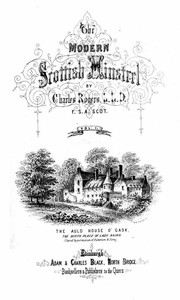
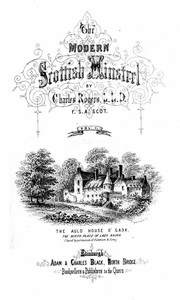
In respect of the present volume of "The Modern Scottish Minstrel," the Editor has to congratulate himself on his being enabled to present, for the first time in a popular form, the more esteemed lays of Carolina, Baroness Nairn, author of "The Laird o' Cockpen," "The Land o' the Leal," and a greater number of popular lyrics than any other Caledonian bard, Burns alone excepted. Several pieces of this accomplished lady, not previously published, have been introduced, through the kindness of her surviving friends. The memoir of the Baroness has been prepared from original documents entrusted to the Editor. For permission to engrave "The Auld House o' Gask," Lady Nairn's birth-place, the Editor's thanks are due to Mr Paterson, music-seller in Edinburgh.
While the present volume of "The Modern Scottish Minstrel" is offered to the public with becoming diffidence, the Editor is not without a faint ray of hope that, if health and sufficient leisure are afforded him, the present publication may be found the most ample and satisfactory repository of national song which has at any period been offered to the public.
ARGYLE HOUSE, STIRLING, April 18, 1855.
CONTENTS.
PAGE JOHN SKINNER, 1 Tullochgorum, 11 John o' Badenyon, 13 The ewie wi' the crookit horn, 17 O! why should old age so much wound us? 20 Still in the wrong, 22 Lizzy Liberty, 24 The stipendless parson, 28 The man of Ross, 31 A song on the times, 33
WILLIAM CAMERON, 35 As o'er the Highland hills I hied, 37
MRS JOHN HUNTER, 39 The Indian death-song, 41 My mother bids me bind my hair, 41 The flowers of the forest, 42 The season comes when first we met, 43 Oh, tuneful voice! I still deplore, 44 Dear to my heart as life's warm stream, 44 The lot of thousands, 45
ALEXANDER, DUKE OF GORDON, 46 Cauld kail in Aberdeen, 48
MRS GRANT OF CARRON, 50 Roy's wife of Aldivalloch, 52
ROBERT COUPER, M.D., 53 Kinrara, 55 The sheeling, 55 The ewe-bughts, Marion, 56
LADY ANNE BARNARD, 58 Auld Robin Gray, 64 " " Part II., 65 Why tarries my love? 68