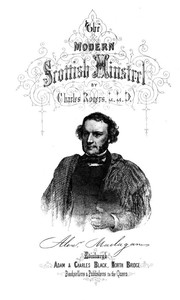
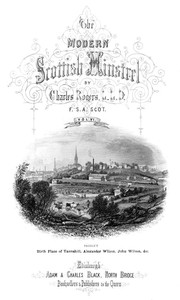
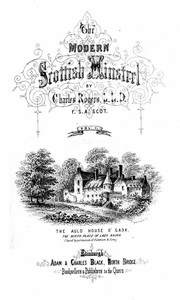
I inscribe to you the present volume of "THE MODERN SCOTTISH MINSTREL," not to express approval of your political sentiments, nor to court your patronage as a man of rank. Political science has occupied only a limited share of my attention, and I have hitherto conducted my peculiar studies without the favour of the great. My dedication is prompted on these twofold grounds:--Bearing in your veins the blood of Scotland's Illustrious Defender, you were one of the first of your order to join in the proposal of rearing a National Monument to his memory; and while some doubted the expediency of the course, and others stood aside fearing a failure, you did not hesitate boldly to come forward as a public advocate of the enterprise. Yourself a man of letters, you were among the foremost who took an interest in the establishment of the Scottish Literary Institute, of which you are now the President--a society having for its main object the relief, in circumstances of virtuous indigence, of those men of genius and learning who have contributed by the pen to perpetuate among our countrymen that spirit of intelligence and love of freedom which, by his sword, Sir William Wallace first taught Scotsmen how to vindicate and maintain.
I have the honour to be, Sir, Your very obedient, humble servant, CHARLES ROGERS.
STIRLING, June 1857.
SCOTTISH LYRICS AND SCOTTISH LIFE.
BY JAMES DODDS.
Judging from a comparison of extant remains, and other means of information now available, it may be doubted whether any country has equalled Scotland in the number of its lyrics. By the term lyrics, I mean specifically poetical compositions, meant and suitable to be sung, with the musical measures to which they have been wedded. I include under the term, both the compositions themselves, and their music. The Scottish ballads are numerous, the Scottish songs all but numberless, and the Scottish tunes an inexhaustible fountain of melody.
"And now 'twas like all instruments, Now like a lonely flute; And now it is an angel's song, That makes the heavens be mute."
Look at the vast collections of them which have been published, and the additions which are ever making, either from some newly-discovered manuscript, or from oral tradition in some out-of-the-way part of the country. The numbers, too, which have been preserved, seem to be exceeded by the numbers that have unfortunately been lost. Who has not in his ears the hum of many lyrics heard by him in his childhood--from mother, or nurse, or some old crooning dame at the fireside--which are to be found in no collection, and which are now to himself but like a distant, unformed sound? All our collectors, whilst smiling in triumph over the pearls which they have brought up and borne to the shore, lament the multitude of precious things irrecoverably buried in the depths of oblivion. Where, for instance, amid the similar wreck which has befallen so many others, are now the ancient words pouring forth the dirge over the "Flowers of the Forest," or those describing the tragic horrors on the "Braes of Yarrow," or those celebrating the wondrous attractions of the "Braw Lads o' Gala Water"? We have but the two first lines--the touching key-note of a lover's grief, in an old song, which has been most tamely rendered in Ramsay's version--these two lines being--
"Alas! that I came o'er the moor, And left my love behind me."
Only one verse has floated down of an old song, which breathes the very soul of a lover's restless longings:--
"Aye wakin', O! Wakin' aye an' eerie; Sleep I canna get For thinkin' on my dearie; Aye wakin', O!"
Does it not at once pique and disappoint the fancy, that these two graceful verses are all that remain of a song, where, doubtless, they were once but two fair blossoms in a large and variegated posy:--
"Within my garden gay The rose and lily grew; But the pride of my garden is wither'd away, And it 's a' grown o'er wi' rue.
"Farewell, ye fading flowers! And farewell, bonnie Jean! But the flower that is now trodden under foot, In time it may bloom again."
Nay--passing from the tender to the grotesque--would it not have been agreeable to hear something more than two lines from the lips of a lover so stout-hearted, yet so ardent, in his own rough, blunt way, as he who has thus commenced his song:--
"I wish my love were in a mire, That I might pull her out again;"
or to know something more of the details of that extraordinary parish, of which one surviving verse draws the following sombre picture:--
"Oh! what a parish!--eh! what a parish! Oh! what a parish is that o' Dunkel': They 've hang'd the minister, droon'd the precentor; They 've pu'd doon the steeple, and drunk the kirk-bell."
The Scottish lyrics, lying all about, thus countless and scattered--
"Thick as autumnal leaves that strew the brooks In Vallambrosa"--
are not like those which mark and adorn the literature of many other countries, the euphonisms of a meretricious court, or the rhymed musings of philosophers, or conceits from Pagan mythology, or the glancing epigrams of men of wit and of the world, or mere hunting choruses and Bacchanalian catches of a rude squirearchy. They are the ballads, songs, and tunes of the people. In their own language, but that language glittering from the hidden well of poesy--in ideas which they at once recognise as their own, because photographed from nature--these lyrics embody the loves and thoughts of the people, the themes on which they delight to dwell, even their passions and prejudices; and vibrate in their memories, quickening the pulses of life, knitting them to the Old Land, and shedding a poetic glow over all the commonplaces of existence and occupation. It is the faithful popular memory, more than anything else, which has been the ark to save the ancient lyrics of Scotland. Not only so, but there is reason to believe that our national lyrics have, generally speaking, been creations of the men, and sometimes of the women, of the people. They are the people's, by the title of origin, no less than by the feeling of sympathy.
This, of course, is clear, as regards the great masters of the lyre who have appeared within the period of known authorship--Ramsay, Burns, Tannahill, Hogg, and Cunningham. The authors of the older lyrics--I mean both compositions and tunes--are, with few exceptions, absolutely unknown; but were there room here for discussion, it might be shewn that all the probabilities lead up, principally, to the ancient order of Minstrels, who from very early times were nearly as much organised and privileged and honoured in Scotland, as ever were the troubadours in Provence and Italy. Ellis, in the Introduction to his "Specimens of Early English Metrical Romances," alluding to Scott's publication of "Sir Tristrem," remarks--"He has shewn, by a reference to ancient charters, that the Scottish minstrels of this early period enjoyed all the privileges and distinctions possessed by the Norman trouveurs, whom they nearly rivalled in the arts of narration, and over whom they possessed one manifest advantage, in their familiar acquaintance with the usual scenes of chivalry." These minstrels, like the majority of poetic singers, were no doubt sons of the people--bold, aspiring, and genius-lit--bursting strong from their mother earth, with all her sap and force and fruitfulness about them. Amongst the last of the professed minstrels was one Burn, who wonned on the Borders as late as the commencement of the eighteenth century, and who, in his pleasant, chirping ditty of "Leader Haughs and Yarrow," takes to himself this very title of Minstrel.
"But Minstrel Burn cannot assuage His grief while life endureth, To see the changes of this age, That fleeting time procureth. For many a place stands in hard case, Where blythe folk kenn'd nae sorrow, With Homes that dwelt on Leader-side, And Scotts that dwelt on Yarrow."
Of this minstrel Burn there is a quaint little personal reminiscence. An aged person at Earlstoun many years ago related, that there used to be a portrait of the minstrel in Thirlestane Castle, near Lauder, "representing him as a douce old man, leading a cow by a straw-rope." The master of the "gay science" gradually slipping down from the clouds, and settling quietly and doucely on the plain hard ground of ordinary life and business! Let all pale-faced and sharp-chinned youths, who are spasmodic poets, or who are in danger of becoming such, keep steadily before them the picture of minstrel Burn, "leading a cow by a straw-rope"--and go and do likewise.
But as trees and flowers can only grow and come to perfection in soils by nature appropriate to them, so it is manifest that all this rich and fertile growth of lyrics, of minstrelsy and music, could only spring up amongst a people most impressionable and joyous. I speak of the Lowland population, and especially of the Borderers, with whose habits, manners and customs, alone I am personally acquainted; and the lingering traces of whose old forms of life--so gay, kindly, and suggestive--I saw some thirty years ago, just before they sank under the mammonism, commonplace, critical apery, and cold material self-seeking, which have hitherto been the plague of the present generation. We have become more practical and knowing than our forefathers, but not so wise. We are now a "fast people;" but we miss the true goal of life--that is, sober happiness. Fast to smattering; fast to outward, isolated show; fast to bankruptcy; fast to suicide; fast to some finale of enormous and dreadful infamy. Bah! rather the plain, honest, homely life of our grandfathers--
"Far from the madding crowd's ignoble strife, Their sober wishes never learn'd to stray; Along the cool, sequester'd vale of life, They kept the noiseless tenor of their way."
Or rather (for every age has its own type, and old forms of life cannot be stereotyped and reproduced), let us have a philosophic and Christian combination of modern adventure and "gold-digging" with old-fashioned balance of mind, and neighbourliness, and open-heartedness, and thankful enjoyment.
Our Scottish race have been--yes, and notwithstanding modern changes, still are--a joyous people--a people full of what I shall term a lyric joyousness. I say they still are--as may be found any day up the Ettricks, and Yarrows, and Galas--up any of our Border glens and dales. The Borderers continue to merit the tribute paid to them in the odd but expressive lines of Wordsworth:--
"The pleasant men of Tiviotdale, Fast by the river Tweed."
From time immemorial they have been enthusiastic lovers of song and music, and have been thoroughly imbued with their influences. Bishop Leslie, a contemporary of the state of manners which he describes, has recorded of them, upwards of two centuries ago--"That they take extreme delight in their music, and in their ballads, which are composed amongst themselves, celebrating the deeds of their ancestors, or the valour and success of their predatory expeditions;" which latter, it must be remembered, were esteemed, in those days, not only not criminal, but just, honourable, and heroic. What a gush of mirth overflows in king James' poem of "Peebles to the Play," descriptive of the Beltane or May-day festival, four hundred years ago! at Peebles, a charming pastoral town in the upper district of the vale of the Tweed:--