Storieta
English
Save & sign up
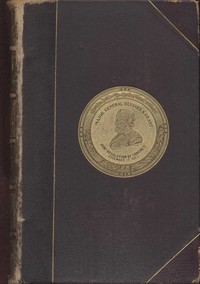
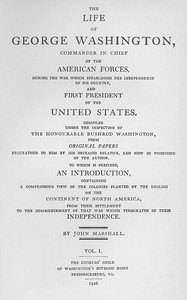
Cover of The Life of George Washington, Vol. 1
 Commander in Chief of the American Forces During the War
 which Established the Independence of his Country and First
 President of the United States

Public-domain ebook

The Life of George Washington, Vol. 1 Commander in Chief of the American Forces During the War which Established the Independence of his Country and First President of the United States

by John Marshall

Language: en8,724 downloads on Project Gutenberg

Subjects

In: Biographies·History - American·History - Modern (1750+)

Public-domain ebook sourced from Project Gutenberg #18591.

About this book

The work is a nineteenth‑century biographical study by John Marshall, catalogued under the subjects of United States generals and presidents, and focused on George Washington (1732‑1799). Though the title promises a portrait of the commander‑in‑chief who led the fight for independence and became the nation’s first president, the opening pages devote considerable space to the earliest English attempts to settle New England. Marshall begins with a detailed chronicle of the Plymouth and Massachusetts Bay companies, the hardships of the 1600s colonists, and the religious and legal disputes that shaped the fledgling settlements. The narrative proceeds in a methodical, documentary style, grounding each episode in the official charters, voyages, and communal covenants that preceded Washington’s own era.

Written in a formal, scholarly tone typical of late‑Victorian historical literature, the book reads like a dense reference work rather than a popular narrative. Its prose is rich in period terminology and exhaustive in its citation of statutes, charters, and colonial records. Readers who appreciate exhaustive archival research, the legal foundations of early American governance, and a measured, academic voice will find this volume rewarding. Those seeking a brisk, story‑driven biography of Washington may prefer a more concise treatment.

Who appears in this book

  • George WashingtonTall, dignified man in 18th‑century military uniform, powdered wig, stoic expression
  • Sir Henry RosewellMiddle‑aged English gentleman, dark ruff collar, doublet with leather boots, solemn gaze
  • Henry VaneYoung English noble, crisp linen shirt, lace cuffs, modest doublet, thoughtful eyes

The opening · free to read

Prosperity of New England.... War with Philip.... Edward Randolph arrives in Boston.... Maine adjudged to Gorges.... Purchased by Massachusetts.... Royal government erected in New Hampshire.... Complaints against Massachusetts.... Their letters patent cancelled.... Death of Charles II.... James II. proclaimed.... New commission for the government of New England.... Sir Edmond Andros.... The charter of Rhode Island abrogated.... Odious measures of the new government.... Andros deposed.... William and Mary proclaimed.... Review of proceedings in New York and the Jerseys.... Pennsylvania granted to William Penn.... Frame of government.... Foundation of Philadelphia laid.... Assembly convened.... First acts of the legislature.... Boundary line with Lord Baltimore settled.

New charter of Massachusetts.... Affairs of New York.... War with France.... Schenectady destroyed.... Expedition against Port Royal.... Against Quebec.... Acadie recovered by France.... Pemaquid taken.... Attempt on St. Johns.... Peace.... Affairs of New York.... Of Virginia.... Disputes between England and France respecting boundary in America.... Recommencement of hostilities.... Quotas of the respective colonies.... Treaty of neutrality between France and the five nations.... Expedition against Port Royal.... Incursion into Massachusetts.... Plan for the invasion of Canada.... Port Royal taken.... Expedition against Quebec.... Treaty of Utrecht.... Affairs of New York.... Of Carolina.... Expedition against St. Augustine.... Attempt to establish the Episcopal church.... Invasion of the colony.... Bills of credit issued.... Legislature continues itself.... Massacre in North Carolina by the Indians.... Tuscaroras defeated.... Scheme of a Bank.

Proceedings of the legislature of Massachusetts.... Intrigues of the French among the Indians.... War with the savages.... Peace.... Controversy with the governor.... Decided in England.... Contests concerning the governor's salary.... The assembly adjourned to Salem.... Contest concerning the salary terminated.... Great depreciation of the paper currency.... Scheme of a land bank.... Company dissolved by act of Parliament.... Governor Shirley arrives.... Review of transactions in New York.

War with the southern Indians.... Dissatisfaction of Carolina with the proprietors.... Rupture with Spain.... Combination to subvert the proprietary government.... Revolution completed.... Expedition from the Havanna against Charleston.... Peace with Spain.... The proprietors surrender their interest to the crown.... The province divided.... Georgia settled.... Impolicy of the first regulations.... Intrigues of the Spaniards with the slaves of South Carolina.... Insurrection of the slaves.

War declared against Spain.... Expedition against St. Augustine.... Georgia invaded.... Spaniards land on an island in the Alatamaha.... Appearance of a fleet from Charleston.... Spanish army re-embarks.... Hostilities with France.... Expedition against Louisbourg.... Louisbourg surrenders.... Great plans of the belligerent powers.... Misfortunes of the armament under the duke D'Anville.... The French fleet dispersed by a storm.... Expedition against Nova Scotia.... Treaty of Aix la Chapelle.... Paper money of Massachusetts redeemed.... Contests between the French and English respecting boundaries.... Statement respecting the discovery of the Mississippi.... Scheme for connecting Louisiana with Canada.... Relative strength of the French and English colonies.... Defeat at the Little Meadows.... Convention at Albany.... Plan of union.... Objected to both in America and Great Britain.

General Braddock arrives.... Convention of governors and plan of the campaign.... French expelled from Nova Scotia, and inhabitants transplanted.... Expedition against fort Du Quesne.... Battle of Monongahela.... Defeat and death of General Braddock.... Expedition against Crown Point.... Dieskau defeated.... Expedition against Niagara.... Frontiers distressed by the Indians.... Meeting of the governors at New York.... Plan for the campaign of 1756.... Lord Loudoun arrives.... Montcalm takes Oswego.... Lord Loudoun abandons offensive operations.... Small-pox breaks out in Albany.... Campaign of 1757 opened.... Admiral Holbourne arrives at Halifax.... Is joined by the earl of Loudoun.... Expedition against Louisbourg relinquished.... Lord Loudoun returns to New York.... Fort William Henry taken.... Controversy between Lord Loudoun and the assembly of Massachusetts.

Preparations for the campaign of 1758.... Admiral Boscawen and General Amherst arrive at Halifax.... Plan of the campaign.... Expedition against Louisbourg, Ticonderoga, and Crown Point.... General Abercrombie repulsed under the walls of Ticonderoga.... Fort Frontignac taken.... Expedition against Fort Du Quesne.... Preparations for the campaign of 1759.... General Amherst succeeds General Abercrombie.... Plan of the campaign.... Ticonderoga and Crown Point taken.... Army goes into winter quarters.... French repulsed at Oswego.... Defeated at Niagara.... Niagara taken.... Expedition against Quebec.... Check to the English army.... Battle on the Plains of Abraham.... Death of Wolfe and Montcalm.... Quebec capitulates.... Garrisoned by the English under the command of General Murray.... Attempt to recover Quebec.... Battle near Sillery.... Quebec besieged by Monsieur Levi.... Siege raised.... Montreal capitulates.... War with the southern Indians.... Battle near the town of Etchoe.... Grant defeats them and burns their towns.... Treaty with the Cherokees.... War with Spain.... Success of the English.... Peace.

Opinions on the supremacy of parliament, and its right to tax the colonies.... The stamp act.... Congress at New York.... Violence in the towns.... Change of administration.... Stamp act repealed.... Opposition to the mutiny act.... Act imposing duties on tea, &c., resisted in America.... Letters from the assembly of Massachusetts to members of the administration.... Petition to the King.... Circular letter to the colonial assemblies.... Letter from the Earl of Hillsborough.... Assembly of Massachusetts dissolved.... Seizure of the Sloop Liberty.... Convention at Fanueil Hall.... Moderation of its proceedings.... Two British regiments arrive at Boston.... Resolutions of the house of Burgesses of Virginia.... Assembly dissolved.... The members form an association.... General measures against importation.... General court convened in Massachusetts.... Its proceedings.... Is prorogued.... Duties, except that on tea, repealed.... Circular letter of the earl of Hillsborough.... New York recedes from the non-importation agreement in part.... Her example followed.... Riot in Boston.... Trial and acquittal of Captain Preston.

The United States of America extend, on the Atlantic, from the bay of Passamaquoddi in the 45th, to Cape Florida in the 25th, degree of north latitude; and thence, on the gulf of Mexico, including the small adjacent islands to the mouth of the Sabine, in the 17th degree of west longitude from Washington. From the mouth of the Sabine to the Rocky mountains, they are separated from Spanish America by a line which pursues an irregular north-western direction to the 42d degree of north latitude, whence it proceeds west, to the Pacific. On the north they are bounded by the British provinces; from which, between the Lake of the Woods and the Rocky, or Stony mountains, they are separated by the 49th parallel of north latitude. Their northern boundary, west of these mountains, has not yet been adjusted.

The extent of this vast Republic, in consequence of its recent acquisition of almost unexplored territory, has not yet been accurately ascertained; but may be stated at two millions of square miles.

Its population, which began on the Atlantic, and is travelling rapidly westward, amounted in 1820, according to the census of that year, to nine millions six hundred and fifty-four thousand four hundred and fifteen persons. The enumerations which have been made under the authority of government, show an augmentation of numbers at the rate of about thirty-four _per centum_[2] in ten years; and it is probable, that for many years to come, this ratio will not be materially changed.

[Footnote 2: The general estimate in the United States is, that their population doubles in twenty-five years.]

Public sentiment, to which the policy of the government conforms, is opposed to a large military establishment; and the distance of the United States from the great powers of the world, protects them from the danger to which this policy might otherwise expose them.

The navy has become an object of great interest to the nation, and may be expected to grow with its resources. In April 1816, Congress passed an act appropriating one million of dollars annually, to its gradual increase; and authorising the construction of nine ships, to rate not less than seventy-four guns each, and of twelve, to rate not less than forty-four guns each.

The execution of this act is in rapid progress. Inconsiderable as the navy now is, with respect to the number and force of its ships, it is deemed inferior to none in existence for the bravery and skill of its officers and men. When we take into view the extensive sea coast of the United States, the magnificent lakes, or inland seas, which form a considerable part of their northern frontier, the abundance of their materials for ship building, and the genius of their population for maritime enterprise, it is not easy to resist the conviction that this bulwark of defence will, at no very distant period, attain a size and strength sufficient to ensure the safety of the nation and the respect of the world.

The net revenue of the United States amounted, in the year 1822, to considerably more than twenty millions of dollars; and, unless a course of legislation unfavourable to its augmentation be adopted, must grow with their population.

In arts, in arms, and in power, they have advanced, and are advancing, with unexampled rapidity.

The history of their progress, from the first feeble settlements made by Europeans on a savage coast, to their present state of greatness; while it has just claims to the attention of the curious of all nations, may be expected deeply to interest every American.

[Sidenote: Commission of Cabot.]

Soon after the return of Columbus from that memorable voyage which opened the vast regions of the west to civilized man, the maritime states of Europe manifested a desire to share with Spain, the glory, the wealth, and the dominion to be acquired in the new world. By no one of these states, was this desire carried into action more promptly than by England, Henry VII. had received communications from Columbus, during the tedious and uncertain negotiations of that great man, at the dilatory court of Ferdinand, which prepared him for the important discoveries afterwards made, and inclined him to countenance the propositions of his own subjects for engaging in similar adventures. On the 5th of March 1495, he granted a commission to John Cabot, an enterprising Venetian who had settled in Bristol, and to his three sons, Lewis, Sebastian, and Sanctius, empowering them, or either of them, to sail under the banner of England, towards the east, north, or west, in order to discover countries unoccupied by any Christian state, and to take possession of them in his name.

The book keeps going

Keep reading, and see it illustrated

Reading is free forever. Sign up and watch scenes appear while you read.

Illustrated scene from FrankensteinIllustrated scene from The Great GatsbyIllustrated scene from Pride and Prejudice

Scenes Storieta drew for other classics.

New illustrated classics

A new classic, drawn, in your inbox.

Once or twice a month: the latest books to get full character casts, scene art, and free comic editions. No account needed.