In this free country every man is at perfect liberty to publish his own thoughts and impressions, and any witness who may differ from me should publish his own version of facts in the truthful narration of which he is interested. I am publishing my own memoirs, not theirs, and we all know that no three honest witnesses of a simple brawl can agree on all the details. How much more likely will be the difference in a great battle covering a vast space of broken ground, when each division, brigade, regiment, and even company, naturally and honestly believes that it was the focus of the whole affair! Each of them won the battle. None ever lost. That was the fate of the old man who unhappily commanded.
In this edition I give the best maps which I believe have ever been prepared, compiled by General O. M. Poe, from personal knowledge and official surveys, and what I chiefly aim to establish is the true cause of the results which are already known to the whole world; and it may be a relief to many to know that I shall publish no other, but, like the player at cards, will "stand;" not that I have accomplished perfection, but because I can do no better with the cards in hand. Of omissions there are plenty, but of wilful perversion of facts, none.
In the preface to the first edition, in 1875, I used these words: "Nearly ten years have passed since the close of the civil war in America, and yet no satisfactory history thereof is accessible to the public; nor should any be attempted until the Government has published, and placed within the reach of students, the abundant materials that are buried in the War Department at Washington. These are in process of compilation; but, at the rate of progress for the past ten years, it is probable that a new century will come before they are published and circulated, with full indexes to enable the historian to make a judicious selection of materials"
Another decade is past, and I am in possession of all these publications, my last being Volume XI, Part 3, Series 1, the last date in which is August 30, 1862. I am afraid that if I assume again the character of prophet, I must extend the time deep into the next century, and pray meanwhile that the official records of the war, Union and Confederate, may approach completion before the "next war," or rather that we, as a people, may be spared another war until the last one is officially recorded. Meantime the rising generation must be content with memoirs and histories compiled from the best sources available.
In this sense I offer mine as to the events of which I was an eye-witness and participant, or for which I was responsible.
WILLIAM T. SHERMAN, General (retired).
St. Louis, Missouri, March 30, 1885.
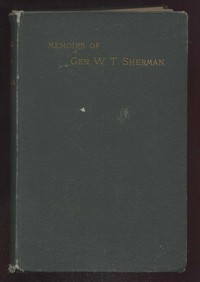
MEMOIRS OF GENERAL WILLIAM T. SHERMAN.
According to Cothren, in his "History of Ancient Woodbury, Connecticut," the Sherman family came from Dedham, Essex County, England. The first recorded name is of Edmond Sherman, with his three sons, Edmond, Samuel, and John, who were at Boston before 1636; and farther it is distinctly recorded that Hon. Samuel Sherman, Rev. John, his brother, and Captain John, his first cousin, arrived from Dedham, Essex County, England, in 1634. Samuel afterward married Sarah Mitchell, who had come (in the same ship) from England, and finally settled at Stratford, Connecticut. The other two (Johns) located at Watertown, Massachusetts.
From Captain John Sherman are descended Roger Sherman, the signer of the Declaration of Independence, Hon. William M. Evarts, the Messrs. Hoar, of Massachusetts, and many others of national fame. Our own family are descended from the Hon. Samuel Sherman and his son; the Rev. John, who was born in 1650-'51; then another John, born in 1687; then Judge Daniel, born in 1721; then Taylor Sherman, our grandfather, who was born in 1758. Taylor Sherman was a lawyer and judge in Norwalk, Connecticut, where he resided until his death, May 4, 1815; leaving a widow, Betsey Stoddard Sherman, and three children, Charles R. (our father), Daniel, and Betsey.
When the State of Connecticut, in 1786, ceded to the United States her claim to the western part of her public domain, as defined by her Royal Charter, she reserved a large district in what is now northern Ohio, a portion of which (five hundred thousand acres) composed the "Fire-Land District," which was set apart to indemnify the parties who had lost property in Connecticut by the raids of Generals Arnold, Tryon, and others during the latter part of the Revolutionary War.
Our grandfather, Judge Taylor Sherman, was one of the commissioners appointed by the State of Connecticut to quiet the Indian title, and to survey and subdivide this Fire-Land District, which includes the present counties of Huron and Erie. In his capacity as commissioner he made several trips to Ohio in the early part of this century, and it is supposed that he then contracted the disease which proved fatal. For his labor and losses he received a title to two sections of land, which fact was probably the prime cause of the migration of our family to the West. My father received a good education, and was admitted to the bar at Norwalk, Connecticut, where, in 1810, he, at twenty years of age, married Mary Hoyt, also of Norwalk, and at once migrated to Ohio, leaving his wife (my mother) for a time. His first purpose was to settle at Zanesville, Ohio, but he finally chose Lancaster, Fairfield County, where he at once engaged in the practice of his profession. In 1811 he returned to Norwalk, where, meantime, was born Charles Taylor Sherman, the eldest of the family, who with his mother was carried to Ohio on horseback.
Judge Taylor Sherman's family remained in Norwalk till 1815, when his death led to the emigration of the remainder of the family, viz., of Uncle Daniel Sherman, who settled at Monroeville, Ohio, as a farmer, where he lived and died quite recently, leaving children and grandchildren; and an aunt, Betsey, who married Judge Parker, of Mansfield, and died in 1851, leaving children and grandchildren; also Grandmother Elizabeth Stoddard Sherman, who resided with her daughter, Mrs. Betsey Parker, in Mansfield until her death, August 1,1848.
Thus my father, Charles R. Sherman, became finally established at Lancaster, Ohio, as a lawyer, with his own family in the year 1811, and continued there till the time of his death, in 1829. I have no doubt that he was in the first instance attracted to Lancaster by the natural beauty of its scenery, and the charms of its already established society. He continued in the practice of his profession, which in those days was no sinecure, for the ordinary circuit was made on horseback, and embraced Marietta, Cincinnati, and Detroit. Hardly was the family established there when the War of 1812 caused great alarm and distress in all Ohio. The English captured Detroit and the shores of Lake Erie down to the Maumee River; while the Indians still occupied the greater part of the State. Nearly every man had to be somewhat of a soldier, but I think my father was only a commissary; still, he seems to have caught a fancy for the great chief of the Shawnees, "Tecumseh."
Perry's victory on Lake Erie was the turning-point of the Western campaign, and General Harrison's victory over the British and Indians at the river Thames in Canada ended the war in the West, and restored peace and tranquillity to the exposed settlers of Ohio. My father at once resumed his practice at the bar, and was soon recognized as an able and successful lawyer. When, in 1816, my brother James was born, he insisted on engrafting the Indian name "Tecumseh" on the usual family list. My mother had already named her first son after her own brother Charles; and insisted on the second son taking the name of her other brother James, and when I came along, on the 8th of February, 1820, mother having no more brothers, my father succeeded in his original purpose, and named me William Tecumseh.
The family rapidly increased till it embraced six boys and five girls, all of whom attained maturity and married; of these six are still living.
In the year 1821 a vacancy occurred in the Supreme Court of Ohio, and I find this petition:
Somerset, Ohio, July 6, 1821.
May it please your Excellency:
We ask leave to recommend to your Excellency's favorable notice Charles R. Sherman, Esq., of Lancaster, as a man possessing in an eminent degree those qualifications so much to be desired in a Judge of the Supreme Court.
From a long acquaintance with Mr. Sherman, we are happy to be able to state to your Excellency that our minds are led to the conclusion that that gentleman possesses a disposition noble and generous, a mind discriminating, comprehensive, and combining a heart pure, benevolent and humane. Manners dignified, mild, and complaisant, and a firmness not to be shaken and of unquestioned integrity.
But Mr. Sherman's character cannot be unknown to your Excellency, and on that acquaintance without further comment we might safely rest his pretensions.
We think we hazard little in assuring your Excellency that his appointment would give almost universal satisfaction to the citizens of Perry County.
With great consideration, we have the honor to be
Your Excellency's most obedient humble servants, CHARLES A. HOOD, GEORGE TREAT, PETER DITTOR, P. ODLIN, J. B. ORTEN, T. BECKWITH, WILLIAM P. DORST, JOHN MURRAY, JACOB MOINS, B. EATON, DANIEL GRIGGS, HENRY DITTOE, NICHOLAS McCARTY.
His Excellency ETHAN A. BROWN, Governor of Ohio, Columbus.
He was soon after appointed a Judge of the Supreme Court, and served in that capacity to the day of his death.
My memory extends back to about 1827, and I recall him, returning home on horseback, when all the boys used to run and contend for the privilege of riding his horse from the front door back to the stable. On one occasion, I was the first, and being mounted rode to the stable; but "Old Dick" was impatient because the stable-door was not opened promptly, so he started for the barn of our neighbor Mr. King; there, also, no one was in waiting to open the gate, and, after a reasonable time, "Dick" started back for home somewhat in a hurry, and threw me among a pile of stones, in front of preacher Wright's house, where I was picked up apparently a dead boy; but my time was not yet, and I recovered, though the scars remain to this day.
The year 1829 was a sad one to our family. We were then ten children, my eldest brother Charles absent at the State University, Athens, Ohio; my next brother, James, in a store at Cincinnati; and the rest were at home, at school. Father was away on the circuit. One day Jane Sturgeon came to the school, called us out, and when we reached home all was lamentation: news had come that father was ill unto death, at Lebanon, a hundred miles away. Mother started at once, by coach, but met the news of his death about Washington, and returned home. He had ridden on horseback from Cincinnati to Lebanon to hold court, during a hot day in June. On the next day he took his seat on the bench, opened court in the forenoon, but in the afternoon, after recess, was seized with a severe chill and had to adjourn the court. The best medical aid was called in, and for three days with apparent success, but the fever then assumed a more dangerous type, and he gradually yielded to it, dying on the sixth day, viz., June 24, 1829.