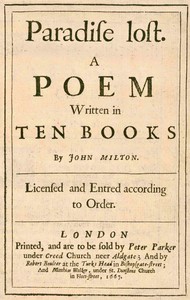
Of Mans First Disobedience, and the Fruit Of that Forbidden Tree, whose mortal tast Brought Death into the World, and all our woe, With loss of Eden, till one greater Man Restore us, and regain the blissful Seat, Sing Heav’nly Muse, that on the secret top Of Oreb, or of Sinai, didst inspire That Shepherd, who first taught the chosen Seed, In the Beginning how the Heav’ns and Earth Rose out of Chaos: Or if Sion Hill Delight thee more, and Siloa’s Brook that flow’d Fast by the Oracle of God; I thence Invoke thy aid to my adventrous Song, That with no middle flight intends to soar Above th’ Aonian Mount, while it pursues Things unattempted yet in Prose or Rhime. And chiefly Thou O Spirit, that dost prefer Before all Temples th’ upright heart and pure, Instruct me, for Thou know’st; Thou from the first Wast present, and with mighty wings outspread Dove-like satst brooding on the vast Abyss And mad’st it pregnant: What in me is dark Illumine, what is low raise and support; That to the highth of this great Argument I may assert th’ Eternal Providence, And justifie the wayes of God to men.
Say first, for Heav’n hides nothing from thy view Nor the deep Tract of Hell, say first what cause Mov’d our Grand Parents in that happy State, Favour’d of Heav’n so highly, to fall off From their Creator, and transgress his Will For one restraint, Lords of the World besides? Who first seduc’d them to that fowl revolt? Th’ infernal Serpent; he it was, whose guile Stird up with Envy and Revenge, deceiv’d The Mother of Mankinde, what time his Pride Had cast him out from Heav’n, with all his Host Of Rebel Angels, by whose aid aspiring To set himself in Glory above his Peers, He trusted to have equal’d the most High, If he oppos’d; and with ambitious aim Against the Throne and Monarchy of God Rais’d impious War in Heav’n and Battel proud With vain attempt. Him the Almighty Power Hurld headlong flaming from th’ Ethereal Skie With hideous ruine and combustion down To bottomless perdition, there to dwell In Adamantine Chains and penal Fire, Who durst defie th’ Omnipotent to Arms. Nine times the Space that measures Day and Night To mortal men, he with his horrid crew Lay vanquisht, rowling in the fiery Gulfe Confounded though immortal: But his doom Reserv’d him to more wrath; for now the thought Both of lost happiness and lasting pain Torments him; round he throws his baleful eyes That witness’d huge affliction and dismay Mixt with obdurate pride and stedfast hate: At once as far as Angels kenn he views The dismal Situation waste and wilde, A Dungeon horrible, on all sides round As one great Furnace flam’d, yet from those flames No light, but rather darkness visible Serv’d only to discover sights of woe, Regions of sorrow, doleful shades, where peace And rest can never dwell, hope never comes That comes to all; but torture without end Still urges, and a fiery Deluge, fed With ever-burning Sulphur unconsum’d: Such place Eternal Justice had prepar’d For those rebellious, here their Prison ordain’d In utter darkness, and their portion set As far remov’d from God and light of Heav’n As from the Center thrice to th’ utmost Pole. O how unlike the place from whence they fell! There the companions of his fall, o’rewhelm’d With Floods and Whirlwinds of tempestuous fire, He soon discerns, and weltring by his side One next himself in power, and next in crime, Long after known in Palestine, and nam’d Beelzebub. To whom th’ Arch-Enemy, And thence in Heav’n call’d Satan, with bold words Breaking the horrid silence thus began.
If thou beest he; But O how fall’n! how chang’d From him, who in the happy Realms of Light Cloth’d with transcendent brightnes didst outshine Myriads though bright: If he whom mutual league, United thoughts and counsels, equal hope, And hazard in the Glorious Enterprize, Joynd with me once, now misery hath joynd In equal ruin: into what Pit thou seest From what highth fal’n, so much the stronger provd He with his Thunder: and till then who knew The force of those dire Arms? yet not for those Nor what the Potent Victor in his rage Can else inflict do I repent or change, Though chang’d in outward lustre; that fixt mind And high disdain, from sence of injur’d merit, That with the mightiest rais’d me to contend, And to the fierce contention brought along Innumerable force of Spirits arm’d That durst dislike his reign, and me preferring, His utmost power with adverse power oppos’d In dubious Battel on the Plains of Heav’n, And shook his throne. What though the field be lost? All is not lost; the unconquerable Will, And study of revenge, immortal hate, And courage never to submit or yield: And what is else not to be overcome? That Glory never shall his wrath or might Extort from me. To bow and sue for grace With suppliant knee, and deifie his power Who from the terrour of this Arm so late Doubted his Empire, that were low indeed, That were an ignominy and shame beneath This downfall; since by Fate the strength of Gods And this Empyreal substance cannot fail, Since through experience of this great event In Arms not worse, in foresight much advanc’t, We may with more successful hope resolve To wage by force or guile eternal Warr Irreconcileable, to our grand Foe, Who now triumphs, and in th’ excess of joy Sole reigning holds the Tyranny of Heav’n.
So spake th’ Apostate Angel, though in pain, Vaunting aloud, but rackt with deep despare: And him thus answer’d soon his bold Compeer.
O Prince, O Chief of many Throned Powers, That led th’ imbattelld Seraphim to Warr Under thy conduct, and in dreadful deeds Fearless, endanger’d Heav’ns perpetual King; And put to proof his high Supremacy, Whether upheld by strength, or Chance, or Fate, Too well I see and rue the dire event, That with sad overthrow and foul defeat Hath lost us Heav’n, and all this mighty Host In horrible destruction laid thus low, As far as Gods and Heav’nly Essences Can Perish: for the mind and spirit remains Invincible, and vigour soon returns, Though all our Glory extinct, and happy state Here swallow’d up in endless misery. But what if he our Conquerour, (whom I now Of force believe Almighty, since no less Then such could hav orepow’rd such force as ours) Have left us this our spirit and strength intire Strongly to suffer and support our pains, That we may so suffice his vengeful ire, Or do him mightier service as his thralls By right of Warr, what e’re his business be Here in the heart of Hell to work in Fire, Or do his Errands in the gloomy Deep; What can it then avail though yet we feel Strength undiminisht, or eternal being To undergo eternal punishment? Whereto with speedy words th’ Arch-fiend reply’d.
Fall’n Cherube, to be weak is miserable Doing or Suffering: but of this be sure, To do ought good never will be our task, But ever to do ill our sole delight, As being the contrary to his high will Whom we resist. If then his Providence Out of our evil seek to bring forth good, Our labour must be to pervert that end, And out of good still to find means of evil; Which oft times may succeed, so as perhaps Shall grieve him, if I fail not, and disturb His inmost counsels from their destind aim. But see the angry Victor hath recall’d His Ministers of vengeance and pursuit Back to the Gates of Heav’n: The Sulphurous Hail Shot after us in storm, oreblown hath laid The fiery Surge, that from the Precipice Of Heav’n receiv’d us falling, and the Thunder, Wing’d with red Lightning and impetuous rage, Perhaps hath spent his shafts, and ceases now To bellow through the vast and boundless Deep. Let us not slip th’ occasion, whether scorn, Or satiate fury yield it from our Foe. Seest thou yon dreary Plain, forlorn and wilde, The seat of desolation, voyd of light, Save what the glimmering of these livid flames Casts pale and dreadful? Thither let us tend From off the tossing of these fiery waves, There rest, if any rest can harbour there, And reassembling our afflicted Powers, Consult how we may henceforth most offend Our Enemy, our own loss how repair, How overcome this dire Calamity, What reinforcement we may gain from Hope, If not what resolution from despare.
Thus Satan talking to his neerest Mate With Head up-lift above the wave, and Eyes That sparkling blaz’d, his other Parts besides Prone on the Flood, extended long and large Lay floating many a rood, in bulk as huge As whom the Fables name of monstrous size, Titanian, or Earth-born, that warr’d on Jove, Briarios or Typhon, whom the Den By ancient Tarsus held, or that Sea-beast Leviathan, which God of all his works Created hugest that swim th’ Ocean stream: Him haply slumbring on the Norway foam The Pilot of some small night-founder’d Skiff, Deeming some Island, oft, as Sea-men tell, With fixed Anchor in his skaly rind Moors by his side under the Lee, while Night Invests the Sea, and wished Morn delayes: So stretcht out huge in length the Arch-fiend lay Chain’d on the burning Lake, nor ever thence Had ris’n or heav’d his head, but that the will And high permission of all-ruling Heaven Left him at large to his own dark designs, That with reiterated crimes he might Heap on himself damnation, while he sought Evil to others, and enrag’d might see How all his malice serv’d but to bring forth Infinite goodness, grace and mercy shewn On Man by him seduc’t, but on himself Treble confusion, wrath and vengeance pour’d. Forthwith upright he rears from off the Pool His mighty Stature; on each hand the flames Drivn backward slope their pointing spires, & rowld In billows, leave i’th’ midst a horrid Vale. Then with expanded wings he stears his flight Aloft, incumbent on the dusky Air That felt unusual weight, till on dry Land He lights, if it were Land that ever burn’d With solid, as the Lake with liquid fire; And such appear’d in hue, as when the force Of subterranean wind transports a Hill Torn from Pelorus, or the shatter’d side Of thundring Aetna, whose combustible And fewel’d entrals thence conceiving Fire, Sublim’d with Mineral fury, aid the Winds, And leave a singed bottom all involv’d With stench and smoak: Such resting found the sole Of unblest feet. Him followed his next Mate, Both glorying to have scap’t the Stygian flood As Gods, and by their own recover’d strength, Not by the sufferance of supernal Power.
Is this the Region, this the Soil, the Clime, Said then the lost Arch Angel, this the seat That we must change for Heav’n, this mournful gloom For that celestial light? Be it so, since hee Who now is Sovran can dispose and bid What shall be right: fardest from him is best Whom reason hath equald, force hath made supream Above his equals. Farewel happy Fields Where Joy for ever dwells: Hail horrours, hail Infernal world, and thou profoundest Hell Receive thy new Possessor: One who brings A mind not to be chang’d by Place or Time. The mind is its own place, and in it self Can make a Heav’n of Hell, a Hell of Heav’n. What matter where, if I be still the same, And what I should be, all but less then hee Whom Thunder hath made greater? Here at least We shall be free; th’ Almighty hath not built Here for his envy, will not drive us hence: Here we may reign secure, and in my choyce To reign is worth ambition though in Hell: Better to reign in Hell, then serve in Heav’n. But wherefore let we then our faithful friends, Th’ associates and copartners of our loss Lye thus astonisht on th’ oblivious Pool, And call them not to share with us their part In this unhappy Mansion, or once more With rallied Arms to try what may be yet Regaind in Heav’n, or what more lost in Hell?