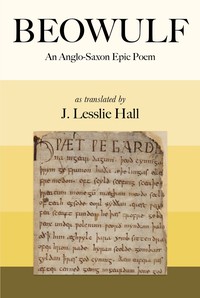
Public-domain ebook
Beowulf: An Anglo-Saxon Epic Poem
Language: en28,485 downloads on Project Gutenberg
Subjects
In: Poetry·Poetry·Mythology, Legends & Folklore
Public-domain ebook sourced from Project Gutenberg #16328.
Public-domain ebook
Language: en28,485 downloads on Project Gutenberg
Subjects
In: Poetry·Poetry·Mythology, Legends & Folklore
Public-domain ebook sourced from Project Gutenberg #16328.
This edition presents the Old English heroic saga Beowulf in a modern English translation that strives to keep the rhythm and alliteration of the original Anglo‑Saxon verse while rendering the story readable for contemporary eyes. The volume opens with a scholarly preface in which the translator, J. Lesslie Hall, explains his method, preserving the four‑stress meter, using occasional end‑ and internal rhyme, and limiting alliteration to what modern ears can tolerate. After the introductory material the narrative is outlined: King Hrothgar’s great mead‑hall is besieged by the monster Grendel, the Geatish hero Beowulf sails across the sea to aid the Danes, and a series of fierce hand‑to‑hand combats ensues, leading to victories over Grendel, Grendel’s mother, and later a fire‑breathing dragon. The structure follows the poem’s traditional divisions, from the opening “Life and Death of Scyld” through the final lament for the fallen hero.
The translation reflects the 19th‑century scholarly tone of its time, blending a formal, slightly archaic diction with a cadence reminiscent of Browning’s verse. It retains the alliterative thrust of the original while offering enough modern phrasing to keep the narrative flowing. Readers who relish epic poetry, enjoy the study of early English literature, or are fascinated by mythic battles between heroes and monsters will find this version rewarding. Those interested in the linguistic texture of Old English verse, as well as students seeking a bridge between the ancient poem and modern English, will appreciate Hall’s careful balance of fidelity and accessibility.
The opening · free to read
Of all English translations of Beowulf, that of Professor Garnett alone gives any adequate idea of the chief characteristics of this great Teutonic epic.
The measure used in the present translation is believed to be as near a reproduction of the original as modern English affords. The cadences closely resemble those used by Browning in some of his most striking poems. The four stresses of the Anglo-Saxon verse are retained, and as much thesis and anacrusis is allowed as is consistent with a regular cadence. Alliteration has been used to a large extent; but it was thought that modern ears would hardly tolerate it on every line. End-rhyme has been used occasionally; internal rhyme, sporadically. Both have some warrant in Anglo-Saxon poetry. (For end-rhyme, see 1_53, 1_54; for internal rhyme, 2_21, 6_40.)
What Gummere[1] calls the "rime-giver" has been studiously kept; viz., the first accented syllable in the second half-verse always carries the alliteration; and the last accented syllable alliterates only sporadically. Alternate alliteration is occasionally used as in the original. (See 7_61, 8_5.)
No two accented syllables have been brought together, except occasionally after a cæsural pause. (See 2_19 and 12_1.) Or, scientifically speaking, Sievers's C type has been avoided as not consonant with the plan of translation. Several of his types, however, constantly occur; e.g. A and a variant (/ x | / x) (/ x x | / x); B and a variant (x / | x / ) (x x / | x / ); a variant of D (/ x | / x x); E (/ x x | / ). Anacrusis gives further variety to the types used in the translation.
The parallelisms of the original have been faithfully preserved. (E.g., 1_16 and 1_17: "Lord" and "Wielder of Glory"; 1_30, 1_31, 1_32; 2_12 and 2_13; 2_27 and 2_28; 3_5 and 3_6.) Occasionally, some loss has been sustained; but, on the other hand, a gain has here and there been made.
The effort has been made to give a decided flavor of archaism to the translation. All words not in keeping with the spirit of the poem have been avoided. Again, though many archaic words have been used, there are none, it is believed, which are not found in standard modern poetry.
Hrothgar, king of the Danes, or Scyldings, builds a great mead-hall, or palace, in which he hopes to feast his liegemen and to give them presents. The joy of king and retainers is, however, of short duration. Grendel, the monster, is seized with hateful jealousy. He cannot brook the sounds of joyance that reach him down in his fen-dwelling near the hall. Oft and anon he goes to the joyous building, bent on direful mischief. Thane after thane is ruthlessly carried off and devoured, while no one is found strong enough and bold enough to cope with the monster. For twelve years he persecutes Hrothgar and his vassals.
Over sea, a day's voyage off, Beowulf, of the Geats, nephew of Higelac, king of the Geats, hears of Grendel's doings and of Hrothgar's misery. He resolves to crush the fell monster and relieve the aged king. With fourteen chosen companions, he sets sail for Dane-land. Reaching that country, he soon persuades Hrothgar of his ability to help him. The hours that elapse before night are spent in beer-drinking and conversation. When Hrothgar's bedtime comes he leaves the hall in charge of Beowulf, telling him that never before has he given to another the absolute wardship of his palace. All retire to rest, Beowulf, as it were, sleeping upon his arms.
Grendel comes, the great march-stepper, bearing God's anger. He seizes and kills one of the sleeping warriors. Then he advances towards Beowulf. A fierce and desperate hand-to-hand struggle ensues. No arms are used, both combatants trusting to strength and hand-grip. Beowulf tears Grendel's shoulder from its socket, and the monster retreats to his den, howling and yelling with agony and fury. The wound is fatal.
The next morning, at early dawn, warriors in numbers flock to the hall Heorot, to hear the news. Joy is boundless. Glee runs high. Hrothgar and his retainers are lavish of gratitude and of gifts.
Grendel's mother, however, comes the next night to avenge his death. She is furious and raging. While Beowulf is sleeping in a room somewhat apart [x] from the quarters of the other warriors, she seizes one of Hrothgar's favorite counsellors, and carries him off and devours him. Beowulf is called. Determined to leave Heorot entirely purified, he arms himself, and goes down to look for the female monster. After traveling through the waters many hours, he meets her near the sea-bottom. She drags him to her den. There he sees Grendel lying dead. After a desperate and almost fatal struggle with the woman, he slays her, and swims upward in triumph, taking with him Grendel's head.
Joy is renewed at Heorot. Congratulations crowd upon the victor. Hrothgar literally pours treasures into the lap of Beowulf; and it is agreed among the vassals of the king that Beowulf will be their next liegelord.
Beowulf leaves Dane-land. Hrothgar weeps and laments at his departure.
When the hero arrives in his own land, Higelac treats him as a distinguished guest. He is the hero of the hour.
Beowulf subsequently becomes king of his own people, the Geats. After he has been ruling for fifty years, his own neighborhood is wofully harried by a fire-spewing dragon. Beowulf determines to kill him. In the ensuing struggle both Beowulf and the dragon are slain. The grief of the Geats is inexpressible. They determine, however, to leave nothing undone to honor the memory of their lord. A great funeral-pyre is built, and his body is burnt. Then a memorial-barrow is made, visible from a great distance, that sailors afar may be constantly reminded of the prowess of the national hero of Geatland.
The poem closes with a glowing tribute to his bravery, his gentleness, his goodness of heart, and his generosity.
It is the devout desire of this translator to hasten the day when the story of Beowulf shall be as familiar to English-speaking peoples as that of the Iliad. Beowulf is our first great epic. It is an epitomized history of the life of the Teutonic races. It brings vividly before us our forefathers of pre-Alfredian eras, in their love of war, of sea, and of adventure.
My special thanks are due to Professors Francis A. March and James A. Harrison, for advice, sympathy, and assistance.
J.L. HALL.
B. = Bugge. C. = Cosijn. Gr. = Grein. Grdvtg. = Grundtvig. H. = Heyne. H. and S. = Harrison and Sharp. H.-So. = Heyne-Socin. K.= Kemble. Kl. = Kluge. M.= Müllenhoff. R. = Rieger. S. = Sievers. Sw. = Sweet. t.B. = ten Brink. Th. = Thorpe. W. = Wülcker.
~Conybeare, J.J.~--Illustrations of Anglo-Saxon Poetry. London, 1826. Full Latin translation, and some passages translated into English blank-verse.
~Ettmuller, L.~--Beowulf, stabreimend übersetzt. Zürich, 1840.
~Garnett, J.M.~--Beowulf: an Anglo-Saxon Poem, and the Fight at Finnsburg. Boston, 1882. An accurate line-for-line translation, using alliteration occasionally, and sometimes assuming a metrical cadence.
~Grein, C.W.M.~--Dichtungen der Angelsachsen, stabreimend übersetzt. 2 Bde. Göttingen, 1857-59.
~Grion, Giusto.~--Beovulf, poema epico anglo-sassone del VII. secolo, tradotto e illustrato. Lucca, 1883. First Italian translation.
~Grundtvig, N.F.S.~--Bjowulfs Drape. Copenhagen, 1820.
~Heyne, M.~--A translation in iambic measures. Paderborn, 1863.
~Kemble, J.M.~--The Anglo-Saxon Poems of Beowulf, the Traveller's Song, and the Battle of Finnsburg. London, 1833. The second edition contains a prose translation of Beowulf.
~Leo, H.~--Ueber Beowulf. Halle, 1839. Translations of extracts.
~Thorkelin, G.J.~--De Danorum rebus gestis secul. III. et IV. poema Danicum dialecto Anglosaxonica. Havniæ, 1815. Latin translation.
~Thorpe, B.~--The Anglo-Saxon Poems of Beowulf, the Scôp or Gleeman's Tale, and the Fight at Finnsburg. Oxford, 1855. English translation in short lines, generally containing two stresses.
~Wackerbarth, A.D.~--Beowulf, translated into English verse. London, 1849.
~Wickberg, R.~--Beowulf, en fornengelsk hjeltedikt, öfersatt. Westervik. First Swedish translation.
~von Wolzogen, H.~--Beowulf, in alliterative measures. Leipzig.
~Zinsser, G.~--Der Kampf Beowulfs mit Grendel. Jahresbericht of the Realschule at Forbach, 1881.
[The figures refer to the divisions of the poem in which the respective names occur. The large figures refer to fitts, the small, to lines in the fitts.]
~Beowulf~.--Son of Scyld, the founder of the dynasty of Scyldings. Father of Healfdene, and grandfather of Hrothgar.--1_18; 2_1.
~Beowulf~.--The hero of the poem. Sprung from the stock of Geats, son of Ecgtheow. Brought up by his maternal grandfather Hrethel, and figuring in manhood as a devoted liegeman of his uncle Higelac. A hero from his youth. Has the strength of thirty men. Engages in a swimming-match with Breca. Goes to the help of Hrothgar against the monster Grendel. Vanquishes Grendel and his mother. Afterwards becomes king of the Geats. Late in life attempts to kill a fire-spewing dragon, and is slain. Is buried with great honors. His memorial mound.--6_26; 7_2; 7_9; 9_3; 9_8; 12_28; 12_43; 23_1, etc.
~Breca~.--Beowulf's opponent in the famous swimming-match.--9_8; 9_19; 9_21; 9_22.
~Brondings~.--A people ruled by Breca.--9_23.
The book keeps going
Reading is free forever. Sign up and watch scenes appear while you read.



Scenes Storieta drew for other classics.
New illustrated classics
Once or twice a month: the latest books to get full character casts, scene art, and free comic editions. No account needed.