Public-domain ebook
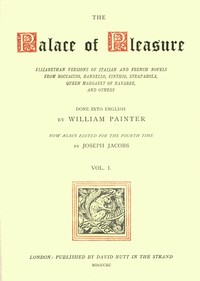
The Palace of Pleasure, Volume 1
Language: en1,282 downloads on Project Gutenberg
Subjects
In: Short Stories·British Literature
Public-domain ebook sourced from Project Gutenberg #20241.
Public-domain ebook
Language: en1,282 downloads on Project Gutenberg
Subjects
In: Short Stories·British Literature
Public-domain ebook sourced from Project Gutenberg #20241.
The Palace of Pleasure, Volume 1 presents a meticulously edited facsimile of the Elizabethan anthology compiled by John Painter, whose work supplied the plots for the great dramatists of the era. This edition follows the limited 1813 printing by Joseph Haslewood, correcting its typographical errors and restoring the original capitals and italics, while also providing facsimile title pages of both the 1575 and 1580 editions. The editor has added a “Preliminary Matter” that supplies biographical notes on Painter, a bibliography, and newly discovered documents from the Record Office and the British Museum, including the only surviving letter of the author. The introductory essay then situates Painter’s collection within the broader European tradition of the novella, tracing its lineage from the Disciplina Clericalis through Boccaccio, Bandello, Cinthio and Straparola, and explaining how these Italian sources fed the English stage.
The prose is dense and scholarly, echoing the 19th‑century editorial voice that produced the original Haslewood volume. Its style combines exhaustive footnotes with a sweeping, almost rhetorical commentary on literary history, reflecting the Victorian fascination with textual fidelity and the origins of drama. Readers who relish detailed textual criticism, the history of translation, and the cultural exchange between Italy and Elizabethan England will find this work rewarding. It especially appeals to students of early modern literature, historians of the novella form, and anyone interested in the foundations of Shakespeare’s source material.
The opening · free to read
For complete notes and errata, see the end of the text.]
PREFACE.
The present edition of Painter’s “Palace of Pleasure,” the storehouse of Elizabethan plot, follows page for page and line for line the privately printed and very limited edition made by Joseph Haslewood in 1813. One of the 172 copies then printed by him has been used as “copy” for the printer, but this has been revised in proof from the British Museum examples of the second edition of 1575. The collation has for the most part only served to confirm Haslewood’s reputation for careful editing. Though the present edition can claim to come nearer the original in many thousands of passages, it is chiefly in the mint and cummin of capitals and italics that we have been able to improve on Haslewood: in all the weightier matters of editing he shows only the minimum of fallibility. We have however divided his two tomes, for greater convenience, into three volumes of as nearly as possible equal size. This arrangement has enabled us to give the title pages of both editions of the two tomes, those of the first edition in facsimile, those of the second (at the beginning of vols. ii. and iii.) with as near an approach to the original as modern founts of type will permit.
I have also reprinted Haslewood’s “Preliminary Matter,” which give the Dryasdust details about the biography of Painter and the bibliography of his book in a manner not too Dryasdust. With regard to the literary apparatus of the book, I have perhaps been able to add something to Haslewood’s work. From the Record Office and British Museum I have given a number of documents about Painter, and have recovered the only extant letter of our author. I have also gone more thoroughly into the literary history of each of the stories in the “Palace of Pleasure” than Haslewood thought it necessary to do. I have found Oesterley’s edition of Kirchhof and Landau’s Quellen des Dekameron useful for this purpose. I have to thank Dr. F. J. Furnivall for lending me his copies of Bandello and Belleforest.
I trust it will be found that the present issue is worthy of a work which, with North’s “Plutarch” and Holinshed’s “Chronicle,” was the main source of Shakespeare’s Plays. It had also, as early as 1580, been ransacked to furnish plots for the stage, and was used by almost all the great masters of the Elizabethan drama. Quite apart from this source of interest, the “Palace of Pleasure” contains the first English translations from the Decameron, the Heptameron, from Bandello, Cinthio and Straparola, and thus forms a link between Italy and England. Indeed as the Italian novelle form part of that continuous stream of literary tradition and influence which is common to all the great nations of Europe, Painter’s book may be termed a link connecting England with European literature. Such a book as this is surely one of the landmarks of English literature.
INTRODUCTION.
A young man, trained in the strictest sect of the Pharisees, is awakened one morning, and told that he has come into the absolute possession of a very great fortune in lands and wealth. The time may come when he may know himself and his powers more thoroughly, but never again, as on that morn, will he feel such an exultant sense of mastery over the world and his fortunes. That image[1] seems to me to explain better than any other that remarkable outburst of literary activity which makes the Elizabethan Period unique in English literature, and only paralleled in the world’s literature by the century after Marathon, when Athens first knew herself. With Elizabeth England came of age, and at the same time entered into possession of immense spiritual treasures, which were as novel as they were extensive. A New World promised adventures to the adventurous, untold wealth to the enterprising. The Orient had become newly known. The Old World of literature had been born anew. The Bible spoke for the first time in a tongue understanded of the people. Man faced his God and his fate without any intervention of Pope or priest. Even the very earth beneath his feet began to move. Instead of a universe with dimensions known and circumscribed with Dantesque minuteness, the mystic glow of the unknown had settled down on the whole face of Nature, who offered her secrets to the first comer. No wonder the Elizabethans were filled with an exulting sense of man’s capabilities, when they had all these realms of thought and action suddenly and at once thrown open before them. There is a confidence in the future and all it had to bring which can never recur, for while man may come into even greater treasures of wealth or thought than the Elizabethans dreamed of, they can never be as new to us as they were to them. The sublime confidence of Bacon in the future of science, of which he knew so little, and that little wrongly, is thus eminently and characteristically Elizabethan.[2]
[Footnote 1: It was suggested to me, if I remember right, by my friend Mr. R. G. Moulton.]
[Footnote 2: There was something Elizabethan in the tone of men of science in England during the “seventies,” when Darwinism was to solve all the problems. The Marlowe of the movement, the late Professor Clifford, found no Shakespeare.]
The department of Elizabethan literature in which this exuberant energy found its most characteristic expression was the Drama, and that for a very simple though strange reason. To be truly great a literature must be addressed to the nation as a whole. The subtle influence of audience on author is shown equally though conversely in works written only for sections of a nation. Now in the sixteenth century any literature that should address the English nation as a whole--not necessarily all Englishmen, but all classes of Englishmen--could not be in any literary form intended to be merely read. For the majority of Englishmen could not read. Hence they could only be approached by literature when read or recited to them in church or theatre. The latter form was already familiar to them in the Miracle Plays and Mysteries, which had been adopted by the Church as the best means of acquainting the populace with Sacred History. The audiences of the Miracle Plays were prepared for the representation of human action on the stage. Meanwhile, from translation and imitation, young scholars at the universities had become familiar with some of the masterpieces of Ancient Drama, and with the laws of dramatic form. But where were they to seek for matter to fill out these forms? Where were they, in short, to get their plots?
Plot, we know, is pattern as applied to human action. A story, whether told or acted, must tend in some definite direction if it is to be a story at all. And the directions in which stories can go are singularly few. Somebody in the _Athenæum_--probably Mr. Theodore Watts, he has the habit of saying such things--has remarked that during the past century only two novelties in plot, Undine and Monte Christo, have been produced in European literature. Be that as it may, nothing strikes the student of comparative literature so much as the paucity of plots throughout literature and the universal tendency to borrow plots rather than attempt the almost impossible task of inventing them. That tendency is shown at its highest in the Elizabethan Drama. Even Shakespeare is as much a plagiarist or as wise an artist, call it which you will, as the meanest of his fellows.
Not alone is it difficult to invent a plot; it is even difficult to see one in real life. When the denouement comes, indeed--when the wife flees or commits suicide--when bosom friends part, or brothers speak no more--we may know that there has been the conflict of character or the clash of temperaments which go to make the tragedies of life. But to recognise these opposing forces before they come to the critical point requires somewhat rarer qualities. There must be a quasi-scientific interest in life quâ life, a dispassionate detachment from the events observed, and at the same time an artistic capacity for selecting the cardinal points in the action. Such an attitude can only be attained in an older civilisation, when individuality has emerged out of nationalism. In Europe of the sixteenth century the only country which had reached this stage was Italy.
The literary and spiritual development of Italy has always been conditioned by its historic position as the heir of Rome. Great nations, as M. Renan has remarked, work themselves out in effecting their greatness. The reason is that their great products overshadow all later production, and prevent all competition by their very greatness. When once a nation has worked up its mythic element into an epos, it contains in itself no further materials out of which an epos can be elaborated. So Italian literature has always been overshadowed by Latin literature. Italian writers, especially in the Middle Ages and the Renaissance, were always conscious of their past, and dared not compete with the great names of Virgil, Ovid, Horace, and the rest. At the same time, with this consciousness of the past, they had evolved a special interest in the problems and arts of the present. The split-up of the peninsula into so many small states, many of them republics, had developed individual life just as the city-states of Hellas had done in ancient times. The main interest shifted from the state and the nation to the life and development of the individual.[3] And with this interest arose in the literary sphere the dramatic narrative of human action--the Novella.
[Footnote 3: See Burckhardt, Cultur der Renaisance in Italien, Buch II., especially Kap. iii.]
The genealogy of the Novella is short but curious. The first known collection of tales in modern European literature dealing with the tragic and comic aspects of daily life was that made by Petrus Alphonsi, a baptized Spanish Jew, who knew some Arabic.[4] His book, the Disciplina Clericalis, was originally intended as seasoning for sermons, and very strong seasoning they must have been found. The stories were translated into French, and thus gave rise to the Fabliau, which allowed full expression to the esprit Gaulois. From France the Fabliau passed to Italy, and came ultimately into the hands of Boccaccio, under whose influence it became transformed into the Novella.[5]
[Footnote 4: On Peter Alphonsi see my edition of Caxton’s Æsop, which contains selections from him in Vol. II.]
[Footnote 5: Signor Bartoli has written on I Precursori di Boccaccio, 1874, Landau on his Life and Sources (Leben, 1880, Quellen des Dekameron, 1884), and on his successors (Beiträge zur Geschichte der ital. Novelle, 1874). Mr. Symonds has an admirable chapter on the Novellieri in his Renaissance, vol. v.]
It is an elementary mistake to associate Boccaccio’s name with the tales of gayer tone traceable to the Fabliaux. He initiated the custom of mixing tragic with the comic tales. Nearly all the novelle of the Fourth Day, for example, deal with tragic topics. And the example he set in this way was followed by the whole school of Novellieri. As Painter’s book is so largely due to them, a few words on the Novellieri used by him seem desirable, reserving for the present the question of his treatment of their text.
The book keeps going
Reading is free forever. Sign up and watch scenes appear while you read.



Scenes Storieta drew for other classics.
New illustrated classics
Once or twice a month: the latest books to get full character casts, scene art, and free comic editions. No account needed.