Public-domain ebook
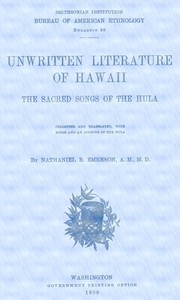
Unwritten Literature of Hawaii: The Sacred Songs of the Hula
Language: en2,055 downloads on Project Gutenberg
Subjects
Public-domain ebook sourced from Project Gutenberg #20299.
Public-domain ebook
Language: en2,055 downloads on Project Gutenberg
Subjects
Public-domain ebook sourced from Project Gutenberg #20299.
The work is a scholarly compilation of Hawaiian hula songs and poetry, presented as the inaugural bulletin of the Bureau’s Hawaiian series. It opens with a brief institutional history, noting the 1906 congressional act that expanded the Bureau’s focus from American Indians to the native peoples of the Hawaiian islands, and then moves to an extensive table of contents that lists more than thirty distinct hula forms, their associated rituals, instruments, and illustrative plates. The introductory essay explains that the book gathers “Hawaiian songs and poetic pieces that have done service from time immemorial as the stock supply of the hula,” supplementing the verses with descriptive notes, glossaries, and commentary intended to situate each piece within its cultural and religious context. The author frames the hula as a sacred, communal art that once served as the Hawaiian equivalent of theater, opera, and lecture hall, preserving mythic narratives of gods such as Pele through song and dance.
Written in the early twentieth‑century academic style of a naturalist‑anthropologist, the text combines earnest ethnographic observation with a lyrical admiration for Hawaiian culture. Emerson’s prose is formal yet occasionally poetic, peppered with Hawaiian terms set in italics and explained in a later glossary. Readers who appreciate detailed cultural histories, folk music scholars, and anyone drawn to the intersection of ritual, poetry, and dance will find this volume rewarding. Its exhaustive catalog of hula varieties, illustrated plates of costumes and instruments, and extensive notes make it especially valuable for students of folklore, musicology, and Pacific Island studies seeking a primary‑source perspective on the sacred songs of the hula.
The opening · free to read
Previous to the year 1906 the researches of the Bureau were restricted to the American Indians, but by act of Congress approved June 30 of that year the scope of its operations was extended to include the natives of the Hawaiian islands. Funds were not specifically provided, however, for prosecuting investigations among these people, and in the absence of an appropriation for this purpose it was considered inadvisable to restrict the systematic investigations among the Indian tribes in order that the new field might be entered. Fortunately the publication of valuable data pertaining to Hawaii is already provided for, and the present memoir by Doctor Emerson is the first of the Bureau’s Hawaiian series. It is expected that this Bulletin will be followed shortly by one comprising an extended list of works relating to Hawaii, compiled by Prof. H.M. Ballou and Dr. Cyrus Thomas.
The book keeps going
Reading is free forever. Sign up and watch scenes appear while you read.



Scenes Storieta drew for other classics.
New illustrated classics
Once or twice a month: the latest books to get full character casts, scene art, and free comic editions. No account needed.