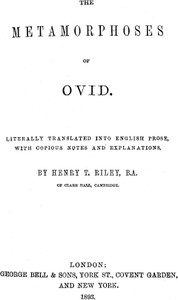
Epaphus, having accused Phaëton of falsely asserting that Phœbus is his father, Phaëton requests Phœbus, as a proof of his affection towards his child, to allow him the guidance of the chariot of the Sun for one day. This being granted, the whole earth is set on fire by him, and the Æthiopians are turned black by the heat. Jupiter strikes Phaëton with a thunderbolt, and while his sisters and his kinsman Cyenus are lamenting him, the former are changed into trees, and Cyenus into a swan. On visiting the earth, that he may repair the damage caused by the conflagration, Jupiter sees Calisto, and, assuming the form of Diana, he debauches her. Juno, being enraged, changes Calisto into a bear; and her own son Arcas being about to pierce her with an arrow, Jupiter places them both among the Constellations. Juno having complained of this to Oceanus, is borne back to the heavens by her peacocks, who have so lately changed their colour; a thing which has also happened to the raven, which has been lately changed from white to black, he having refused to listen to the warnings of the crow (who relates the story of its own transformation, and of that of Nyctimene into an owl), and having persisted in informing Phœbus of the intrigues of Coronis. Her son Æsculapius being cut out of the womb of Coronis and carried to the cave of Chiron the Centaur, Ocyrrhoë, the daughter of Chiron, is changed into a mare, while she is prophesying. Her father in vain invokes the assistance of Apollo, for he, in the guise of a shepherd, is tending his oxen in the country of Elis. He neglecting his herd, Mercury takes the opportunity of stealing it; after which he changes Battus into a touchstone, for betraying him. Flying thence, Mercury beholds Herse, the daughter of Cecrops, and debauches her. Her sister Aglauros, being envious of her, is changed into a rock. Mercury returns to heaven, on which Jupiter orders him to drive the herds of Agenor towards the shore; and then, assuming the form of a bull, he carries Europa over the sea to the isle of Crete.
Agenor commands his son Cadmus to seek his sister Europa. While he is doing this, he slays a dragon in Bœotia; and having sowed its teeth in the earth, men are produced, with whose assistance he builds the walls of Thebes. His first cause of grief is the fate of his grandson Actæon, who, being changed into a stag, is torn to pieces by his own hounds. This, however, gives pleasure to Juno, who hates not only Semele, the daughter of Cadmus, and the favourite of Jupiter, but all the house of Agenor as well. Assuming the form of Beroë, she contrives the destruction of Semele by the lightnings of Jupiter; while Bacchus, being saved alive from his mother’s womb, is brought up on the earth. Jupiter has a discussion with Juno on the relative pleasures of the sexes, and they agree to refer the question to Tiresias, who has been of both sexes. He gives his decision in favour of Jupiter, on which Juno deprives him of sight; and, by way of recompense, Jupiter bestows on him the gift of prophesy. His first prediction is fulfilled in the case of Narcissus, who, despising the advances of all females (in whose number is Echo, who has been transformed into a sound), at last pines away with love for himself, and is changed into a flower which bears his name. Pentheus, however, derides the prophet; who predicts his fate, and his predictions are soon verified; for, on the celebration of the orgies, Bacchus having assumed a disguise, is brought before him; and having related to Pentheus the story of the transformation of the Etrurian sailors into dolphins, he is thrown into prison. On this, Pentheus is torn in pieces by the Bacchanals, and great respect is afterwards paid to the rites of Bacchus.
Still Alcithoë and her sisters, neglecting the rites, attend to their spinning, during the festivities, and pass the time in telling stories; and, among others, that of Pyramus and Thisbe, by whose blood the mulberry is turned from white to black, and that of the discovery of the intrigues of Mars and Venus, on the information of the Sun. They also tell how the Sun assumed the form of Eurynome, that he might enjoy her daughter Leucothoë; how Clytie, becoming jealous of her sister, was transformed into a sun-flower; and how Salmacis and Hermaphroditus had become united into one body. After this, through the agency of Bacchus, the sisters are transformed into bats, and their webs are changed into vines. Ino rejoicing at this, Juno, in her hatred and indignation, sends one of the Furies to her, who causes her to be struck with insanity, on which she leaps into the sea, with her son Melicerta in her arms; but by the intercession of Venus, they become sea Deities, and their Sidonian attendants, who are bewailing them as dead, are changed into rocks. Cadmus, afflicted at this fresh calamity, retires from Thebes, and flies to Illyria, together with his wife, where they are both transformed into serpents. Of those who despise Bacchus, Acrisius alone remains, the grandfather of Perseus, who, having cut off the head of the Gorgon Medusa, serpents are produced by her blood. Perseus turns Atlas into a mountain, and having liberated Andromeda, he changes sea-weed into coral, and afterwards marries her.
A tumult arising during the celebration of the nuptials, Phineus claims Andromeda, who has been betrothed to him; and together with Prœtus, he and Polydectes are turned into stone. Pallas, who has aided Perseus, now leaves him, and goes to Helicon, to see the fountain of Hippocrene. The Muses tell her the story of Pyreneus and the Pierides, who were transformed into magpies after they had repeated various songs on the subjects of the transformation of the Deities into various forms of animals; the rape of Proserpine, the wanderings of Ceres, the change of Cyane into a fountain, of a boy into a lizard, of Ascalaphus into an owl, of the Sirens into birds in part, of Arethusa into a spring, of Lyncus into a lynx, and of the invention of agriculture by Triptolemus.
Jason, by the aid of Medea, having conquered the bulls that breathe forth flames, having sowed the teeth of a serpent, from which armed men are produced, and having lulled the dragon to sleep, recovers the Golden Fleece. Medea, accompanying Jason to Greece, restores Æson to youth by the aid of drugs; and promising the same to Pelias, having first, as a specimen, changed a ram into a lamb, by stratagem she kills him. Passing through many places made remarkable by various transformations, and having slain her children, she marries Ægeus, when Theseus returns home, and narrowly escapes being poisoned by her magic potions. Minos interrupts the joy of Ægeus on the return of his son, and wages war against him; having collected troops from all parts, even from Paros, where Arne has been changed into a jackdaw. Minos endeavours to gain the alliance of Æacus, who, however, refuses it, and sends the Myrmidons, (who have been changed into ants from men after a severe pestilence), under the command of Cephalus to assist Ægeus. Cephalus relates to Phocus, the son of Æacus, how, being carried off by Aurora and assuming another shape, he had induced his wife Procris to prove faithless; and how he had received from her a dog and a javelin, the former of which, together with a fox, was changed into stone; while the latter, by inadvertence, caused the death of his wife.
INTRODUCTION.
[By Edward Brooks, Jr., from McKay edition.]
P. Ovidius Naso--commonly known as Ovid--was born at Sulmo, about, ninety miles from Rome, in the year 43 B.C. His father belonged to an old equestrian family, and at an early age brought his son to Rome, where he was educated under the most distinguished masters. Very little is known of the poet’s life, except that which is gathered from his own writings. After finishing his education at home he visited Athens, in company with the poet Macer, for the purpose of completing his studies, and before returning visited the magnificent cities of Asia Minor and spent nearly a year in Sicily.
Although as a young man Ovid showed a natural taste and inclination for poetical composition, he was by no means encouraged to indulge in this pursuit. His father thought that the profession of law was much more apt to lead to distinction and political eminence than the vocation of a poet. He therefore dissuaded his son from writing poetry and urged him to devote himself to the legal profession. Compliance with his father’s wishes led him to spend much time in the forum, and for a while poetry was abandoned. Upon attaining his majority, he held several minor offices of state; but neither his health nor his inclinations would permit him to perform the duties of public life. Poetry was his love, and in spite of the strong objections of his father, he resolved to abandon the law courts and devote himself to a more congenial occupation. He sought the society of the most distinguished poets of the day, and his admiration for them amounted almost to reverence. He numbered among his intimate friends the poets Macer, Propertius, Ponticus and Bassus, while Æmilius Macer, Virgil’s contemporary, used to read his compositions to him, and even the fastidious Horace, it is said, occasionally delighted the young man’s ear with the charm of his verse.
Ovid was married three times. His first wife he married when little more than a boy, and the union does not seem to have been a happy one, though it was probably due to no fault of the wife. His second wife seems also to have been of blameless character, but his love for her was of short duration. His third wife was a lady of the great Fabian house and a friend of the Empress Livia. She appears to have been a woman in every way worthy of the great and lasting love which the poet lavished upon her to the day of his death.
Up to the age of fifty Ovid had lived a life of prosperity and happiness. Though not a wealthy man, his means were such as to permit him to indulge in the luxuries of refined life, and his attainments as a poet had surrounded him with a circle of most desirable friends and admirers. He had even obtained the favor and patronage of the royal family. About the year 8 A.D. he, however, incurred the great displeasure of Augustus, and was ordered by him to withdraw from Rome and dwell in the colony of Tomi, on the shore of the Euxine sea. Leaving behind him a wife to whom he was devotedly attached he obeyed the edict of his emperor and entered upon an exile from which he was destined never to return. He died in banishment at Tomi in the year 18 A.D.
The exact reason for Ovid’s banishment has never been clear, though there have been many conjectures as to the cause. About two years previous to his exile Ovid had published a composition which had greatly displeased Augustus, on account of its immoral tendency. Almost coincident with this publication was the discovery of the scandal relating to Julia, daughter of the emperor. It is probable that the proximity of these two events tended to intensify the imperial displeasure, and when some time later there was made public the intrigue of the emperor’s granddaughter, the indignation of Augustus gave itself vent in the banishment of Ovid.