Public-domain ebook
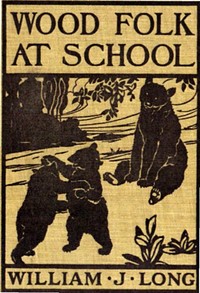
Wood folk at school
Language: en4,234 downloads on Project Gutenberg
Subjects
In: Animals-Wild·Children & Young Adult Reading·Nature/Gardening/Animals
Public-domain ebook sourced from Project Gutenberg #22101.
Public-domain ebook
Language: en4,234 downloads on Project Gutenberg
Subjects
In: Animals-Wild·Children & Young Adult Reading·Nature/Gardening/Animals
Public-domain ebook sourced from Project Gutenberg #22101.
The work is a natural‑history sketchbook that treats the wild creatures of North America as students in an informal “school.” Written by William J. Long, a seasoned field observer, the opening pages explain his aim to separate instinct, maternal training, and experience as the three forces shaping animal behavior. He recounts a series of close‑up encounters, watching purple martins leave the nest, a crow’s fledglings learning to fly, a fox guiding its cubs, then presents a series of vivid, anecdotal studies drawn from his own journals. The narrative begins with a reflective description of a fallen log by a brook, where the author discovers two newborn fawns hidden beneath hemlock curtains, and proceeds to detail their tentative interactions with him, their mother’s alarm, and the subtle sounds that signal danger. The book offers a series of numbered episodes, each focusing on a single animal or bird, and is framed by a glossary of Indigenous names and full‑page illustrations.
Long’s voice is that of an early‑20th‑century naturalist, blending earnest observation with a lyrical, almost poetic tone. The prose is detailed yet accessible, avoiding heavy scientific jargon while still conveying the rigor of his field notes. Readers who enjoy immersive wildlife narratives, such as those of John Muir or Henry David Thoreau, will appreciate the blend of personal adventure and thoughtful reflection. It will especially appeal to those interested in animal behavior, folklore, and the romantic view of nature that was popular in the Progressive Era, as well as teachers seeking evocative material for lessons about the natural world.
The opening · free to read
It may surprise many, whose knowledge of wild animals is gained from rare, fleeting glimpses of frightened hoof or wing in the woods, to consider that there can be such a thing as a school for the Wood Folk; or that instruction has any place in the life of the wild things. Nevertheless it is probably true that education among the higher order of animals has its distinct place and value. Their knowledge, however simple, is still the result of three factors: instinct, training, and experience. Instinct only begins the work; the mother's training develops and supplements the instinct; and contact with the world, with its sudden dangers and unknown forces, finishes the process.
For many years the writer has been watching animals and recording his observations with the idea of determining, if possible, which of these three is the governing factor in the animal's life. Some of the results of this study were published last year in a book called "School of the Woods," which consisted of certain studies of animals from life, and certain theories in the form of essays to account for what the writer's eyes had seen and his own ears heard in the great wilderness among the animals.
A school reader is no place for theories; therefore that part of the book is not given here. The animal studies alone are reproduced in answer to the requests from many teachers that these be added to the Wood Folk books. From these the reader can form his own conclusions as to the relative importance of instinct and training, if he will. But there is another and a better way open: watch the purple martins for a few days when the young birds first leave the house; find a crow's nest, and watch secretly while the old birds are teaching their little ones to fly; follow a fox, or any other wild mother-animal, patiently as she leaves the den and leads the cubs out into the world of unknown sights and sounds and smells,--and you will learn more in a week of what education means to the animals than anybody's theories can ever teach you.
These are largely studies of individual animals and birds. They do not attempt to give the habits of a class or species, for the animals of the same class are alike only in a general way; they differ in interest and intelligence quite as widely as men and women of the same class, if you but watch them closely enough. The names here given are those of the Milicete Indians, as nearly as I can remember them; and the incidents have all passed under my own-eyes and were recorded in the woods, from my tent or canoe, just as I saw them.
WILLIAM J. LONG.
STAMFORD, CONN., March, 1903.
The book keeps going
Reading is free forever. Sign up and watch scenes appear while you read.



Scenes Storieta drew for other classics.
New illustrated classics
Once or twice a month: the latest books to get full character casts, scene art, and free comic editions. No account needed.