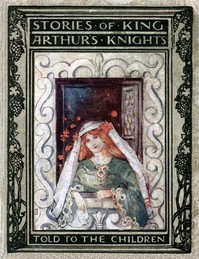
No doubt many of you, my young readers, have at some time or another taken down the Morte D'Arthur from your father's bookshelves and read a few pages of it here and there. But I doubt if any of you have ever gone very far in the volume. You found generally, I think, that it was written in a puzzling, old-fashioned language, that though it spoke of many interesting things, and seemed that it ought to be well worth reading, yet somehow it was tedious and dry.
In the tales as I have retold them for you, I hope you will not find any of these faults. Besides writing them in simple language, I have chosen only those episodes which I know would appeal to you. I have added or altered here and there, for in places it struck me that there was just wanting a word or two to make you feel the magic that was everywhere abroad in those days. It seemed to me that some mysterious adventure might easily be waiting in the ruined and deserted Roman town on the desolate moor, or even just round the mossy trunk of the next oak in the forest-drive, through which the knight was riding; or that any fair lady or questing dog which he might meet could turn out to be a wizard seeking to work woe upon him. Nevertheless, I was always sure that in those bright days when the world was young, whatever evil power might get the mastery for a little while, the knight's courage, humility, and faith would win through every peril at the end.
In this book, besides reading of wonderful adventures and brave fighting, you will learn just what sort of man a perfect knight was required to be in the chivalrous times when men wore armour and rode on errantry. The duties of a 'good and faithful knight' were quite simple, but they were often very hard to perform. They were--to protect the distressed, to speak the truth, to keep his word to all, to be courteous and gentle to women, to defend right against might, and to do or say nothing that should sully the fair name of Christian knighthood.
Although, therefore, these stories of King Arthur and his men treat of knights and their ladies, of magical trolls and wonder-working wizards, and it might seem for that reason that they can have little or nothing in common with life of the present day, it will be seen that the spirit in which they are told conveys something which every boy can learn.
Indeed, the great and simple lesson of chivalry which the tales of King Arthur teach is, in a few words, to merit 'the fine old name of gentleman.'
The history of King Arthur and his Knights is contained in two books, one being the Morte D'Arthur, written by Sir Thomas Malory, the other being the Mabinogion, a collection of old Welsh stories, first translated by Lady Charlotte Guest in 1838. I have selected thirteen tales from the number which these two books contain; but there are many more, equally as interesting, which remain.
Little is known about Sir Thomas Malory, who lived in the fifteenth century. We only learn that he was a Welshman, a man of heroic mind who, as an old writer relates, 'from his youth, greatly shone in the gifts of mind and body.' Though much busied with cares of state, his favourite recreation was said to be the reading of history, and in this pursuit 'he made selections from various authors concerning the valour and the victories of the most renowned King Arthur of the Britons.' We know, further, that these selections or tales were translated mostly from poems about Arthur written by old French poets in the eleventh and twelfth centuries, and that Sir Thomas Malory finished his translation in the ninth year of King Edward the Fourth (1469). This, of course, was before printing was introduced into England, but no doubt many written copies were made of the book, so as to enable the stories to be read to the lords and ladies and other rich people who would desire to hear about the flower of kings and chivalry, the great King Arthur. When, in 1477, Caxton set up his printing press at Westminster, the Morte D'Arthur was one of the books which then saw the light of day.
The Mabinogion, which contains other tales about King Arthur, is a collection of old Welsh romances. Though our earliest collection of them is to be found in a manuscript written in the thirteenth or fourteenth century, some of them are probably as old as the time when Welshmen clothed themselves in the skins of the beaver and the bear, and used stone for their tools and weapons.
It may be that, when you get older, you will go back to the two books I have mentioned, and you will find them so fascinating that you will be impatient of any other book which pretends to tell you the same tales. But until that time arrives, I hope you will find the stories as I have told them quite interesting and exciting.
HENRY GILBERT.
June 1911.
The book keeps going
Keep reading, and see it illustrated
Reading is free forever. Sign up and watch scenes appear while you read.
Scenes Storieta drew for other classics.