Public-domain ebook
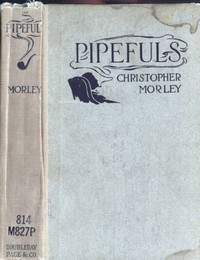
Pipefuls
Language: en5,575 downloads on Project Gutenberg
Subjects
In: Humour·Essays, Letters & Speeches
Public-domain ebook sourced from Project Gutenberg #22699.
Public-domain ebook
Language: en5,575 downloads on Project Gutenberg
Subjects
In: Humour·Essays, Letters & Speeches
Public-domain ebook sourced from Project Gutenberg #22699.
Pipefuls is a collection of short, newspaper‑sourced sketches assembled by Christopher Morley in 1920. The book opens with a playful acknowledgment of its origins in the rib‑like columns of the New York Evening Post and the Philadelphia Evening Public Ledger, then launches into a series of whimsical essays on topics ranging from friendship and cider to high finance and book‑shop visits. Morley’s introductory note frames the pieces as “slattern paragraphs” that were written under the pressure of an evening‑paper deadline, promising a mix of humor, observation, and a touch of self‑deprecation as he reflects on the daily grind of a writer.
The voice is distinctly early‑twentieth‑century, marked by a conversational, slightly sardonic tone that references contemporary writers such as Tristram Shandy, G. K. Chesterton, and Emerson. Morley’s style blends literary allusion with colloquial wit, creating a lively, essayistic rhythm that will appeal to readers who enjoy period‑piece humor, literary criticism, and the occasional nostalgic glimpse into 1920s urban life. Those who appreciate clever, observational prose and the charm of a bygone newspaper era will find Pipefuls an engaging companion.
The opening · free to read
Sir Thomas Browne said that Eve was "edified out of the rib of Adam." This little book was edified (for the most part) out of the ribs of two friendly newspapers, The New York Evening Post and The Philadelphia Evening Public Ledger. To them, and to The Bookman, Everybody's, and The Publishers' Weekly, I am grateful for permission to reprint.
Tristram Shandy said, "When a man is hemm'd in by two indecorums, and must commit one of 'em let him chuse which he will, the world will blame him." Now it is one indecorum to let this collection of small sketches go out (as they do) unrevised and just as they assaulted the defenceless reader of the daily prints; and the other indecorum would be to take fragments of this kind too gravely, and attempt by more careful disposition of their pallid members to arrange them into some appearance of painless decease. As Gilbert Chesterton said (I wish I could say, on a similar occasion): "Their vices are too vital to be improved with a blue pencil, or with anything I can think of, except dynamite."
These sketches gave me pain to write; they will give the judicious patron pain to read; therefore we are quits. I think, as I look over their slattern paragraphs, of that most tragic hour--it falls about 4 P. M. in the office of an evening newspaper--when the unhappy compiler tries to round up the broodings of the day and still get home in time for supper. And yet perhaps the will-to-live is in them, for are they not a naked exhibit of the antics a man will commit in order to earn a living? In extenuation it may be pleaded that none of them are so long that they may not be mitigated by an accompanying pipe of tobacco.
THE AUTHOR.
Roslyn, Long Island, July, 1920.
The book keeps going
Reading is free forever. Sign up and watch scenes appear while you read.



Scenes Storieta drew for other classics.
New illustrated classics
Once or twice a month: the latest books to get full character casts, scene art, and free comic editions. No account needed.
![Cover of Love and Freindship [sic]](/covers/1212.jpg)